


Most people are trying to fix the wrong problem.
They treat anxiety, loss of meaning, or spiritual disorientation as issues of belief, mindset, or mental health. So they look for better answers. Better frameworks. Something to hold onto. But the underlying condition does not resolve. You can understand yourself and still feel ungrounded. You can leave religion and still feel confined. You can reject belief entirely and still find yourself without a way to orient your life from the inside.
What is breaking down is not just belief or psychology. It is your capacity to stay in contact with reality, to think and choose without handing over authority, and to build a life that holds without relying on borrowed certainty.
This work begins there.
This is what I call existential health.
Existential health is not a belief system. It does not tell you what to think about God, meaning, or reality. It names a set of capacities that determine whether your life is inhabitable from the inside.
These capacities can be described simply.
The first is reality contact, the ability to stay in direct contact with your experience without immediately reshaping it to fit a framework. Without this, you live in your explanations of life rather than life itself.
The second is self-authorship, the capacity to think, choose, and orient your life without handing over authority. Without this, your life is assembled from external systems rather than lived from within.
The third is meaning formation, the ability to actively form meaning in contact with your life rather than inheriting or dismissing it. Without this, you move between certainty and emptiness without building anything that holds.
The fourth is existential resilience, the capacity to remain oriented inside uncertainty without collapsing into control, avoidance, or borrowed certainty. Without this, the pressure of not knowing becomes intolerable, and something else rushes in to take its place.
These capacities do not operate in isolation. They reinforce each other. When one weakens, the others distort or compensate. Without reality contact, meaning drifts into interpretation. Without self-authorship, it is inherited rather than formed. Without meaning, resilience collapses. Without resilience, none of it can be sustained.
This is why the breakdown feels pervasive. It is not one thing failing, but the structure itself becoming unstable.
When these capacities are developed, something shifts. You are no longer dependent on certainty in order to stand. You can remain in contact with reality without needing to resolve it prematurely, and begin to build a life that holds from the inside.
Existential health does not remove uncertainty. It increases your capacity to remain inside it without distortion or escape. It does not give you meaning. It requires you to form it in contact with your life. It does not provide authority. It returns responsibility to you.
If that capacity is missing, no belief system will resolve it. If it is developed, you no longer need one to stand.
That is the shift.
These capacities do not operate in isolation. They reinforce each other. When one weakens, the others distort or compensate. Without reality contact, meaning drifts into interpretation. Without self-authorship, it is inherited rather than formed. Without meaning, resilience collapses. Without resilience, none of it can be sustained.
This is why the breakdown feels pervasive. It is not one thing failing, but the structure itself becoming unstable.
When these capacities are developed, something shifts. You are no longer dependent on certainty in order to stand. You can remain in contact with reality without needing to resolve it prematurely, and begin to build a life that holds from the inside.
Existential health does not remove uncertainty. It increases your capacity to remain inside it without distortion or escape. It does not give you meaning. It requires you to form it in contact with your life. It does not provide authority. It returns responsibility to you.
If that capacity is missing, no belief system will resolve it. If it is developed, you no longer need one to stand.
You don’t need more answers. You need a way to stand without them.
About This Work
My work sits at the intersection of existential health, post-religious spirituality, and the psychology of meaning, identity, and authority. I am the founder of the Center for Non-Religious Spirituality, where I am developing the field of existential health through frameworks, training, and practitioner formation. I am the author of six books, with academic work being published in this emerging area.
My earlier books focused on religious deconstruction and the process of leaving inherited belief systems behind, which led directly into the development of existential health as a more complete framework.
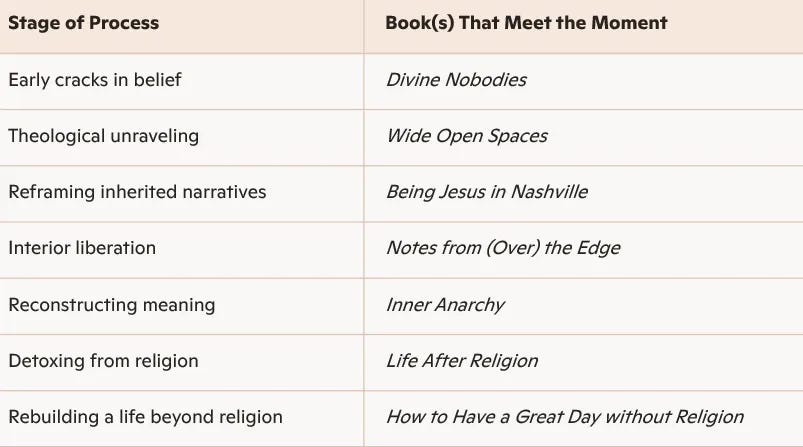
My forthcoming book, The Practice of Being Alive, develops this work into a direct, lived approach. This project is part of a broader effort to build language and structure for people navigating meaning without dogma, reduction, or borrowed authority.
This publication is where I develop and apply this work in public. You can expect precise breakdowns of belief, authority, and identity, frameworks for navigating life after religious deconstruction, critiques of both religion and secular reduction, and original writing on meaning, mortality, and being human in the modern world. This is not motivational writing. It is not self-help. It is not a substitute belief system. It is an attempt to describe reality more accurately, and to build the capacity to live within it.
If this resonates, you can stay at the level of reading. But the work does not stop there. For those who want to go further, the Center for Non-Religious Spirituality offers a space for deeper engagement, including structured conversations, training, and the development of existential health as a lived practice. This is not about agreement. It is about participation.
You don’t need more answers. You need a way to stand without them.
The Practice of Being Alive is where this work becomes practice.
Read more about the Center for Non-Religious Spirituality.
Join the Center for Non-Religious Spirituality
Paid Substack subscribers receive a free CNRS membership.
Engage This Work
Reading is the entry point. For those who want to go further, the Center for Non-Religious Spirituality offers structured dialogue, training, and the development of existential health as a lived practice.
Paid subscribers support the continuation of this work and receive full access to this ongoing body of work and its deeper forms of participation.
