

Make Friends With Nothingness
Buddhism’s answer to Western nihilism’s meltdown


I’m not a Buddhist. I don’t identify with any particular lineage or school. But some of the most meaningful conversations of my life have been with one of my closest friends, a renowned Buddhist scholar. Through him, I’ve encountered Buddhist philosophy not as a religion to join, but as a way of seeing the human condition with clarity and compassion.
What I appreciate about Buddhism is that it doesn’t ask me to believe anything. It doesn’t demand allegiance to a deity, a doctrine, or a metaphysical system. Instead, it invites me to look directly at my own experience—my suffering, my attachments, my illusions, my longing for control—and to see what is actually there.
Buddhist philosophy gives language to things I’ve spent my life wrestling with:
the impermanence of everything we cling to
the way desire and fear shape our inner world
the possibility of living with less grasping and more presence
the dignity of every being who is trying to make sense of their life
I don’t need to be Buddhist to recognize the wisdom in that.
I don’t need to adopt a new identity to appreciate a tradition that has spent centuries studying the human mind with honesty and depth.
For me, Buddhist philosophy isn’t a belief system—it’s a mirror.
It reflects back the parts of my humanity that religion often taught me to suppress: my questions, my contradictions, my longing for freedom, my capacity for compassion.
So no, I’m not Buddhist.
But I’m grateful for the ways Buddhist thought has expanded my understanding of what it means to be human.
And I’m grateful for the friend who opened that door—not to convert me, but to accompany me as a fellow traveler on the path of becoming more fully alive.
The Big Mistake
Over the past few years, I’ve found myself returning again and again to a quiet tension that sits beneath so much of our cultural life: the way Western nihilism and Buddhist philosophy often get mistaken for one another, even though they emerge from entirely different worlds and lead us toward entirely different futures. I see this confusion everywhere — in the people who come to CNRS seeking language for their disorientation, in the broader cultural exhaustion around meaning, and in my own attempts to articulate a framework for existential health that neither collapses into despair nor retreats into dogma.
We are living through a moment when many of the West’s inherited meaning structures have fractured. Institutions that once anchored identity and purpose no longer feel trustworthy. Narratives that once held communities together now feel thin, brittle, or coercive. And in the vacuum that follows, nihilism often rushes in — not as a philosophical position, but as a lived experience of groundlessness.
At the same time, there’s a growing fascination with Buddhist ideas: impermanence, non-self, emptiness. But when these teachings are filtered through a nihilistic cultural lens, they can be misread as confirmation that nothing matters, that the self is an illusion in the bleakest sense, or that detachment is the only path to peace. This is not Buddhism. It’s the West projecting its own crisis onto a tradition that has spent millennia exploring the very terrain we are now stumbling into.
This article is an attempt to slow down that projection — to look carefully at what Western nihilism is actually expressing, to explore what Buddhist philosophy is actually offering, and to consider how the emerging discipline of existential health might serve as a bridge between them. Not to merge the two, not to romanticize either, but to illuminate the space where they meet and the possibilities that open when we stop confusing collapse with clarity.
If you’re someone who feels the ache of meaninglessness, or someone who senses that our culture is in the middle of a profound existential transition, my hope is that this piece gives you a way to breathe a little deeper — and to see that the loss of old certainties is not the end of the story. It may be the beginning of a new kind of freedom.
Buddhist philosophy can be a supportive resource for people moving through spiritual crisis or brushing up against nihilism—not as a new belief system to adopt, but as a set of perspectives and practices that help steady the inner landscape. Its insights into suffering, impermanence, and interdependence offer non‑dogmatic ways to understand what feels overwhelming, while its reframing of “emptiness” shifts the collapse of old structures from meaninglessness to possibility. For many, these teachings function less like doctrine and more like tools—gentle ways of seeing that make space for self-authored meaning, reduce existential fear, and help a person stay present with their own unfolding experience.
Buddhist Philosophy and Western Nihilism
There’s a quiet crisis running through Western culture — not the loud, spectacular kind that makes headlines, but a slow erosion of meaning that shows up in the eyes of people who no longer know what to trust, what to hope for, or what to belong to. It’s the crisis that Nietzsche diagnosed, that postmodernism amplified, and that many of us now carry in our bones: the sense that the world has slipped out from under us.
And yet, across the world and across centuries, Buddhist philosophy has been exploring a very different relationship to meaninglessness — one that doesn’t collapse into despair, but instead opens into clarity, compassion, and a radically different understanding of what it means to be human.
This piece is an attempt to hold these two traditions side by side — not to resolve them, not to synthesize them into a neat package, but to see what becomes possible when we let them illuminate one another.
The Western Drift Toward Nothingness

There is a quiet unraveling happening beneath the surface of Western culture — not a sudden collapse, but a slow erosion of the stories that once held people’s lives together. You can feel it in the exhaustion that so many carry, in the cynicism that passes for maturity, in the way institutions that once commanded trust now feel hollow or coercive. This drift toward nothingness didn’t appear overnight. It’s the cumulative effect of centuries of over-reliance on certainty, hierarchy, and inherited narratives that no longer match the complexity of lived experience.
1. The collapse of inherited meaning structures
For generations, the West anchored meaning in grand narratives: divine authority, national identity, rational progress, economic growth, the autonomous individual. These frameworks promised coherence and stability. But as scientific revolutions, social upheavals, and historical reckonings accumulated, those narratives began to fracture. The institutions built on them — churches, governments, universities, even the idea of the “self-made” individual — lost their aura of inevitability. When the scaffolding cracked, many people mistook the collapse of their frameworks for the collapse of reality itself.
2. The rise of skepticism without a replacement worldview
The West became skilled at deconstruction — at critiquing power, exposing illusions, dismantling dogma. But it never developed an equally robust capacity for reconstruction. Once the old certainties were questioned, nothing emerged to take their place. This left a vacuum where meaning used to be. Skepticism became a default posture, but skepticism alone cannot sustain a life. Without a shared horizon of purpose, people drifted into fragmentation, irony, and quiet despair.
3. The burden of radical individualism
Western culture placed enormous weight on the individual — on personal achievement, personal identity, personal responsibility. When meaning was no longer guaranteed by community or tradition, the individual was expected to generate it alone. This is an impossible task. Human beings are not designed to create meaning in isolation. When the self becomes the sole source of purpose, it eventually collapses under the pressure. The result is not freedom but loneliness, anxiety, and a sense of existential fatigue.
4. The erosion of trust in institutions and authorities
As scandals, failures, and systemic injustices came to light, trust in institutions eroded. People no longer believed that the systems around them were capable of holding their lives with integrity. Without trusted institutions, meaning-making becomes precarious. People are left to navigate existential questions without communal support, which intensifies the drift toward nihilism. When nothing feels trustworthy, nothing feels meaningful.
5. The emotional tone of cultural disorientation
This drift toward nothingness is not just intellectual; it’s emotional. It shows up as a pervasive sense of disconnection — from community, from purpose, from one’s own inner life. It shows up as burnout, cynicism, and the quiet belief that nothing we do ultimately matters. It shows up as a culture that oscillates between frantic productivity and numbing distraction, because stillness feels too close to the void.
6. Nihilism as a predictable — not pathological — response
From an existential health perspective, nihilism is not a personal failure. It’s a culturally conditioned response to the collapse of meaning structures that once held society together. When people say “nothing matters,” they are not expressing a philosophical conclusion; they are expressing a wound. They are naming the absence of a framework that can hold their lives with coherence and dignity. Nihilism is what happens when a culture loses its story and has not yet learned how to create new ones.
Nihilism Isn’t the Enemy — It’s the Doorway

Most people hear the word nihilism and think: despair, emptiness, meaninglessness, the emotional equivalent of falling into a black hole and never coming back.
Keiji Nishitani (1900–1990) was a Japanese philosopher and one of the central figures of the Kyoto School of Philosophy, a twentieth‑century movement that sought to confront the crisis of meaning in modernity—especially the problem of nihilism—by bringing Western philosophy into sustained dialogue with Zen and Mahāyāna Buddhism.
Nishitani was trained in Japan under Nishida Kitarō, the founder of the Kyoto School, and later studied in Germany with Martin Heidegger. This gave him an unusual depth in both traditions: he understood Nietzsche and Heidegger from the inside, and he engaged Buddhist thought not as an abstract curiosity, but as a lived philosophical resource. His most important work, Religion and Nothingness (1961; English translation 1982), focuses on nihilism and how it must be moved through rather than denied.
The Kyoto School itself was not a formal institution but a loose network of Japanese philosophers centered around Kyoto University in the early to mid‑twentieth century. Its core figures—Nishida Kitarō, Keiji Nishitani, and Hajime Tanabe—shared a common project: to confront modern Western nihilism using the resources of Buddhist philosophy while still taking Western thought seriously rather than rejecting it outright. They asked difficult questions that Western philosophy often struggled to answer:
What happens to meaning after God, metaphysics, and absolute values collapse?
Can the self survive the loss of foundations?
Is nihilism the end of religion, or the doorway to a deeper form of it?
Unlike much Western philosophy, the Kyoto School insisted that philosophy must be existentially lived, not merely intellectually solved. For Nishitani in particular, philosophy was literally a matter of life and death, rooted in his own confrontation with despair and meaninglessness.
At the heart of Nishitani’s thinking is the conviction that nihilism is not merely an idea but a lived condition. Modern people do not simply think that life is meaningless; they feel it at the level of existence. Attempts to escape nihilism through belief systems, optimism, or moral frameworks only conceal the problem rather than resolve it.
Nishitani argued instead that nihilism must be entered fully. He distinguished between nihility, the experience that life, values, and the self are groundless, and śūnyatā, or emptiness, which emerges when the ego relinquishes its effort to secure itself against that groundlessness.
This notion of emptiness is not despair, negation, or annihilation. Rather, it is a Buddhist understanding of non‑separateness, in which the self is no longer experienced as a lonely subject standing over against a meaningless world, but as fundamentally interdependent with everything else. In this way, nihilism becomes a passage rather than a dead end: a clearing that dissolves the illusion of an isolated, ego‑centered self and opens the possibility of a more grounded, relational way of being.
Nishitani matters today precisely because he refuses the two most common responses to nihilism: religious denial and secular resignation. Instead, he treats nihilism as a necessary existential rupture—one capable of dismantling the false self and making room for a life that is no longer abstract, performed, or secondhand. For this reason, his work continues to resonate deeply with existential psychology, Jungian individuation, and contemporary conversations about meaning, identity, and existential health. His basic claim is demanding but unmistakable: only by passing through nihilism—not around it—can a person arrive at a life that is genuinely lived rather than merely inherited or performed.
For Nishitani, modern people don’t choose nihilism. Nihilism happens when inherited meanings collapse - when God becomes unbelievable, values feel arbitrary, and the self starts to feel like a cosmic accident. Science, technology, and secular modernity didn’t just challenge religion; they hollowed out the foundations of meaning itself. [link.springer.com]
But here’s where Nishitani flips the script.
Instead of asking how to escape nihilism, he asks what happens when we go all the way through it.
From Nihility to Emptiness
Nishitani distinguishes between nihility—the experience of meaninglessness—and what he calls śūnyatā, or emptiness. Nihility is what happens when the self realizes there’s no ultimate ground beneath it. Emptiness is what happens when the self lets go of its need to stand on anything at all.
This is not the Western idea of nothingness as sheer negation. Nishitani’s “absolute nothingness” isn’t a void—it’s a field of radical interdependence, where the ego stops trying to secure itself over against the world and instead discovers itself within it.
In other words: nihilism dismantles the false self. Emptiness reveals what’s left when the illusion of separateness collapses.
Liberation, Not Despair
For Nishitani, liberation doesn’t come from recovering old certainties or inventing new belief systems. It comes from the death of the ego’s obsession with control, permanence, and meaning-as-possession. When the self stops demanding guarantees from reality, reality shows up differently.
This is why Nishitani refuses both dogmatic religion and shallow secular optimism. Religion that denies nihilism becomes dishonest. Secularism that gets stuck in nihilism becomes despairing. Emptiness, by contrast, is post‑nihilistic—it doesn’t deny the abyss; it walks through it and discovers a deeper way of being human.
This Matters Because …
Nishitani’s work feels uncomfortably relevant. We live in a world where belief systems are crumbling, identities are unstable, and certainty is in short supply. The temptation is either to cling harder to absolutes or to give up altogether.
Nishitani offers a third way: let nihilism do its work. Not as an ending, but as a clearing. Not as a failure of faith, but as the collapse of illusions that were never true to begin with.
And in that clearing, something quietly radical emerges: a self no longer centered on itself, a world no longer divided into sacred and profane, and a freedom that doesn’t need to be defended.
That’s not despair. That’s liberation.
Buddhism: A Tradition That Begins Where Nihilism Ends

If Western nihilism represents the collapse of inherited meaning structures, Buddhism begins at the very point where that collapse feels most frightening. It doesn’t try to rebuild the old scaffolding or reassure us that meaning is secretly waiting to be rediscovered. Instead, it invites us to look directly at the conditions that make meaning feel unstable — impermanence, uncertainty, the fluidity of identity — and to see them not as threats but as the basic texture of reality. Buddhism starts where nihilism panics. It begins where the Western imagination often stops.
1. Buddhism does not fear impermanence — it assumes it.
Where the West often treats impermanence as a crisis, Buddhism treats it as the ground of all experience. Everything changes, everything arises and passes away, everything is in motion. This is not a philosophical claim but an observable fact. The suffering comes not from impermanence itself but from our refusal to accept it. Buddhism doesn’t offer permanence; it offers a way to live with impermanence without collapsing. This is why it feels so foreign to a culture that has spent centuries trying to secure the world against change.
2. Buddhism does not cling to the self — it investigates it.
The Western self is imagined as a solid, autonomous entity that must be protected and perfected. When that identity fractures, nihilism rushes in. Buddhism begins with a different question: what exactly is this “self” we are trying so desperately to defend? Through careful observation, it reveals the self as a dynamic process — a constellation of sensations, memories, habits, and relationships. This insight is not meant to erase the person; it is meant to free us from the impossible task of making the self permanent. When the self is understood as fluid, the collapse of identity becomes less catastrophic and more liberating.
3. Buddhism does not search for inherent meaning — it looks at how meaning arises.
Nihilism assumes that if meaning is not inherent, then meaning is gone. Buddhism sidesteps this entirely. It doesn’t look for meaning “out there” in the universe; it looks at how meaning emerges through intention, attention, and relationship. Meaning is not a cosmic guarantee; it is a lived practice. This is why Buddhist philosophy feels both unsettling and relieving to Westerners: it removes the fantasy of inherent meaning but replaces it with something more grounded — the possibility of co‑creating meaning moment by moment.
4. Buddhism does not collapse into despair — it cultivates clarity and compassion.
The emotional tone of Buddhist emptiness is radically different from the emotional tone of nihilism. Where nihilism leads to resignation, emptiness leads to spaciousness. Where nihilism isolates, emptiness connects. When we see that everything is interdependent, compassion becomes a natural response. Not because we “should” be compassionate, but because the boundaries between self and other soften. This is why Buddhist traditions emphasize ethical practice: compassion is not an add‑on; it is the natural expression of seeing reality clearly.
5. Buddhism offers practices, not just ideas.
One of the most important differences between Buddhism and Western philosophical traditions is that Buddhism is not primarily a set of beliefs. It is a set of practices — meditation, ethical commitments, relational disciplines — designed to transform how we experience the world. These practices cultivate the capacity to sit with impermanence, to observe the self without clinging, and to meet suffering with curiosity rather than fear. Without these practices, Buddhist concepts can easily be misinterpreted as nihilistic abstractions. With them, they become tools for liberation.
6. Buddhism begins where Western meaning-making breaks down.
This is the heart of the matter. Buddhism does not try to restore the old Western frameworks of certainty, identity, or inherent meaning. It begins at the point where those frameworks fail. It meets us in the collapse — not to rebuild what was lost, but to show that the collapse is not the end of the story. It is the beginning of a different way of relating to reality, one that does not require permanence, inherent meaning, or a solid self to feel grounded and alive.
Western Nihilism vs. Buddhist Emptiness
Western nihilism and Buddhist emptiness often get conflated, but they are not the same. Here are several examples:
Western Nihilism: “Meaning is believed to be gone.”
When nihilism takes hold, it feels as though the world has been emptied of significance. The stories that once anchored a person’s identity no longer feel trustworthy, and the frameworks that once offered coherence now seem arbitrary or false. Meaning isn’t just questioned — it feels absent, as if the universe has withdrawn its invitation to participate in anything purposeful.
Buddhist Emptiness: “Meaning is not inherent but can be created relationally.”
Buddhist philosophy begins from a different premise: meaning was never something the universe handed out in fixed form. Instead, meaning arises through relationship, context, and participation. Emptiness doesn’t imply a void; it points to the fluid, co-created nature of significance. When meaning isn’t required to be inherent, it becomes something we can cultivate with intention and care.
Western Nihilism: “Nothing is understood to matter.”
In a nihilistic frame, the collapse of inherent meaning leads to a sense that nothing carries weight. Values feel interchangeable, commitments feel fragile, and the future feels directionless. This isn’t apathy so much as exhaustion — a sense that without absolute foundations, everything dissolves into pointlessness.
Buddhist Emptiness: “Everything is understood to be interdependent.”
Buddhism responds not with indifference but with a deep recognition of interconnectedness. When nothing exists independently, everything becomes consequential. Every action ripples outward. Every moment is part of a larger web of causes and conditions. Instead of “nothing matters,” the insight becomes “everything is connected,” which opens the door to responsibility, compassion, and care.
Western Nihilism: “Values are seen as collapsed or arbitrary.”
Nihilism often interprets the loss of absolute values as the loss of value itself. If nothing is fixed, then nothing can be trusted. This collapse creates a vacuum where ethical commitments feel ungrounded, and the individual is left without a compass.
Buddhist Emptiness: “Value becomes clearer when freed from rigid absolutes.”
Buddhist thought suggests that values become more authentic when they’re not propped up by metaphysical guarantees. Compassion, non-harm, and clarity don’t need to be absolute to be meaningful; they emerge naturally from understanding interdependence. When values are not rigid, they can be responsive, contextual, and alive.
Western Nihilism: “The individual feels fundamentally isolated.”
Nihilism often leaves people feeling cut off — from community, from purpose, from any sense of belonging to a larger whole. Without shared narratives or trusted institutions, the self becomes a solitary figure navigating a world stripped of coherence.
Buddhist Emptiness: “The individual is recognized as interconnected with all beings.”
Buddhism dissolves the illusion of separateness. The self is not a sealed container but a dynamic process shaped by relationships, histories, and conditions. This recognition doesn’t erase individuality; it situates it within a larger field of mutual influence and care. Isolation gives way to connection, not through belief but through direct insight.
Western Nihilism: “The emotional tone is despair or resignation.”
When meaning collapses and isolation sets in, despair becomes a natural response. It’s not a moral failure — it’s the emotional consequence of losing the frameworks that once held a person’s life together. Resignation often follows, a quiet sense that nothing can be rebuilt.
Buddhist Emptiness: “The emotional tone is liberation, compassion, and clarity.”
Emptiness, when understood through Buddhist practice, brings relief rather than despair. Letting go of fixed identities and rigid meanings creates space for freedom. Compassion arises naturally when the boundaries between self and other soften. Clarity emerges when we stop demanding certainty from a world that was never designed to provide it. The emotional landscape shifts from collapse to spaciousness.
Why the West Misreads Buddhism
One of the most persistent confusions I see — in spiritual circles, academic conversations, and even therapeutic spaces — is the Western tendency to interpret Buddhist philosophy through a nihilistic filter. It’s not that people are careless or shallow; it’s that the West is carrying an unresolved crisis of meaning, and that crisis shapes how it receives any tradition that speaks about emptiness, impermanence, or the dissolution of the self. When a culture is already struggling with existential collapse, it tends to hear confirmation of its own despair even in teachings that were never meant to point toward despair at all.
1. The West approaches Buddhism with a wounded worldview.
Most Westerners encounter Buddhism after some form of disillusionment — with religion, with institutions, with capitalism, with themselves. They come to Buddhist ideas not from a place of grounded curiosity but from a place of existential injury. When a worldview has already fractured, concepts like “non-self” or “emptiness” can feel like validation of the fracture rather than an invitation into a different mode of being. The teachings are filtered through a wound that has not yet been tended.
2. Buddhism is often stripped from its ethical, communal, and contemplative context.
In its original settings, Buddhist philosophy is inseparable from practice: meditation, ethical commitments, community, lineage, and a shared cosmology. But when the West imports Buddhism, it often extracts the concepts while leaving behind the container that makes them intelligible. Emptiness without ethics becomes nihilism. Impermanence without community becomes anxiety. Non-self without practice becomes dissociation. The teachings collapse because the scaffolding that holds them is missing.
3. Western individualism misinterprets relational insights as personal annihilation.
The Western self is imagined as a bounded, autonomous unit — a sovereign individual. So when Buddhism says “the self is empty,” the Western ear hears “the self is erased.” But Buddhism is not negating the person; it’s negating the illusion of separateness. It’s pointing to interdependence, not obliteration. Yet in a culture that equates identity with survival, any softening of the self feels like a threat rather than a liberation.
4. The West confuses the collapse of certainty with the collapse of meaning.
Western philosophy has long tied meaning to metaphysical guarantees — God, reason, progress, the autonomous subject. When those guarantees falter, meaning feels endangered. Buddhism, by contrast, never relied on inherent meaning to begin with. It sees meaning as emergent, relational, and dynamic. But when Westerners hear “nothing has inherent existence,” they assume it means “nothing matters.” They project their own crisis onto a tradition that is not in crisis.
5. The West often uses Buddhism as a bypass rather than a path.
In a culture uncomfortable with grief, ambiguity, and existential vulnerability, Buddhist language can become a way to avoid confronting the deeper fractures in one’s worldview. “Everything is impermanent” becomes a way to avoid attachment. “There is no self” becomes a way to avoid responsibility. “Let go” becomes a way to avoid feeling. This is not Buddhism; it’s a psychological defense dressed in spiritual vocabulary. It’s meaning bypassing — a way to escape the discomfort of rebuilding a worldview that has collapsed.
6. Colonial and orientalist histories distort the encounter.
The West has long projected fantasies onto Asian traditions — romanticizing them, flattening them, or treating them as exotic antidotes to Western problems. This history shapes how Buddhism is received: as a tool, a lifestyle accessory, or a philosophical novelty rather than a rigorous, relational, ethical tradition. When a tradition is consumed rather than engaged, its depth becomes invisible.
7. The West expects Buddhism to solve a crisis it was never designed to solve.
Western nihilism is a cultural, historical, and institutional crisis — not a metaphysical one. Buddhism can illuminate the terrain of meaninglessness, but it cannot repair the social, political, and relational fractures that produced the crisis in the first place. When people expect Buddhism to “fix” nihilism, they inevitably misread it. Buddhism is not a replacement worldview; it’s a different way of relating to experience. It can support healing, but it cannot substitute for the cultural work the West has not yet done.
Buddha and Nietzsche Walk into a Bar
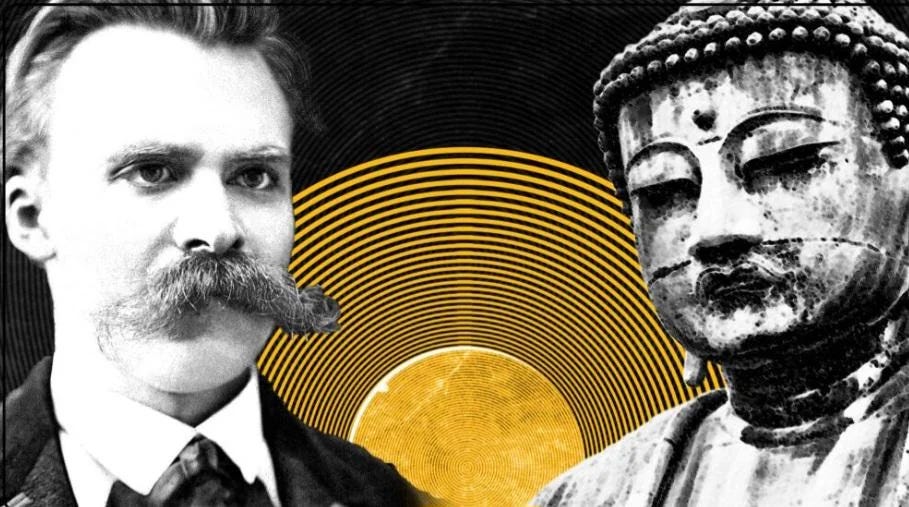
If Buddha and Nietzsche sat down together, they wouldn’t argue about gods or doctrines. They would talk about the human condition—about suffering, illusion, freedom, and the courage it takes to live without borrowed meaning.
Both would agree on this:
Nihilism is not the end. It is the clearing where honest meaning-making begins.
I imagined the following exchange between Buddha and Nietzsche:
Nietzsche:
“When people lose the old gods, they often fall into nothingness. They collapse into nihilism because the structures that once gave them meaning dissolve. My concern is that without those structures, people drift into despair or herd‑thinking. They either cling to old illusions or sink into meaninglessness.”
Buddha:
“People suffer not because meaning disappears, but because they cling to what is impermanent. When the structures fall away, what remains is not nothingness—it is the raw experience of being human. Suffering arises from resisting this truth.”
Nietzsche:
“But when you remove the illusions, what’s left? A void. A terrifying freedom. Most people cannot bear it. They need stories, doctrines, something to hold onto. Without them, they feel lost.”
Buddha:
“The void you speak of is not a threat. It is simply the absence of illusions. When a person stops grasping for certainty, they discover clarity. Not a cosmic meaning imposed from above, but a direct experience of life as it is.”
Nietzsche:
“You’re describing a kind of self‑overcoming. A willingness to face reality without anesthetic. That resonates with me. But I reject the idea of dissolving the self. The self must be strengthened, not erased.”
Buddha:
“I do not teach the erasure of the self. I teach the recognition that the self is not a fixed entity. It is a process—fluid, changing, interdependent. When you stop clinging to a rigid identity, you become free to respond to life with wisdom.”
Nietzsche:
“So you’re saying the self is a creative act, not a metaphysical fact.”
Buddha:
“Yes. And when you see this clearly, nihilism loses its power. Meaning is not something you inherit. It is something you participate in.”
Nietzsche:
“Then perhaps our difference is not as great as it seems. I warn against nihilism because it leaves people passive. You dissolve the illusions that cause suffering. We are both trying to free people from the stories that imprison them.”
Buddha:
“And we both trust the human being to discover meaning from within, not from authority.”
Nietzsche:
“Agreed. The danger is not the absence of God. The danger is the absence of courage.”
Buddha:
“And courage grows when one stops resisting impermanence.”
What Buddhism Offers the Nihilistic West

When a culture is struggling with a crisis of meaning, it often looks outward for rescue — to new philosophies, new practices, new identities. But Buddhism doesn’t offer the West a replacement worldview or a metaphysical cure. What it offers is something quieter and more radical: a different way of relating to the very conditions that make nihilism feel inevitable. It doesn’t deny impermanence, uncertainty, or the absence of inherent meaning. It teaches us how to live with them without collapsing.
1. A way to hold impermanence without falling apart
Nihilism experiences impermanence as a threat — the erosion of stability, the loss of guarantees. Buddhism treats impermanence as the basic texture of reality, not a crisis to be solved. When we stop demanding permanence from a world that is fundamentally dynamic, we begin to experience change not as a personal failure or cultural catastrophe, but as the natural unfolding of life. This shift doesn’t eliminate grief or uncertainty, but it removes the panic around them. Impermanence becomes something we can breathe with rather than brace against.
2. A way to experience selfhood without clinging to it
The Western self is often imagined as a fixed identity that must be protected, perfected, or proven. When that identity cracks — through trauma, disillusionment, or cultural upheaval — nihilism rushes in. Buddhism offers a different understanding: the self is not a solid object but a fluid process shaped by relationships, conditions, and histories. This doesn’t erase individuality; it frees it from the impossible task of being absolute. When the self is allowed to be porous and dynamic, the collapse of old identities becomes less of an existential emergency and more of an invitation to grow.
3. A way to generate meaning without needing it to be inherent
Nihilism assumes that if meaning isn’t built into the universe, then meaning doesn’t exist. Buddhism sidesteps this entirely. It doesn’t look for inherent meaning; it looks at how meaning arises through participation, intention, and relationship. Meaning becomes something we do, not something we discover. This is profoundly empowering. It shifts us from passive recipients of meaning to active co-creators of it. In existential health terms, this is the move from collapse to agency — from waiting for meaning to appear to cultivating it through how we live.
4. A way to cultivate compassion in a world without guarantees
One of the most striking differences between nihilism and Buddhist emptiness is emotional tone. Nihilism often leads to resignation or cynicism because it assumes that without inherent meaning, nothing matters. Buddhism arrives at the opposite conclusion: because everything is interdependent and impermanent, everything is precious. Compassion becomes a natural response to seeing the fragility and interconnectedness of all beings. It’s not a moral command; it’s a perceptual shift. When we stop imagining ourselves as isolated units, care becomes instinctive.
5. A way to meet suffering without collapsing into it
Nihilism tends to interpret suffering as evidence that life is meaningless. Buddhism treats suffering as a teacher — not something to romanticize, but something to understand. The First Noble Truth doesn’t say “life is suffering”; it says “suffering is part of life.” The difference is subtle but profound. When suffering is acknowledged rather than denied, and understood rather than feared, it becomes workable. It becomes a site of insight rather than a verdict on existence. This is one of the most powerful gifts Buddhism offers a culture that often feels overwhelmed by its own pain.
6. A way to live ethically without metaphysical absolutes
Western ethics often relies on external authority — divine command, rational universals, or institutional norms. When those authorities lose credibility, ethical life can feel unmoored. Buddhism offers an ethics grounded not in absolutes but in consequences: actions matter because they shape experience, relationships, and the world we inhabit. This is an ethics of interdependence rather than obedience. It’s flexible, contextual, and deeply human. It allows for moral clarity without moral rigidity.
7. A way to rebuild meaning-making as a communal practice
Nihilism isolates. Buddhism reconnects. Not through ideology, but through practice — meditation, community, shared rituals, ethical commitments. These practices create a sense of belonging that doesn’t depend on dogma. They remind us that meaning is not a solitary achievement but a relational process. This aligns closely with the existential health movement: the recognition that meaning is co-created, that community is not optional, and that healing happens in relationship.
The Existential Health Lens: A Bridge Between Worlds

The emerging discipline of existential health sits in a unique position between Western nihilism and Buddhist philosophy — not as a mediator, not as a synthesis, but as a framework that can hold the tensions between them without flattening either tradition. Existential health doesn’t try to rescue the West from its crisis of meaning, nor does it attempt to import Buddhism as a ready-made solution. Instead, it recognizes that both the Western collapse and the Buddhist insights reveal something essential about the human condition, and that what we need now is a way to navigate meaning-making that is pluralistic, relational, and grounded in lived experience.
🌿Existential health acknowledges the legitimacy of the Western crisis.
Rather than pathologizing nihilism or treating it as a philosophical error, existential health understands it as a predictable response to cultural, institutional, and relational breakdown. The West is not “wrong” for feeling unmoored; it is experiencing the consequences of centuries of over-reliance on certainty, hierarchy, and inherited narratives. Existential health doesn’t shame this collapse — it names it, contextualizes it, and treats it as a real wound that requires care, not correction.
🌿Existential health recognizes the value of Buddhist insights without appropriating them.
Buddhism offers profound tools for understanding impermanence, interdependence, and the fluidity of the self. But existential health refuses to extract these insights from their ethical and cultural contexts or to treat them as universal truths. Instead, it honors them as one of many wisdom traditions that illuminate the terrain of meaning-making. It draws inspiration without claiming ownership. It learns without collapsing into imitation. This is a posture of humility rather than consumption.
🌿Existential health reframes meaning as a relational, co-created process.
Both nihilism and certain Western religious frameworks assume that meaning must be inherent — either guaranteed by the universe or absent altogether. Existential health rejects this binary. Meaning is neither fixed nor void; it is emergent. It arises through relationships, communities, practices, and commitments. This aligns with Buddhist interdependence but remains grounded in a secular, pluralistic context. It allows people to build meaning without requiring metaphysical certainty.
🌿Existential health integrates trauma-informed understanding into meaning-making.
Where Buddhism offers philosophical clarity, existential health adds psychological containment. It recognizes that many Western encounters with emptiness are shaped by trauma — personal, cultural, and institutional. A person cannot simply “see through the self” if their sense of self has never been safe to begin with. Existential health brings the necessary scaffolding: grounding, relational repair, and emotional literacy. It ensures that insights about impermanence or non-self do not become tools for bypassing or dissociation.
🌿Existential health restores community as a central dimension of meaning.
Nihilism isolates. Buddhism reconnects. Existential health operationalizes that reconnection in a contemporary, secular context. It emphasizes that meaning is not a solitary achievement but a communal practice — built through shared rituals, ethical commitments, and relational accountability. This is where CNRS becomes more than an institution; it becomes a living ecosystem of meaning-making, where people can explore existential questions without fear of dogma or collapse.
🌿Existential health offers a framework for navigating uncertainty without demanding resolution.
Both nihilism and certain Western religious frameworks are uncomfortable with ambiguity — one collapses under it, the other tries to eliminate it. Existential health takes a different stance: uncertainty is not a problem to be solved but a condition to be lived with skillfully. This is where the bridge becomes most visible. From Buddhism, existential health inherits the capacity to sit with impermanence. From Western philosophy, it inherits the commitment to inquiry and self-reflection. The result is a way of being that neither clings nor despairs.
🌿Existential health creates a space where multiple worldviews can coexist without hierarchy.
This is perhaps the most radical contribution. Existential health does not ask people to adopt a single metaphysical position. It does not elevate Buddhism above Western thought or vice versa. Instead, it creates a container where different traditions, identities, and experiences can inform one another without collapsing into sameness. It is a discipline of pluralism — rigorous, relational, and accountable.
An Invitation to Breathe

If you’ve stayed with me through this exploration — through nihilism’s collapse, through Buddhism’s clarity, through the emerging contours of existential health — I want to offer something simple and sincere: an invitation to breathe a little more gently with the questions that shape your life.
We are living in a moment when many people feel unmoored. The stories that once held us no longer fit. The institutions that once anchored us no longer feel trustworthy. And the frameworks we inherited often feel too small for the complexity of our lives. It’s understandable to feel disoriented. It’s understandable to feel the pull of nihilism. There is nothing wrong with you for feeling this way. You are responding to a world in transition.
But the collapse of old meanings is not the end of meaning itself. It’s the end of a particular way of making meaning — one that relied on certainty, hierarchy, and inherited narratives. What comes next is not predetermined. It is something we will have to build together, slowly, relationally, with humility and courage.
This is where Buddhist philosophy can be a companion, not as a replacement worldview but as a reminder that impermanence is not a failure, that the self is not a fortress, and that meaning does not need to be inherent to be real. And this is where existential health steps in — not to merge East and West, but to create a space where we can explore meaning-making without collapsing into despair or clinging to dogma.
Existential health is not a doctrine. It’s a posture. A way of standing in the world with openness, clarity, and compassion. A way of acknowledging our wounds without letting them define the horizon of what’s possible. A way of rebuilding meaning as a communal practice rather than a solitary burden.
So here is the invitation:
Stay curious.
Stay connected.
Stay open to the possibility that meaning is something we create with one another, not something we inherit or lose.
If you feel the ache of meaninglessness, you’re not alone. If you feel the pull toward Buddhist thought, you’re not alone. If you sense that we are collectively crossing an existential threshold, you’re not alone. There is a growing community of people — including all of us at CNRS — who are committed to navigating this transition with dignity, pluralism, and care.
The story of meaning in the West is not over. It is unfolding. And you are part of that unfolding, whether you realize it or not.
Thank you for being here. Thank you for thinking with me. And thank you for helping shape a future where meaning is not something we wait for, but something we cultivate — together.
A Post-Nihilism Reading List

Buddhism Without Beliefs by Stephen Batchelor
Religion and Nothingness by Keiji Nishitani
The Self-Overcoming of Nihilism by Keiji Nishitani
Nothing & Everything: How to stop fearing nihilism and embrace the void by Val N. Tine
The 21st Century Self: Belief, Illusion, and the Machinery of Meaning by Robert Saltzman
The Wisdom of Insecurity: A Message for an Age of Anxiety by Alan Watts
Philosophers of Nothingness: An Essay on the Kyoto School by James Heisig
(If this writing adds depth to how you think or live, I invite you to support it. Your subscription helps keep this work independent, unhurried, and focused on substance over noise. As a token of my appreciation for those who support this Substack newsletter as a paid subscriber - $50 annually - I extend a free membership to the Center for Non-Religious Spirituality.)
My wife ibecame a Buddhist in the Theravada tradition back in the 1980s when iit was first gaining popularity in the U.S. Like you, I don't identify as a Buddhist, mainly because I'm not particularly interested in the ritualistic aspects. But the philosophy speaks to me deeply and has influenced my writing. And the accompanying meditation is intensely valuable.
From what I see, the underlying cause for this is greed driven unfettered capitalism that places money on top of everything. If it cannot be monetized then it has no value. So things like the common good, our natural environment, community, peace, being there for others, picking up the fallen, etc are only important if someone can cash in on it. I wish there was light on the horizon but I am losing hope.