

Unhuman
Hidden Threats to Your Existential Health

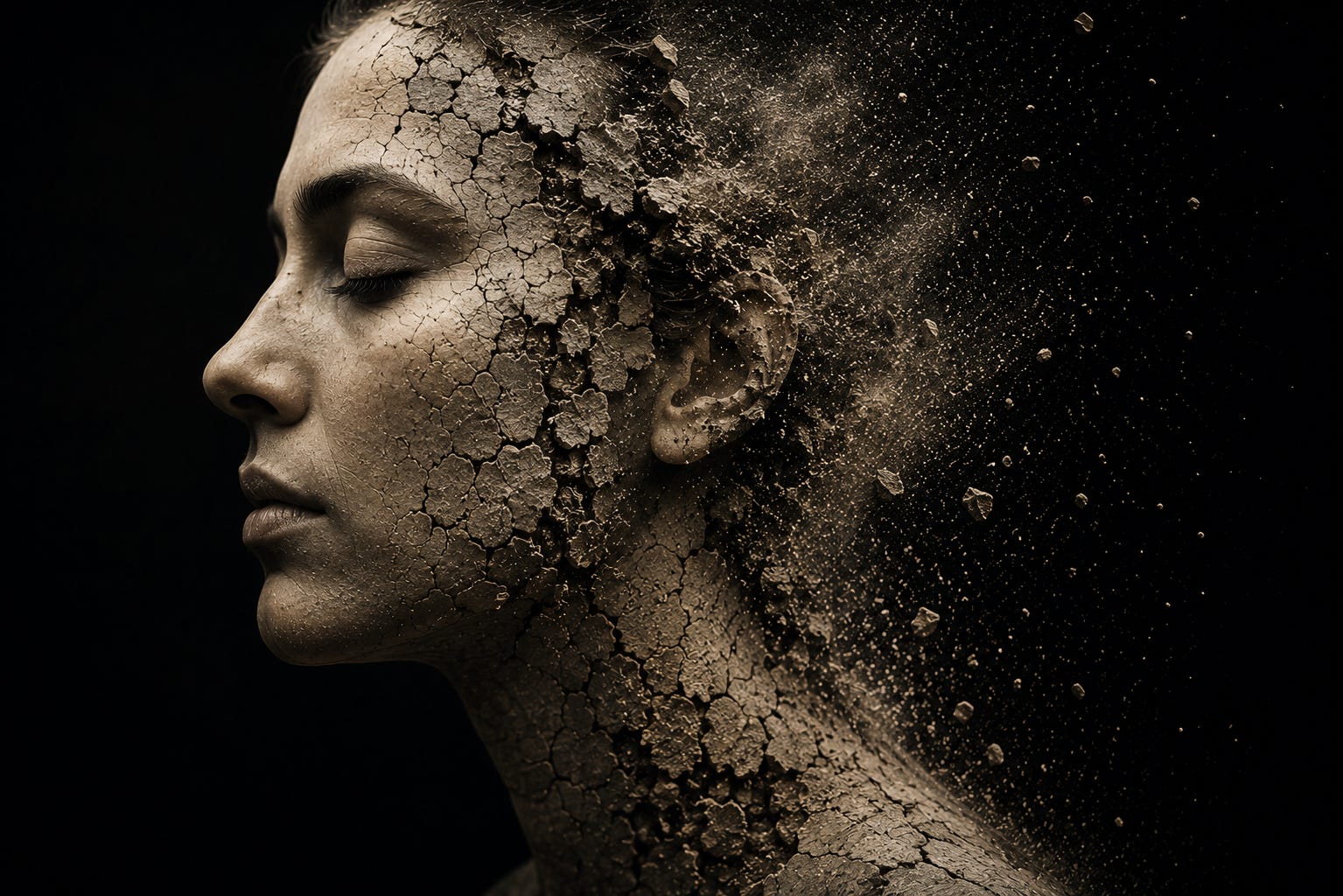
Let’s start with what we think we know.
We are human. More specifically, Homo sapiens. That is our species.
But what does it actually mean to be human?
A Rosa gallica is a species of wild rose. Its pattern of growth and development is remarkably consistent. Given the right conditions, it simply becomes what it is. Being a Rosa gallica is relatively straightforward.
Being human is another matter.
As a species, we understand a great deal about biological survival. We know what our bodies require to grow, heal, and remain healthy. Yet more than 300,000 years after Homo sapiens first appeared, the larger question remains surprisingly unsettled. What does it mean to become fully human?
We have learned to care about physical, mental, and emotional health. Yet there is another dimension of human well-being that shapes every life despite having almost no place in our public vocabulary.
The phrase existential health is unfamiliar to many people. Most of us understand that health has many dimensions, and that some conditions strengthen them while others gradually diminish them. Poor sleep, chronic stress, smoking, prolonged isolation, and a sedentary lifestyle slowly erode physical well-being. We also recognize that caring for our bodies is not something we do once. It is something we either cultivate or neglect through countless ordinary choices.
This dimension of health deserves to become part of our everyday vocabulary for the same reason. It concerns the quality of our relationship with existence itself. It asks how we inhabit meaning, identity, freedom, responsibility, uncertainty, belonging, love, grief, mortality, and reality. These are not abstract philosophical questions reserved for scholars or monasteries. They are enduring features of every human life. Whether we notice them or not, they influence the way we experience ourselves, our relationships, and the world.
The reason we have struggled to recognize this dimension of health is that it has never belonged entirely to any one discipline. Philosophy asked what existence means. Psychology explored how the mind functions. Religion offered stories about ultimate reality. Medicine cared for the body. None of them were primarily concerned with the quality of our lived relationship with existence itself. As a result, one of the most consequential dimensions of human flourishing has remained scattered across many fields without ever becoming a field in its own right. We have had countless conversations about life. We have rarely asked what makes a healthy relationship with life itself.
Like every dimension of health, existential health can become stronger or weaker over time. Its decline rarely happens through a single dramatic event. More often, it develops gradually through ways of living that diminish our capacity to inhabit reality, assume authorship of our lives, remain present to existence, and engage life’s deepest questions with honesty and courage. Because these patterns are deeply woven into modern culture, they often feel normal. We stop noticing them precisely because they have become so familiar.
None of the conditions that follow should be understood as moral failings. They do not make someone a bad person, nor do they suggest weakness or lack of character. Most of us inherited them from families, institutions, cultures, or historical circumstances we never chose. The purpose of naming them is not to assign blame but to increase awareness. We cannot strengthen a dimension of health we have never learned to recognize.
1. Living at a Distance from Reality
Existential health begins with our relationship to reality itself. Whenever we organize our lives around denial, distraction, ideology, wishful thinking, or carefully constructed illusions, we gradually lose the ability to inhabit existence as it actually is. This does not mean embracing pessimism or rejecting hope. It means developing the courage to meet life honestly, including its beauty, suffering, uncertainty, limitations, and complexity. Reality remains what it is whether we acknowledge it or not. Reality does not negotiate with our preferences. The farther we distance ourselves from it, the more fragile every other dimension of existential health becomes.
2. Living from Borrowed Meaning
Every human being longs for meaning, but not all meaning is truly our own. Many of us inherit answers long before we have asked the questions ourselves. Religion, family, politics, culture, career, and ideology often provide ready-made narratives that explain who we are, why we exist, and how we should live. Some of these inheritances contain genuine wisdom. Others become substitutes for the difficult work of discovering meaning through lived experience. Our relationship with existence is strengthened when meaning becomes something we help create rather than something we merely inherit.
3. Abandoning Self-Authorship
No one begins life as the author of their own existence. We all inherit languages, traditions, identities, expectations, and stories that shape us long before we become aware of them. Maturity does not require rejecting everything we have received, but it does require deciding what we will continue carrying forward. Damage occurs whenever we surrender that responsibility and allow others to write the story of our lives indefinitely. Becoming fully human requires gradually assuming authorship of the life only we can live.
4. Becoming Unable to Bear Uncertainty
One of the clearest signs of existential health is not possessing all the answers but developing the capacity to live well without them. Human existence contains ambiguity that cannot be eliminated. We cannot know the future with certainty. We cannot remove every doubt. We cannot resolve every mystery. Yet many people spend their lives searching for systems that promise exactly that. When our need for certainty becomes absolute, curiosity gives way to rigidity, humility disappears, and growth comes to an end. A healthy relationship with existence allows us to remain steady without requiring life to become certain first.
5. Forgetting That You Will Die
Mortality is not simply the end of life. It is one of the conditions that gives life its shape. Every decision, every relationship, every act of love derives much of its significance from the fact that our time is limited. Modern culture encourages us to postpone this reality through endless distraction, productivity, and promises of perpetual youth. The more we postpone facing death, the more likely we are to postpone fully living. Remembering our mortality does not diminish life. It reveals what deserves our attention while we are still here.
6. Confusing Identity with Roles
Throughout life we inhabit countless roles. We become parents, partners, employees, leaders, citizens, believers, skeptics, caregivers, and friends. These roles matter deeply, but they are not the whole of who we are. Identity becomes fragile when it depends entirely upon the positions we occupy or the achievements we accumulate. Careers end. Children grow up. Communities change. Bodies age. If our entire sense of self rests upon what we do, life eventually takes that identity away. Existential health asks a deeper question: Who remains when the roles begin to disappear?
7. Losing the Capacity for Wonder
Human beings possess a remarkable ability to become accustomed to existence itself. The sunrise becomes ordinary. Relationships become routine. Consciousness becomes something we rarely notice. Even our own lives begin to feel automatic. Yet wonder is one of the experiences that continually renews our relationship with existence. It reminds us that life is not merely a collection of problems to solve or tasks to complete. It is something to encounter with curiosity, gratitude, humility, and awe. When wonder disappears, existence slowly becomes flat, mechanical, and forgettable.
8. Avoiding Existential Courage
Existential courage is not the absence of fear. It is the willingness to move toward reality despite fear. It is the courage to love knowing loss will eventually come. To make meaningful choices without guarantees. To speak honestly without controlling the outcome. To continue living after disappointment, grief, or failure. Every significant human life requires decisions that cannot be justified by certainty alone. A healthy relationship with existence grows whenever we choose participation over avoidance and courage over retreat.
9. Mistaking Survival for Living
Modern society excels at teaching us how to survive. We learn how to make a living, manage responsibilities, solve problems, meet expectations, and remain productive. Yet survival and aliveness are not the same thing. It is possible to become extraordinarily competent while quietly losing contact with the experience of being alive. We can spend years functioning efficiently without ever fully participating in our own existence. Existential health asks not merely whether we are getting through life but whether we are genuinely inhabiting it.
10. Failing to Become Present to Existence
The greatest threat to existential health is living without ever fully arriving in our own lives. We become preoccupied with what comes next, distracted by endless demands, or trapped in memories of what has already passed. Gradually, the ordinary miracle of being here slips beyond our awareness.
Presence is not simply a mindfulness technique. It is the capacity to participate consciously in this one unrepeatable life while it is unfolding.
This moment has never existed before and never will again. Every face you love is changing. Every season is passing. Every ordinary Tuesday becomes, without announcing itself, part of the only life you will ever have. To become present is to awaken to that reality before it has already become memory.
11. Living Without Genuine Belonging
Human beings are formed in relationship. We long not merely to be included but to experience ourselves as participants in the larger reality of existence. Yet modern life often leaves many of us isolated, fragmented, and disconnected from one another, from nature, from community, and sometimes even from ourselves. Loneliness is not only a social problem. It can become an existential condition in which life feels fundamentally separate. Our relationship with existence deepens whenever we discover forms of belonging that do not depend upon performance, conformity, achievement, or the approval of others.
Becoming More Fully Alive
Every one of us carries some of these conditions. None of us reaches adulthood untouched by inherited beliefs, cultural pressures, relational wounds, or strategies of survival. This dimension of health is not about becoming perfect, enlightened, or free from struggle. It is about becoming more capable of inhabiting reality as it is rather than as we wish it to be.
The encouraging news is that it can be cultivated. Just as physical health is shaped through countless ordinary choices, our relationship with existence is formed through the ways we respond to the realities of being human. Examined beliefs, acts of self-authorship, honest encounters with grief, the willingness to face uncertainty, movement toward deeper belonging, and the courageous acceptance of mortality gradually strengthen our capacity to live more fully.
That is the deepest invitation of this emerging field. It is not simply to solve life’s greatest questions but to become the kind of person who can inhabit them with greater wisdom, integrity, courage, and love.
We are born Homo sapiens. Becoming fully human is something else. It is not guaranteed by age, education, success, or survival. It is a lifelong process of learning to inhabit reality with greater wisdom, courage, integrity, love, and presence.
We cannot choose the conditions of being human. We can choose how deeply we learn to inhabit them.
Thank you for reading.
If this way of thinking about what it means to be human resonates with you, I hope you’ll consider becoming a paid subscriber. Your support allows me to keep writing, researching, and developing the emerging field of existential health, while inviting you into a community of people asking many of the same questions.
I’d be grateful to have you along.
There something I reflect every time I read your essays about existential health and that I have not yet learned how to metabolize: the relationship with injustice. I can make amends with grief, death, uncertainty, religious deconstruction. I can recognize belonging, responsibility, love, etc. But I cannot reconcile, or accept the history of a violent, genocidal human kind as it is without experiencing deep emotions. I would love to hear your thoughts about this.
@Jim, I am still trying to understand what you mean by existential health (EH).
In this article, you say EH "asks how we inhabit meaning, identity, freedom, responsibility, uncertainty, belonging, love, grief, mortality, and reality" and you say, EH is strong when we "inhabit existence as it actually is."
These two pieces together imply to me that existence contains meaning, identity, etc. That meaning exists and we simply have to inhabit or fully live in it.
For me, a person has strong EH when s/he has done extensive deconstruction of their self concept (i.e., narrative self). This enables them to live more fully in the Here and Now - to experience life more directly. This person is largely free of inherited beliefs, should, etc. In this clear state, we don't inhabit meaning or identity. Instead, we *construct* meaning or identity - intentionally and consciously, when it is needed.
The idea that life has no meaning unless I give it meaning has been a challenge for me to embrace, but every experience of life I have - prior to the mind's interpretations - has NO meaning, only existence. The mind then generates meaning based on goals, expectations, prior experiences, and prior knowledge.
How can we inhabit meaning/identity when we must first construct it? Or, are you saying, once we consciously construct the meaning or identity, then we should fully inhabit it? Thanks for clarifying.