


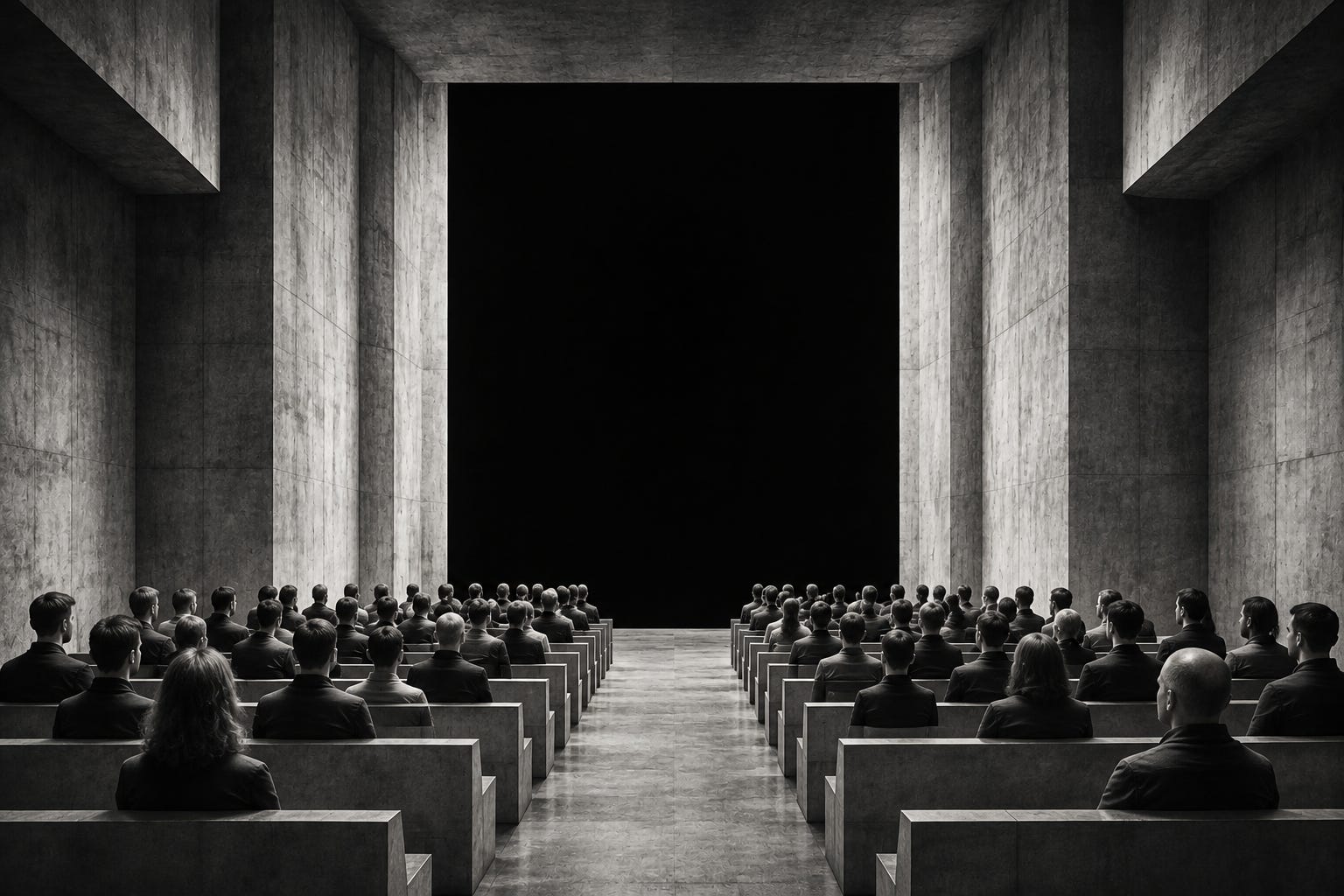
Preface
For nearly thirty years, my work has placed me alongside people navigating religious deconstruction and reconstruction, post-religion spirituality, and, more recently, the emerging field of Existential Health. Across those years, I have watched people lose far more than beliefs.
When a religious framework collapses, it can take with it an entire structure of meaning, identity, belonging, moral orientation, purpose, and certainty. Questions that were once answered before they were even asked suddenly become open again. Who am I without this story? What makes my life matter? How do I know what is true? Where do I belong? What happens when I die?
For many people, nihilism emerges somewhere in that territory, less as an abstract philosophical position than as the lived experience of discovering that the world no longer comes with the guarantees they once assumed it did.
I understand why this response feels almost inevitable at that threshold. When a system has taught you that God is the source of morality, purpose, and human significance, losing confidence in God seems to place the entire structure in jeopardy. The movement from God gives everything meaning to without God nothing matters often happens with surprising speed.
Even outside explicitly religious contexts, people experience similar collapses when political, cultural, psychological, or personal frameworks that once organized their lives cease to hold. Nihilism names something real about the exposure that follows when inherited structures of meaning no longer convince us.
Over the years, however, I have noticed a curious pendulum swing. What begins as the destabilizing experience of losing a framework gradually becomes another framework. The very condition that once threatened identity, belonging, and certainty begins supplying all three.
“Nothing matters” ceases to function only as a frightening possibility and becomes a position from which to interpret the world. Disenchantment signals intellectual maturity. Cynicism becomes evidence that one has seen through the illusions others still require.
Communities form around shared disbelief, recognizable vocabularies emerge, and a subtle distinction develops between those who have accepted the hard truth of meaninglessness and those still consoling themselves with stories of purpose and significance.
I find this development fascinating because the structure is so familiar. People who have escaped systems of certainty sometimes find themselves certain once again. Those who rejected identities organized around belief may construct new identities around disbelief.
A worldview that once supplied belonging is replaced by communities gathered around the conviction that worldviews themselves are illusions. Even the sense of having awakened from deception, a feature common to many religious conversion narratives, can reappear in nihilistic form: I used to believe what everyone else believes, but now I see reality as it actually is.
None of this means that nihilism is simply another religion, nor do I use the comparison to dismiss the serious philosophical questions it raises. The tradition deserves better than caricature. It has exposed genuine weaknesses in inherited systems of meaning and forced modern human beings to confront questions that metaphysical certainty once allowed us to avoid.
My concern is with what happens when nihilism stops functioning as a confrontation with uncertainty and begins protecting us from it. The conviction that nothing ultimately matters can then provide many of the existential benefits once supplied by religion: identity, belonging, interpretive coherence, and certainty.
Moving beyond this position requires relinquishing both the old metaphysical guarantees and the certainty of meaninglessness, opening territory beyond the familiar choice between a universe governed by predetermined purpose and one in which nothing has ultimate value.
I have come to think of this territory as post-nihilism. It neither restores the assurances that have collapsed nor asks us to construct a new purpose capable of replacing them. It begins by examining an assumption shared more often than we recognize by the religious believer and the committed nihilist: that life possesses value only when its significance is ultimately guaranteed.
Nihilism asks how life possesses value without such a guarantee. Post-nihilism asks why the guarantee is necessary in the first place.
That is the territory I want to explore here.
Beyond the Search for Meaning
What if the problem of meaninglessness begins with our demand that life must mean something?
For more than a century, nihilism has haunted modern consciousness as one consequence of losing the metaphysical structures that once made existence intelligible. God recedes. Providence becomes difficult to believe. Sacred cosmologies lose their authority. Scientific accounts of the universe offer astonishing explanatory power while remaining largely silent about what our lives are for. Death appears less like a passage within a larger story and more like an ending whose significance we cannot know.
The familiar questions follow.
If no transcendent order guarantees the meaning of life, what keeps existence from collapsing into absurdity?
If the universe has no discernible purpose for us, on what basis can anything matter?
If our lives occupy an almost imperceptible moment in cosmic history, why should anything we do matter beyond the temporary importance we assign to it?
These questions reach far beyond philosophy. People who would never describe themselves as nihilists still wonder whether their lives matter, whether they have found their purpose, whether they are doing what they were “meant” to do, whether their suffering means anything, and whether a life without some larger purpose can finally be enough.
The modern crisis of meaning, then, is not confined to people who believe nothing matters. It also appears in the enormous pressure many people feel to make their lives matter.
Much of contemporary life responds to that pressure by offering new sources of meaning. Religion continues to locate existence within larger sacred narratives. Secular society offers purpose, authenticity, contribution, legacy, self-actualization, creativity, relationships, political commitment, and personal growth. These provide genuine orientation and often deepen a life. The problem lies elsewhere.
Beneath the religious answer and many of its secular replacements sits an assumption that receives remarkably little scrutiny: a life must possess sufficient meaning in order to justify itself.
Once that premise is accepted, meaninglessness becomes more than an existential possibility. It becomes a threat. A life without an overarching purpose begins to appear deficient. Experiences that resist incorporation into a larger story become difficult to bear. Suffering seems to demand an explanation. Mortality threatens whatever significance we create because anything that ends may appear ultimately futile.
Nihilism accepts more of this architecture than its opposition to religion initially suggests. It rejects the old guarantees while preserving the standard by which their absence becomes catastrophic. If life requires ultimate meaning in order to matter, and nothing provides it, the nihilistic conclusion follows with considerable force.
But the conclusion depends upon the premise.
The history of nihilism is generally told as a story about the collapse of meaning. I want to consider another possibility. The deeper crisis may arise when our inherited demand for ultimate significance survives the metaphysical systems that once satisfied it. We stop believing in the architecture while continuing to require the guarantee.
That distinction changes the terrain considerably. Rather than immediately trying to recover, reconstruct, invent, or choose something to replace what disappeared, we can examine why human existence was placed under this requirement in the first place.
Post-nihilism begins there.
It begins when the absence of guaranteed meaning no longer automatically becomes evidence that life has failed, and when the demand for such a guarantee becomes available for examination.
Nihilism Needs What It Rejects

Nietzsche understood with unusual clarity that the death of God involved far more than declining religious belief. Remove God from a civilization whose moral, metaphysical, and cultural assumptions were constructed around God, and the consequences do not remain confined to theology. Entire structures of value become unstable.
The significance of Nietzsche’s diagnosis is sometimes reduced to the familiar claim that without God we must create our own meaning. That interpretation captures something important while missing the deeper disturbance. Nietzsche saw that European civilization had inherited values whose metaphysical foundations it was simultaneously dismantling. The old world could become unbelievable long before we learned how to live without it.
This creates a peculiar historical condition. A person ceases to believe that the universe contains an objective purpose for existence while continuing to feel that life ought to possess one. Someone rejects divine providence yet still experiences suffering as intolerable unless it fits within a larger story.
Another person abandons belief in eternal life while remaining troubled that love, achievement, and relationship might lose their value if death eventually erases them. The propositions disappear while the expectations remain.
I call this metaphysical afterlife: the persistence of existential expectations after the worldview that generated them has lost credibility.
Nihilism often inhabits this territory.
The nihilist declares that life has no ultimate meaning and experiences this as devastating. Yet devastation follows only if existence was expected to provide such an assurance. The universe has failed a test whose criteria came from somewhere. Reality has been judged deficient because it offers no guaranteed purpose, permanence, cosmic significance, or metaphysical reassurance.
Something unexpected has happened to nihilism as it has moved from philosophy into the wider social imagination. What once named a philosophical crisis has increasingly become an identity, sometimes even a badge of intellectual sophistication. In certain corners of contemporary life, declaring that nothing matters can function as evidence that one has seen through the consoling illusions others still require. Detachment becomes a mark of lucidity, cynicism a sign of intelligence, and disbelief a form of emancipation.
Once this position becomes an identity, it takes on features strikingly similar to the religious systems it imagines itself to have transcended. It offers an account of reality, a distinction between those who have awakened and those who remain deceived, a vocabulary that signals belonging, and a recognizable posture toward existence. The nihilist can become deeply invested in defending a final answer to the human condition, only now the answer is that there is no answer.
The irony reaches deeper than resemblance. A philosophy born from the collapse of certainty sometimes hardens into another certainty. Disbelief becomes doctrine, disenchantment becomes identity, and the rejection of purpose supplies an existential orientation of its own.
This position then provides something psychologically similar to what the abandoned worldview once offered: belonging, interpretive coherence, a sense of direction, and the confidence of knowing what reality ultimately is.
Seen from this angle, nihilism has not fully escaped the metaphysical world it opposes. Something of that world survives inside the structure of its rejection.
The believer may say that life matters because God guarantees its meaning. The nihilist answers that without such a guarantee nothing ultimately has value. Their conclusions could hardly be further apart, yet underneath them sits a strikingly similar premise: for life to possess genuine value, its significance must somehow be guaranteed beyond the contingencies of human existence.
This dependency rarely receives serious scrutiny. The guarantor has been rejected while the absence of the guarantee continues to organize the worldview.
Post-nihilism begins by questioning whether the guarantee was ever necessary.
The Meaning Imperative
We make meaning. We interpret experience, construct narratives, create symbols, remember the past, anticipate the future, form identities, participate in cultures, and situate ourselves within stories larger than the immediate moment. This interpretive activity is so deeply woven into cognition and social existence that imagining life entirely without it may be incoherent.
The difficulty emerges when this natural activity becomes an existential requirement that reality itself must satisfy.
I call this the meaning imperative: the belief that a viable life requires an overarching explanation, purpose, or significance capable of justifying existence as a whole.
The imperative takes religious forms. God created you for a reason. Everything happens according to a larger plan. Your suffering serves a purpose that may eventually be revealed. Your earthly life belongs to an eternal story.
Its secular forms are often harder to recognize because they present themselves as liberation from metaphysics. Find your purpose. Discover your authentic self. Build a life that matters. Make an impact. Leave a legacy. Become the person you were meant to be. Identify the contribution only you are positioned to make.
These ideas are often enormously generative. Purpose organizes attention and action, while a coherent identity helps people navigate complexity. Commitment to work, relationships, art, justice, community, or service deepens a life considerably. Nothing about post-nihilism requires treating our search for significance as an illusion or purpose as a pathology.
The difficulty arises when these possibilities harden into conditions for existential legitimacy. An individual unable to identify a purpose begins to experience themselves as failing at life. Ordinary existence feels insufficient. Work must become vocation. Pain must produce growth. Trauma must reveal a lesson. Relationships must advance our development. Experiences acquire value partly through their contribution to the story we are constructing about ourselves.
Even suffering becomes subject to the demand for productivity. We speak of what hardship taught us, how grief transformed us, and what adversity made possible, as though suffering that produces no wisdom leaves behind an unresolved account.
Meaning has moved from something humans experience and create into something life is expected to deliver.
The modern person may have escaped divine judgment only to find themselves standing before another tribunal: Does my life mean enough?
When Meaning Becomes an Achievement
The decline of inherited meaning did not leave an empty space. Markets, institutions, therapeutic cultures, political movements, digital platforms, lifestyle industries, and personal-development systems entered the territory.
Meaning became increasingly individualized.
Where earlier societies often assigned identity through religion, family, community, geography, class, and tradition, modern individuals are expected to construct themselves from a proliferating field of possibilities. This expansion of freedom has produced genuine gains. People can leave inherited roles, challenge oppressive traditions, revise identities, cross social boundaries, and author lives unavailable to previous generations.
Freedom, however, can become another burden when every major dimension of existence becomes a project of self-construction.
Who are you?
What do you believe?
What matters most?
What is your purpose?
What kind of life are you building?
What difference will you make?
These can be fruitful questions. Living permanently under their interrogation is another matter.
The self becomes responsible for generating the significance that metaphysics once supplied. Meaning shifts from inheritance to production. A person must now create enough coherence, purpose, identity, and direction to convince themselves that their existence is justified.
This creates what I would call existential performance: the pressure to turn one’s life into evidence that one has successfully solved the problem of being alive.
Social media intensifies this pressure because the self is increasingly narrated in public. Experiences become content. Careers become personal brands. Recovery becomes testimony. Travel becomes identity. Political commitments become signals of moral location. Even vulnerability can be organized into a coherent narrative of transformation.
Under these conditions, meaning becomes strangely close to productivity. A meaningful life should be going somewhere. It should demonstrate development. It should accumulate experiences, relationships, achievements, insights, or contributions that form a recognizable trajectory.
The possibility that a human life might be valuable without becoming an impressive story receives far less cultural attention.
Post-nihilism begins to disturb this economy.
The Reconstruction Trap

People leaving religion encounter this problem with particular intensity.
When an inherited religious worldview collapses, the immediate experience can involve far more than disbelief. The person may lose a cosmology, moral structure, community, identity, explanation of suffering, understanding of death, language for transcendence, and account of their own significance at roughly the same time.
The understandable response is reconstruction. People begin reconsidering what they believe, searching for new sources of meaning and community, developing moral frameworks no longer dependent upon divine authority, and trying to understand what might occupy the existential territory once organized by God. Purpose, identity, belonging, and orientation all become matters that must now be negotiated rather than inherited.
The impulse to reconstruct deserves to be taken seriously because we cannot live indefinitely without some form of orientation. We need relationships, practices, language, and workable interpretations of experience. The danger lies in rebuilding too quickly according to the architecture of what was lost.
Someone leaves Christianity and adopts a spiritual cosmology in which “the universe” now performs many of the functions once assigned to God. Another replaces divine calling with an intensely individualized concept of purpose. Psychological language can become a new interpretive authority. Political ideology may provide a comprehensive moral map. Philosophy can become another fortress against uncertainty.
The content changes while the structure remains recognizable.
A central authority explains reality. A framework organizes experience. Identity becomes coherent inside it. Suffering acquires interpretation. Uncertainty is reduced. Belonging is secured through shared language. The world becomes manageable again.
None of these frameworks is necessarily false or harmful. The issue concerns the function they are being asked to perform.
If reconstruction primarily restores protection from existential exposure, we may have changed our beliefs without changing our relationship to uncertainty.
Religious deconstruction is only one place where this pattern appears. Modern culture is filled with systems that perform many of the functions once assigned to metaphysics while presenting themselves as entirely secular.
Someone may become dogmatic about wellness, identity, productivity, politics, science, spirituality, therapy, or personal development. Any framework becomes existential shelter when too much of one’s ability to inhabit reality depends upon its remaining intact.
Post-nihilism therefore requires something more demanding than replacing bad answers with better ones. It asks whether we are capable of living without making any answer carry more existential weight than it can bear.
What Nihilism Gets Right
The temptation to move beyond nihilism too quickly may prevent us from receiving its most important disclosure. Reality does not appear obligated to satisfy our longing for explanation, coherence, or justice. Some suffering remains senseless, and people die with lives unfinished. Cruelty sometimes escapes consequence while goodness offers no reliable protection from catastrophe. History provides little assurance that moral progress is inevitable, and entire civilizations that once imagined themselves permanent have disappeared.
The same impermanence reaches into the intimate territories of human life. Love sometimes ends without becoming less real because it ended. People devote decades to work that fails, relationships disappear before reconciliation becomes possible, and some questions remain unanswered for an entire lifetime. A person may reach the end of life without ever discovering what it was all “about.” Any worldview serious enough to remain in contact with reality must be spacious enough to hold these facts without forcing them into a story that makes them easier to bear.
Religious traditions have often developed sophisticated ways of holding them, and secular philosophies have done the same. The problem arises whenever explanation becomes a means of refusing the full weight of what happened.
The parent whose child dies may eventually create meaning around the loss. They might establish a foundation, change careers, help others, deepen relationships, or develop insights that would otherwise never have emerged. Those developments can be profoundly real.
Yet none of them retroactively makes the child’s death necessary.
Some losses should be allowed to remain losses.
The meaning imperative can become morally dangerous when every experience is expected to fit within a coherent larger story. Suffering then becomes vulnerable to interpretation by people who did not endure it. Tragedy is turned into a lesson, oppression absorbed into a spiritual journey, trauma recast as a pathway to growth, and death explained as something that was somehow “meant to be.”
Meaning can become a way of making difficult experiences easier for observers to tolerate.
Post-nihilism refuses that requirement. It allows what happened to remain what happened without requiring an explanation that justifies it.
That refusal does not diminish what matters in life. It protects experience from being colonized by explanations imposed upon it.
Meaning Is Not Significance
Nihilism gains much of its force by collapsing two different realities into one: meaning and significance. Although we often use the terms interchangeably, separating them opens another way of understanding existence.
Meaning primarily concerns interpretation. Experiences acquire coherence within symbolic, narrative, cultural, or conceptual frameworks through which we understand what has happened and locate ourselves in relation to it. We interpret events, suffering, relationships, and our lives as a whole through these frameworks, continually weaving experience into stories that make existence more intelligible.
Significance is more immediate and relational. Something carries weight before we understand what it means.
A newborn child carries profound weight for a parent who has no idea what that life will become. Friends can hold an irreplaceable place in our lives without occupying a place in some comprehensive philosophy. Landscapes move us before we understand why, while injustice makes a claim upon us long before we have integrated it into a theory of history.
Grief reveals this distinction with unusual force.
When someone dies, their importance is not created by our ability to explain their death. We grieve because a relationship existed and because its absence changes the world we inhabit. The person mattered through contact, history, attachment, memory, embodiment, and shared life.
Meaning may eventually form around the loss. Significance was already present.
This distinction helps loosen nihilism’s grip because the absence of ultimate meaning does not necessarily entail that nothing matters. Once these two dimensions of human experience are separated, that familiar progression becomes far less inevitable.
The universe may contain no readable statement explaining why your friend exists, yet their presence alters the shape of your life and their absence leaves a space no one else fills. A child needs no cosmic purpose for hunger to matter, nor does a forest require an eternal destiny for its destruction to become a genuine loss. Another person’s suffering makes a claim upon us without first being incorporated into a metaphysical story that explains why their life matters.
Significance arises within the relationships through which we encounter one another and the world. It does not require cosmic authorization before it becomes real. This does not resolve nihilism so much as expose a category error within one of its most powerful conclusions: the absence of ultimate meaning does not entail the absence of anything that matters.
How Significance Happens

Once significance is understood relationally, another possibility comes into view.
Much of what matters most in human existence does not exist entirely inside us or entirely outside us. It happens between.
Love is an obvious example. Love cannot be reduced to an objective property located in the universe, but neither is it adequately described as an arbitrary meaning invented by an isolated individual. It emerges through relationship. Two lives encounter one another and something becomes possible that neither contained independently.
Belonging works similarly. So do trust, responsibility, grief, intimacy, beauty, recognition, betrayal, solidarity, and care.
These realities complicate the familiar choice between objective and subjective meaning. The standard debate tends to locate value either in reality itself, independent of us, or within individuals who create it for themselves. The first position risks metaphysical certainty; the second can make value sound arbitrary, as though we simply decide what deserves our investment.
Lived experience suggests a third territory. Meaning and significance can be participatory, emerging through our encounter with a world we neither created nor merely observe. They take shape through relationship, contact, and participation.
You do not invent the person you love. You also do not discover “love” sitting objectively inside them like a measurable property. Love takes shape through participation in a relationship that changes both the lover and the loved.
The same is true of place. A forest comes to matter through years of walking its trails, learning its seasons, encountering its animals, grieving beneath its trees, and developing a history with it. What emerges is neither wholly subjective nor simply embedded in the trees.
A relationship has formed.
This participatory understanding moves beyond one of modernity’s most limiting binaries: what matters must either descend from a transcendent source or be fabricated by autonomous individuals. Human beings are neither passive recipients of cosmic purpose nor sovereign manufacturers of value. We encounter a world we did not create and participate in relationships through which significance takes shape.
Why the Universe Is the Wrong Measure

Nihilism frequently relies upon a peculiar shift in scale. A person looks at the immensity of the universe, considers billions of galaxies and billions of years, recognizes the brevity of a single lifespan, and concludes that our existence is insignificant.
From a cosmic perspective, we are unimaginably small, but physical scale tells us very little about value. An infant is tiny beside a mountain, yet few parents would conclude that the mountain therefore deserves greater importance. Immensity and importance belong to different categories, and the movement from cosmic smallness to existential insignificance depends upon confusing the two.
A seventy-year life occupies an almost invisible fraction of cosmic time, but duration is no more reliable a measure of value than size. A thirty-second event may alter the remainder of a person’s life.
The cosmic perspective becomes nihilistic only when we assume that the universe is the appropriate observer from whose standpoint our value must be assessed.
But the universe, so far as we know, does not have a standpoint.
We do.
The demand that our lives must matter to the cosmos may be one of the strangest residues of metaphysical thinking. It imagines an ultimate spectator whose recognition would certify our importance, even after we have stopped believing such a spectator exists.
We continue looking upward, waiting for reality to validate us, as though our lives require recognition from some imagined vantage point beyond existence. Post-nihilism relinquishes this cosmic audience and returns what matters to the scale where life is actually lived.
A life can matter relationally, historically, bodily, ethically, and ecologically without being certified by the universe as a whole. Local significance is no lesser form of mattering; it emerges through our participation in the lives, places, relationships, and realities with which we are entangled.
Mortality Without Rescue
Death intensifies every problem discussed so far.
If everything ends, nihilism asks, what was any of it for?
The force of the question comes partly from our tendency to make permanence a condition of value. If love ends, its meaning appears threatened. If our accomplishments disappear, why pursue them? If no one remembers us in five hundred years, why should our lives matter now?
Human cultures have developed countless responses to mortality. Afterlives, reincarnation, ancestral continuity, legacy, descendants, monuments, institutions, art, historical memory, and cultural contribution all offer forms of continuation.
Some may be true. Many can be beautiful.
Post-nihilism does not require certainty about what follows death. Its concern lies elsewhere: why should finitude cancel significance?
A piece of music is not defective because it reaches its final note. A meal does not fail because it is eaten. Childhood does not become meaningless because adulthood arrives. Experiences often possess their particular character precisely because they unfold within limits.
Human mortality is more difficult than these analogies can capture. Death involves the disappearance of consciousness as we know it, the rupture of relationships, and the permanent loss of possibilities. No aesthetic metaphor should make that easy.
Permanence and value remain conceptually distinct. Someone matters completely without existing forever, just as a relationship alters the course of two lives without surviving death. Human beings leave traces in people, communities, and generations they will never meet, even though their names may eventually disappear from memory. Finitude does not diminish what occurred or render a finite life incomplete. Nothing has to last forever in order to have mattered.
Living with that possibility changes our orientation toward existence. Instead of trying to make our lives important enough to defeat death, we become more attentive to what matters within mortal life itself.
Mortality ceases to function only as an argument against meaning. It becomes part of the condition under which attention, urgency, grief, tenderness, and responsibility acquire their particular human weight.
Post-Nihilism Is Not Indifference
A serious objection now appears.
If there is no ultimate meaning, no cosmic moral order, and no transcendent guarantee of value, what prevents post-nihilism from becoming sophisticated relativism?
Why care about justice rather than cruelty?
Why protect vulnerable people?
Why prefer truth to deception?
Why should another person’s suffering place any obligation upon me?
These questions cannot be dismissed. Any post-nihilist framework that ends with “choose what matters to you” simply reproduces an individualism incapable of grounding serious ethical life.
Relational significance provides part of an answer, though not a complete moral theory.
Human beings enter existence vulnerable, embodied, dependent, social, and capable of suffering. We require forms of care long before we possess philosophies. Our lives are shaped by conditions we did not choose and relationships we cannot simply transcend. Actions affect actual bodies, possibilities, communities, ecosystems, and futures.
Ethical seriousness does not have to begin with a command issued from outside existence. It may begin with the conditions of shared life itself.
Pain has consequences because it is experienced by a living being whose world is altered by it. Domination narrows another person’s ability to inhabit their own life, while violence reaches beyond the immediate act into bodies, relationships, possibilities, and futures. Deception damages the shared reality upon which trust and cooperation depend. Care moves in another direction, creating conditions in which another person has greater freedom to participate in existence and exercise agency within it.
None of this settles every moral dispute or produces a universal ethical formula. Values conflict, cultures understand flourishing differently, and ethical reasoning remains difficult precisely because we share a world without occupying identical positions within it. Power distorts perception, competing goods make genuine demands upon us, and we remain extraordinarily capable of constructing moral justifications for actions that harm others.
Post-nihilism offers no escape from this difficulty. It removes the assumption that ethical seriousness depends upon morality being guaranteed from somewhere beyond the human condition. Responsibility can arise within the conditions of shared existence itself, where what we do alters the lives and possibilities of other beings.
Without a metaphysical authority capable of resolving every ambiguity or ensuring that justice ultimately prevails, the work of ethical discernment becomes more rather than less consequential. No transcendent guarantee can relieve us of the responsibility for what we make possible, what we permit, and how our participation affects the world we share.
From Meaning to Participation

At this point the original problem has changed.
We began with the fear that life without guaranteed meaning might not be worth living. That fear assumed that existence needed to pass a metaphysical test before participation could be justified.
A different orientation has gradually emerged.
Human beings find themselves already embedded in a world of relationships, bodies, histories, environments, vulnerabilities, possibilities, losses, and other lives. Significance develops through contact with these realities. Meaning arises as we interpret them, but interpretation is not the prerequisite for their mattering.
This leads me toward a proposition I have become increasingly interested in: the alternative to nihilism may be less about recovering meaning than deepening participation.
That shift changes the structure of the inquiry.
The observer stands outside life conceptually and asks whether existence has provided sufficient justification for entering it. The participant begins from the recognition that no such outside position actually exists. We are already implicated.
We are born into relationships before choosing them. We inherit languages before evaluating them. History reaches us before we understand it. Bodies expose us to pleasure, pain, limitation, dependence, aging, and death. Other people make claims upon us simply by sharing a world in which our actions have consequences.
Participation does not abolish reflection. It gives reflection somewhere to stand.
The danger of endless meaning-seeking is that life itself can become deferred while we attempt to determine what life is supposed to mean. People spend years searching for their purpose while overlooking the relationships, responsibilities, pleasures, injustices, and possibilities already asking something of them.
Post-nihilism does not tell them to stop thinking.
It challenges the assumption that they must finish thinking before they are permitted to live.
Existential Health Beyond Meaning
This has significant implications for how I understand Existential Health, which concerns our relationship to being alive across identity, mortality, belonging, agency, uncertainty, purpose, significance, and reality itself. Meaning belongs within that landscape, but it cannot become the master category through which every other dimension is interpreted.
A person may possess a powerful sense of purpose while inhabiting a worldview that requires chronic denial of what they encounter. Another may live with profound uncertainty about ultimate questions while maintaining strong relationships, ethical seriousness, self-trust, reality contact, and a deep ability to participate in life. Existential health therefore cannot be measured by how successfully someone has made their existence intelligible.
This has consequences for therapeutic, spiritual, educational, and cultural settings, where existential distress often triggers an immediate effort to reconstruct meaning. Sometimes that is exactly what is needed. At other times, the urgency to reconstruct interrupts a different kind of development: learning to inhabit uncertainty, ambiguity, mortality, and the absence of comprehensive explanation without psychological collapse.
Leaving religion may require time before constructing another worldview, just as someone grieving may need freedom from the expectation that loss must eventually yield a lesson. Someone approaching death may have little interest in turning a lifetime into a coherent final story.
Someone who has spent decades pursuing purpose may eventually discover that ordinary participation in relationships, places, responsibilities, pleasures, and daily life is not a lesser form of existence.
Within a post-nihilist frame, Existential Health includes the capacity to remain in relationship with life when meaning is partial, changing, contested, or absent altogether. This involves a different developmental task from finding the correct philosophy or constructing a worldview capable of resolving every uncertainty.
It concerns how much of what we encounter we can inhabit without first demanding reassurance before we are willing to participate in it.The World After Guarantees

Post-nihilism does not announce the end of meaning. We will continue creating religions, philosophies, stories, rituals, identities, art, communities, and visions of what makes life worth living. We should. These are among the great expressions of being alive.
The shift concerns the authority we grant them.
Stories can orient us without becoming the conditions under which reality is allowed to matter. Purpose can organize a season of life without serving as the justification for our existence. Religious traditions offer profound symbolic resources without requiring certainty about the metaphysical status of every symbol, while philosophy helps us think without hardening into an architecture designed to protect us from uncertainty.
Meaning becomes something we participate in rather than something required to save us.
For those of us who have lived inside systems of comprehensive explanation, this can feel exposed. I spent years inside a worldview that told me why human beings existed, what history meant, what suffering meant, what God wanted, where morality came from, what happened after death, and how the entire story would end. Losing those answers involved more than changing my mind. It changed the conditions under which I understood being alive.
For a long time, I assumed reconstruction meant finding better answers.
Increasingly, I have become interested in another possibility: developing a different relationship to the unanswered.
Some questions remain important enough to pursue for a lifetime. I still care about meaning, consciousness, morality, spirituality, mortality, and what kind of existence human beings might build together. Post-nihilism does not require intellectual retreat from any of them.
It changes what is at stake in answering them.
My life does not have to wait for the verdict.
Love does not become provisional until metaphysics explains it. Grief needs no theory before testifying that someone mattered. Beauty interrupts us without presenting credentials. Responsibility arises because another vulnerable being is here. A morning remains worth inhabiting without contributing to a larger narrative of personal transformation.
The absence of an ultimate guarantee does not leave us with nothing. It leaves us here.
That may be more demanding than the old assurances because participation offers no final refuge from contingency. People we love are lost. Work fails. Bodies break. Communities disappear. Our deepest convictions sometimes require revision, and some questions remain unanswered when we die.
Post-nihilism does not make these realities beautiful in order to make them bearable. It asks whether being alive can be enough to place us in relationship with them.
We have spent enormous intellectual and spiritual energy asking how life can matter without a guarantee of ultimate meaning. Post-nihilism turns the problem around and asks whether such a guarantee was ever necessary in the first place.
Once that second question is taken seriously, the terrain changes. We are no longer standing before existence demanding proof that it deserves our participation. We begin to notice that the demand itself belonged to a world we may already have left.
Life has been happening while we waited for an explanation.
The work after nihilism may be learning how fully we are willing to enter it.
Article Glossary: The Language of Post-Nihilism
Post-Nihilism
A way of inhabiting existence after both metaphysical certainty and nihilistic despair have lost their authority. Post-nihilism neither restores transcendent guarantees nor attempts to defeat nihilism by constructing a replacement framework. It questions the deeper assumption that life requires cosmic purpose or metaphysical authorization in order to matter. Its central movement is away from the search for ultimate guarantees and toward participation in a finite, relational, consequential world.
The Meaning Imperative
The inherited assumption that a human life must possess sufficient meaning, purpose, or significance in order to justify itself. The meaning imperative can survive the collapse of religion and reappear in secular forms through demands to discover one’s purpose, create a legacy, make an impact, or construct a coherent life narrative. Post-nihilism questions whether existence needs to justify itself through meaning at all.
The Guarantee
The expectation that the significance of human existence must ultimately be secured by something beyond its contingent conditions. God, providence, cosmic purpose, objective moral order, historical destiny, or another transcendent framework can function as guarantors. Nihilism often rejects the guarantor while retaining the assumption that without such a guarantee, nothing can ultimately matter.
The Reconstruction Trap
The tendency to respond to the collapse of one meaning system by constructing another system that reproduces the same existential architecture. Beliefs may change while the underlying demand for certainty, identity, belonging, coherence, authority, and ultimate explanation remains intact. Reconstruction becomes a trap when new answers replace old answers without examining why such answers must perform these functions in the first place.
Metaphysical Substitution
The process through which ostensibly secular systems begin performing functions once assigned to religion or metaphysics. Political ideology, identity, productivity, personal development, romantic love, nationalism, technology, wellness, or even nihilism itself can become sources of ultimate orientation, belonging, certainty, and explanation without explicitly claiming metaphysical status.
The New Religion of Nihilism
The cultural transformation through which nihilism moves from philosophical confrontation into a source of identity, belonging, interpretive certainty, and social distinction. In this form, disbelief hardens into doctrine, disenchantment signals intellectual status, and the conviction that nothing ultimately matters becomes a worldview defended with some of the certainty associated with the systems it originally challenged.
Relational Significance
Significance that arises through relationship rather than metaphysical authorization. People, experiences, places, ecosystems, actions, and relationships can matter because they affect beings and worlds capable of being affected. Relational significance distinguishes mattering from possessing an ultimate cosmic purpose: something does not have to matter to the universe in order to matter profoundly within existence.
Local Significance
The recognition that significance occurs at the scales where existence is actually lived: bodily, relational, communal, historical, ethical, and ecological. Calling significance “local” does not diminish its value. It challenges the assumption that something becomes genuinely significant only when validated from an imagined cosmic perspective.
The Cosmic Audience
The imagined external vantage point from which human existence must somehow be observed, evaluated, or validated in order to matter. Even after abandoning belief in God, people can continue seeking recognition from “the universe,” history, posterity, humanity, or cosmic significance. Post-nihilism relinquishes the cosmic audience and returns significance to the relationships and realities within which life occurs.
The Cosmic Scale Error
The category mistake of treating physical size, duration, or cosmic permanence as measures of existential significance. Human beings are unimaginably small relative to the universe and occupy an extraordinarily brief period of cosmic history, but neither fact establishes their insignificance. Scale describes magnitude; it does not determine value.
Participation
A mode of relating to existence in which life ceases to be primarily a problem requiring explanation and becomes a reality to inhabit. Participation shifts attention from discovering what life ultimately means toward involvement in relationships, responsibilities, creativity, embodiment, care, place, and the world as it is encountered. Meaning may emerge through this involvement, but it does not have to appear before we begin living.
Life Without Guarantees
The existential condition accepted by post-nihilism: human beings participate in a world that may provide no final explanation for suffering, no assurance of cosmic purpose, no guarantee of moral progress, and no promise that what matters will endure forever. Living without guarantees does not require indifference or despair. It means allowing significance, responsibility, love, and participation to remain real without requiring infinity to certify them.
Mortality Without Rescue
An approach to finitude that does not require death to be overcome metaphysically before life possesses value. A relationship matters despite ending, a life transforms others despite eventually being forgotten, and an experience retains significance without becoming permanent. Finitude does not render what occurs within it futile.
Reality Without Reassurance
The developmental capacity to remain in relationship with existence when meaning is incomplete, changing, contested, or absent. Rather than requiring reality to provide explanation, certainty, justice, or metaphysical consolation before we can fully participate in it, reality without reassurance describes an increasing ability to inhabit what is actually here without demanding that existence first make itself existentially safe.
The World After Guarantees
The existential territory that becomes visible once both metaphysical certainty and nihilistic certainty are relinquished. It is neither a meaningless wasteland nor a universe restored to predetermined purpose. It is the finite, relational, unfinished world in which suffering and beauty, loss and attachment, consequence and possibility remain real without requiring a final story that guarantees what they mean.
Further Exploration
For readers who want to continue exploring the territory beyond nihilism, these essays and resources approach the problem from different philosophical, existential, and practical directions.
1. The Gifts of Nihilism: Only the Idols Died
Nihilism does not have to be treated solely as a catastrophe to overcome. This essay considers what it clears away when inherited certainties collapse and asks whether what dies in the process may be less life itself than the idols, guarantees, and metaphysical constructions we once believed life required. It provides an important foundation for understanding this collapse as a passage rather than a final destination.
2. After Atheism: When Belief and Disbelief Stop Working
Atheism can provide an important liberation from religious claims that no longer withstand scrutiny, but disbelief can eventually become as existentially limiting as the belief system it replaced. This essay explores the territory that opens when the binary of belief and unbelief loses its organizing power and human beings begin relating to existence without needing either position to function as a final identity.
3. Make Friends With Nothingness: Buddhism’s Answer to Western Nihilism’s Meltdown
Western nihilism often interprets emptiness as evidence that something essential is missing. Buddhist traditions offer a radically different encounter with nothingness, impermanence, and the absence of fixed essence. This essay explores what becomes possible when emptiness is approached less as an existential deficiency than as a feature of reality that can transform how we understand attachment, identity, and being alive.
4. Stone-Cold Absurd: Living Life with No Answers and No Refunds
Drawing from the existential territory of absurdism, this essay explores what it means to live without expecting existence to explain itself. Instead of resolving the contradiction between our hunger for answers and a world that may never provide them, absurdism asks whether a fully inhabited life remains possible inside that tension. It offers another important pathway beyond the demand for metaphysical resolution.
5. Half the Story Is Killing You: The Affirmative Givens of Human Existence
Existential thought has often concentrated on mortality, anxiety, isolation, uncertainty, and meaninglessness. Those realities deserve their place, but they constitute only part of the human condition. This essay develops the affirmative givens of existence, including relationship, embodiment, participation, creativity, wonder, and belonging, expanding existential thought beyond its longstanding preoccupation with threat, loss, and finitude.
6. The CNRS Spiritual Crisis Guide: A Non-Religious Companion for Nihilism and Existential Health
For readers experiencing nihilism as lived existential disorientation rather than primarily as a philosophical question, this guide brings the discussion into practical territory. It offers a non-religious companion for navigating spiritual and existential crisis without imposing predetermined answers, restoring abandoned certainties, or treating existential struggle as something that must immediately be solved.
Help Make This Work Possible
If this essay gave you language for something you have been trying to understand, I invite you to become a paid subscriber ($50 annually).
My work is increasingly devoted to exploring the territory beyond the inherited binaries of belief and disbelief, religion and atheism, meaning and meaninglessness. I am interested in what becomes possible when we stop replacing one certainty with another and begin developing ways of inhabiting existence that can withstand ambiguity, finitude, complexity, and change.
Paid subscriptions make this work possible. They give me the freedom to pursue questions that do not fit neatly into established categories, develop new frameworks such as Post-Nihilism and Existential Health, and continue building a body of thought for people searching for ways of being human after the old guarantees have lost their authority.
If you believe these questions deserve sustained attention, I would be grateful to have you alongside me as a paid subscriber.
Anything containing the word /nihilism/ is probably gonna be depressing and dark. This article is wondrous! There is hope, and it's not in religion necessarily. I love the statement: "People spend years searching for their purpose while overlooking the relationships, responsibilities, pleasures, injustices, and possibilities already asking something of them." The challenge is to move beyond the simplistic & thought-less, and to be critical in our questioning.
This must have taken a great deal of time to write and I am very grateful that you did. It is the answer to "Man's Search for Meaning" that has weighed heavy on my bookshelf for much too long. Coincidentally, before scrolling here I picked up a poetry book by Mary Oliver reread "Wild Geese" -"You only have to love what your soft body loves" -it spoke to me, then this article gave me the words and coherence of thought I was seeking. I will be thinking of this for some time to come. I feel a large measure of comfort right now. Thank you, thank you.