

The Great Capacity Gap
The hidden developmental challenge at the center of modern life.

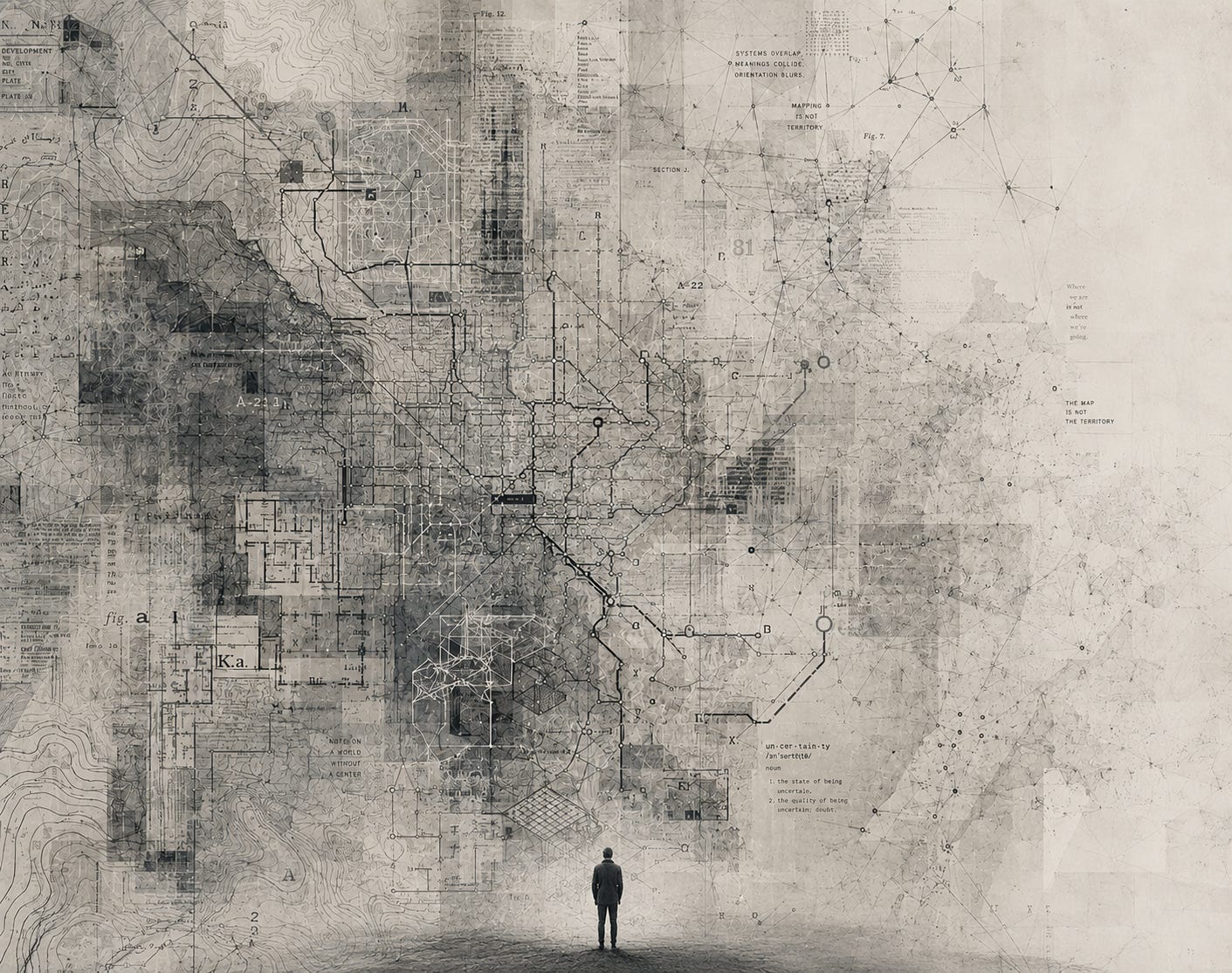
For most of human history, individuals did not carry the full burden of constructing a life on their own.
Religion provided explanations. Communities provided belonging. Traditions supplied identity. Culture offered moral frameworks, social roles, rituals, and narratives that helped people orient themselves within existence. These structures were often imperfect and sometimes oppressive, yet they performed an important function. They absorbed a significant portion of the existential labor required to be human.
Today many of those structures have weakened.
People enjoy unprecedented freedom to choose their beliefs, values, identities, relationships, careers, lifestyles, and worldviews. The expansion of freedom is often celebrated as progress. In many respects it is. Yet something important is frequently overlooked.
Freedom does not eliminate existential burdens. It redistributes them.
Questions once answered collectively become questions individuals must answer for themselves. What gives life meaning? Who am I? How should I live? What should I believe? What matters? How do I face suffering? What makes life worth continuing when certainty disappears?
Modernity did not solve these questions.
It privatized them.
The result is a profound transfer of responsibility from external structures to the individual. Increasing numbers of people are being asked to carry psychological and existential responsibilities that previous generations often shared with religion, culture, family, community, and tradition. Yet society rarely pauses to ask whether people possess the capacities necessary to meet these demands.
This may be one of the defining developmental challenges of our age.
The Developmental Mismatch
Much of modern life assumes that human development occurs automatically.
We assume that if people have access to information, education, opportunity, and freedom, they will naturally acquire the capacities required to navigate existence successfully. Yet experience suggests otherwise.
Many people possess extraordinary levels of knowledge while remaining deeply confused about how to live. We have impressive professional competence while struggling to sustain meaningful relationships. Many enjoy freedoms that previous generations could scarcely imagine while feeling overwhelmed by the responsibility those freedoms create.
Something important has become decoupled.
The structures of modern life have evolved rapidly. Human development has not necessarily kept pace.
Technology has expanded dramatically, but wisdom has not developed at the same rate. Choice now exceeds many people’s capacity for discernment. Freedom has widened faster than responsibility. Connectivity is everywhere, while belonging remains scarce. Information accumulates endlessly, yet understanding struggles to keep pace.
The result is what might be called a capacity gap: a growing discrepancy between the demands of modern existence and the developmental resources required to navigate those demands effectively.
Modernity has expanded the demands placed upon the individual faster than it has expanded the capacities required to meet those demands.
The defining feature of our age is the growing mismatch between what modern life demands and the capacities human beings have developed to carry it.
This helps explain why many forms of contemporary distress cannot be reduced to mental illness, economic hardship, political polarization, or technological disruption alone. These factors matter, but they do not fully explain the experience of disorientation that characterizes modern life.
Many people are navigating conditions that require capacities they were never taught to develop.
The capacity gap rarely announces itself directly. It appears in ordinary life. A person excels professionally yet cannot tolerate uncertainty when a relationship changes. Another consumes endless information yet feels no closer to knowing how to live. Someone enjoys unprecedented freedom while becoming increasingly overwhelmed by choices that previous generations never had to make. Outwardly these struggles appear unrelated. Beneath them lies a common pattern. The demands of modern life have expanded faster than the capacities required to carry them.
Capability Is Not Capacity
Part of the confusion emerges from a distinction that modern culture rarely makes.
Capability concerns what a person can do.
Capacity concerns what a person can hold.
One builds a life. The other enables us to inhabit it.
A person may possess the capability to run a company while lacking the ability to sustain intimacy. They may have the capability to accumulate wealth while lacking the resilience required to tolerate uncertainty. They may exhibit the capability to persuade audiences, lead organizations, solve complex problems, and build successful careers while lacking the capacity to process grief, confront mortality, navigate freedom, or remain psychologically grounded during periods of upheaval.
This imbalance is not accidental. Modern institutions are largely designed to identify, reward, and reproduce capability. Schools measure academic performance. Employers evaluate productivity. Organizations reward results. Markets reward efficiency. Digital platforms reward attention and engagement. Capability produces visible outputs that can be measured, compared, optimized, and scaled.
Capacity operates differently. A person’s ability to tolerate uncertainty, remain present during grief, sustain belonging, exercise restraint, or stay grounded when familiar structures collapse generates no easily quantifiable metric. Capacity often becomes visible only when circumstances become difficult. It reveals itself not through performance but through what a person can carry without avoidance, fragmentation, or retreat into illusion.
As a result, societies become effective at developing capability while paying far less attention to the capacities required to inhabit life well. Yet these capacities determine whether achievement becomes a source of flourishing or a source of exhaustion.
The modern world has become remarkably effective at helping people accomplish, perform, and succeed. It remains far less effective at helping them navigate uncertainty, sustain belonging, carry loss, and remain grounded when familiar structures collapse. Increasingly, the quality of a person’s life depends not only on what they can do, but on what they can hold.
The Capacity for Uncertainty
Few capacities have become more important than the ability to live without certainty.
For much of human history, uncertainty was often contained by shared systems of meaning. Religious traditions, cultural narratives, communal identities, and inherited worldviews supplied answers to fundamental questions about reality, morality, purpose, suffering, and death.
Today many of those answers no longer command universal authority.
Individuals find themselves exposed to competing truth claims, endless streams of information, and a global marketplace of worldviews. The result is not merely greater freedom. It is greater uncertainty.
Many people respond by searching for new forms of certainty. Others attempt to avoid the questions altogether. Still others become trapped in perpetual analysis, endlessly evaluating possibilities while remaining unable to commit themselves to any path.
Yet the challenge is not finding certainty. It is developing the capacity to move forward without it.
Human flourishing does not require certainty. It requires the ability to choose, love, create, and participate despite uncertainty, and to act without guarantees.
The Capacity for Freedom
Freedom is often treated as an unquestioned good. Yet it carries weight.
Every expansion of freedom transfers responsibility onto the individual.
Choice requires judgment. Self-definition requires the capacity to tolerate uncertainty regarding identity. The rejection of inherited answers requires the capacity to construct a life without relying on those answers for orientation.
The burden of self-authorship is substantial. Previous generations often inherited scripts. Modern individuals write their own.
This sounds liberating until one recognizes what authorship entails. Every choice excludes alternatives. Every commitment closes other possibilities. Every identity requires relinquishing identities that might have been. Freedom does not eliminate limits. It requires individuals to participate in creating them.
Many contemporary struggles emerge not because people possess too little freedom, but because they are asked to carry more responsibility for meaning, identity, and direction than previous generations. The challenge is not simply choosing among options. It is learning how to live with the consequences of those choices.
Freedom without capacity can become overwhelming.
Freedom supported by capacity becomes agency.
The Capacity for Belonging
Belonging represents another challenge frequently misunderstood in modern life.
Many people think belonging is something they either possess or lack. In reality, belonging also involves capacity.
Belonging requires vulnerability, emotional honesty, relational presence, trust, reciprocity, and the ability to remain connected without collapsing into dependency or withdrawing into self-protection.
As traditional forms of community weaken, belonging increasingly requires active participation rather than passive inheritance. Individuals can no longer assume that belonging will emerge automatically from shared geography, religion, family structures, or social roles.
This creates a paradox.
Many people long for belonging while simultaneously lacking the capacities required to sustain it.
Belonging is not simply received. It is also a capacity we develop and learn to inhabit.
The Capacity for Reality
Perhaps the most important capacity of all is the capacity for reality itself.
Human beings possess a remarkable ability to construct interpretations that protect them from discomfort. We create stories, ideologies, identities, certainties, and explanatory systems that help us feel safe in a world that often refuses to provide guarantees.
These structures can be useful. They can also become barriers to reality.
Human beings do not merely seek truth. They also seek psychological shelter. Throughout history we have constructed systems of meaning that reduce uncertainty, protect identity, manage anxiety, and create a sense of order within an unpredictable world. Religion often serves this function. So do political ideologies, cultural narratives, personal mythologies, and even certain forms of self-help and therapeutic thinking.
Most human beings do not exchange reality for illusion because they are irrational. They do it because reality can be costly. Certainty feels safer than ambiguity. Identity feels safer than openness. Belonging feels safer than questioning. Every person eventually encounters moments when reality threatens something they depend upon psychologically. The developmental question is not whether this tension appears. It is whether a person can remain in contact with reality when reality becomes inconvenient, destabilizing, or painful.
The problem is not that human beings seek shelter. Psychological shelter is often necessary. The problem emerges when shelter becomes more important than reality itself. A subtle shift occurs. The function of a belief system changes from helping a person engage reality to protecting them from aspects of reality they do not wish to encounter. The desire for certainty begins to override the pursuit of truth. Identity becomes more important than inquiry. Coherence becomes more important than contact.
Much of human development can be understood as a gradual expansion of one's contact with reality. The challenge is not merely learning new information or replacing old beliefs with better ones. It is developing the ability to encounter uncertainty without demanding guarantees, loss without denial, ambiguity without premature closure, and complexity without retreating into simplistic explanations. Existential maturity requires an increasing willingness to exchange psychological shelter for reality contact.
The challenge of development is not merely acquiring better beliefs. It is increasing one’s capacity to remain in relationship with reality even when reality disrupts preferred narratives.
This includes the capacity to encounter loss without collapsing, ambiguity without demanding premature certainty, disagreement without requiring enemies, mortality without denial, and change without disintegration.
Reality contact is not a belief system.
It is a developmental achievement.
The future will favor those capable of sustaining contact with reality amid complexity, uncertainty, and transformation.
Seen from this perspective, many of the struggles that define contemporary life begin to look different. The problem is not simply that people lack information, resources, freedom, or opportunity. Increasingly, it’s developmental. Modern life places unprecedented existential demands upon individuals while providing few environments dedicated to cultivating the capacities required to meet those demands. The result is a growing gap between the world human beings have created and the developmental capacities required to inhabit it.
Existential Health and the Future of Human Development
The language of health has traditionally focused on physical and psychological functioning. Both remain essential. Yet neither fully addresses the developmental demands emerging within contemporary life.
Physical health concerns the body’s capacity to function. Psychological health concerns the mind’s capacity to function. Existential health concerns the human person’s capacity to engage reality, freedom, uncertainty, meaning, belonging, responsibility, and mortality without becoming overwhelmed by them.
From this perspective, existential health is not a belief system, worldview, or philosophy. It is a developmental domain. Just as physical health concerns the condition of the body and psychological health concerns the condition of the mind, existential health concerns the developmental requirements necessary to navigate the fundamental conditions of human existence.
These include the abilities that allow human beings to engage reality without requiring certainty, exercise freedom without becoming overwhelmed by responsibility, construct meaning without self-deception, sustain belonging without losing themselves, and face mortality without surrendering to despair.
The encouraging reality is that these capacities are not fixed traits. They can be developed. Human beings can increase their tolerance for uncertainty, deepen their capacity for belonging, strengthen their ability to exercise freedom responsibly, and cultivate greater contact with reality. The challenge is that such capacities rarely emerge automatically. They require practice, reflection, relationships, experiences, and developmental environments that support their growth. The question is not whether these capacities can be cultivated. It is whether modern societies will begin treating their cultivation as seriously as they treat the development of knowledge, skills, and technical competence.
Capacities develop differently than skills. Skills often emerge through instruction and repetition. Capacities are usually expanded through experience. We increase our capacity for uncertainty by facing uncertainty rather than avoiding it. We deepen our capacity for belonging through relationships that require vulnerability. We strengthen our capacity for reality by repeatedly choosing contact over comfort when the two come into conflict. Development rarely occurs through information alone. It occurs through sustained engagement with the very conditions we are learning to carry.
These capacities are not luxuries reserved for philosophers, spiritual practitioners, or therapists. They are becoming necessities for ordinary life.
The question beneath many contemporary crises may therefore be developmental. We have built a world that demands unprecedented levels of existential capacity while investing comparatively little in cultivating those capacities. The resulting gap shapes how individuals experience freedom, meaning, belonging, and reality itself.
The central challenge of the twenty-first century may not be technological, political, or economic alone. Beneath each of these domains lies a deeper developmental question.
The future will not belong primarily to those who possess the strongest beliefs, the most information, or the greatest technical competence. Increasingly, it will belong to those who can remain grounded amid uncertainty, adaptive amid change, connected amid fragmentation, and open to reality without demanding that reality conform to their preferences.
The defining challenge of modern life is not simply discovering better answers. It is becoming the kind of person capable of living well when many of the old answers no longer carry us. That work cannot be outsourced.
Modern life has given us extraordinary power. We can communicate across continents, reshape ecosystems, alter genomes, create artificial intelligence, and transform entire societies. Yet none of these achievements answer the developmental question beneath them.
Can we develop the capacities required to live responsibly with the power we have created?
The defining challenge of our age is not merely what we can build.
It is whether we can become large enough to inhabit what we have built without losing ourselves.
If this article resonates with you, consider becoming a paid subscriber ($50 annually). Your subscription helps support the ongoing development of existential health as a framework, practice, and community. In addition to supporting this work, you’ll receive complimentary membership in the Center for Non-Religious Spirituality (CNRS), including access to workshops, discussion circles, support groups, Sunday gatherings, monthly Q&A sessions, and the Existential Health Daily Reader.
It seems that what you are saying is that people are being asked to grow up spiritually and emotionally. I agree.
The capability-capacity distinction cuts deep – and I think there's a clarifying contribution to be made here.
Capacity isn't one thing. There are structurally different capacities with their own developmental conditions:
the ability to regulate,
to build genuine belonging,
to act effectively – and perhaps the rarest of all – to genuinely explore without an outcome imperative.
But what societies actually develop isn't simply action-capacity. It's action-capacity systematically coupled with fear. Avoid failure, secure status, don't fall behind. That's not a side effect – that's the design. Performance from protective mode rather than from genuine agency.
What makes this so stubborn is the identity coupling. When identity is built primarily from action, and that action is coupled to protection, a self-reinforcing loop starts turning. Every threat to that identity activates the protective mode – which suppresses connection and exploration – which deepens the monoculture further. The system actively defends its own narrowness. Not from unwillingness. Because the identity structure itself is at stake.
I come from an environment that didn't have these collective structures. It took decades to understand why this combination alone doesn't hold. What actually helped wasn't more action – it was slowly building the other capacities, with the right people, under the right conditions.
And what I learned in that process: capacity development doesn't simply happen through exposure. The system has to be in a state that allows integration in the first place. That's the missing layer in almost every approach to this topic – including very good ones like this.