

The Day Utopia Died
Debunking Secular Salvation


We didn’t abandon religion. We translated it. The language changed. The structure didn’t. We still believe history is going somewhere, that things are improving in some deep, moral sense, that the future will resolve what the present cannot. We just no longer call it God. We call it progress.
This is the illusion John Gray dismantles in Black Mass: Apocalyptic Religion and the Death of Utopia. What he exposes is not just a philosophical mistake, but the quiet persistence of salvation thinking in secular form. Modern political ideologies are not alternatives to religion. They are its continuation, stripped of theology but driven by the same promise: that something, somewhere, will finally make this all come together.
This is what makes this moment more significant than it appears. Because what we are witnessing is not just the failure of political systems or ideological projects.
It is the collapse of the expectation that anything is going to save us.
The day utopia died was not a historical event. It is an ongoing realization. One that most people are still resisting.
But John Gray’s analysis doesn’t go far enough. Because the deeper issue is not just that we believe these utopian narratives. It’s that we need them. Gray exposes the illusion. He does not explain why it persists.
Human beings are not primarily truth-seeking or power-seeking. We are anxiety-regulating. We are trying to live inside a reality that is uncertain, unresolved, and uncontrollable. Beneath that effort are the givens we cannot escape: we are finite and will die, we live without ultimate ground or guarantees, we are never fully satisfied, we are unavoidably alone in our own experience, and we suffer.
These are not problems to solve but conditions to live within. And so we build systems that organize experience, reduce ambiguity, and promise closure. Religion did this explicitly. Modernity does it implicitly. The forms change. The function does not. The wheels on the bus…
What John Gray Exposed
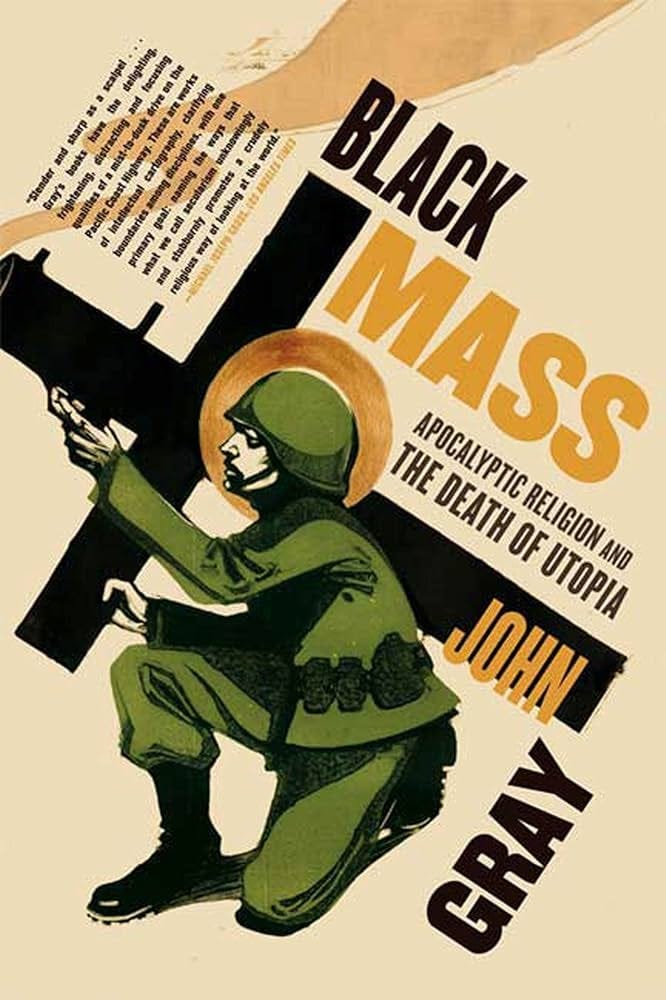
To see how deeply this pattern runs, it helps to look at one of its clearest critics. John Gray is a political philosopher who has spent much of his career dismantling one of modernity’s most protected assumptions, that history is moving forward in any meaningful moral sense. His work consistently cuts against both secular optimism and religious certainty, arguing that human beings remain as conflicted, unstable, and self-divided as ever. He is not offering a better version of progress. He is questioning whether progress, as we imagine it, exists at all.
In Black Mass: Apocalyptic Religion and the Death of Utopia, Gray makes a decisive move. He argues that what we call modern, secular thinking is not actually secular. It is a translation. The core structure of religious salvation has been preserved and relocated into politics, culture, and ideology. The belief that history is moving toward a final answer, that disorder will be overcome, that human life will eventually be made coherent, has not disappeared. It has simply changed language. God is removed. Progress takes his place. Heaven becomes utopia. Salvation becomes political.
Keep reading with a 7-day free trial
Subscribe to Deconstructionology with Jim Palmer to keep reading this post and get 7 days of free access to the full post archives.