


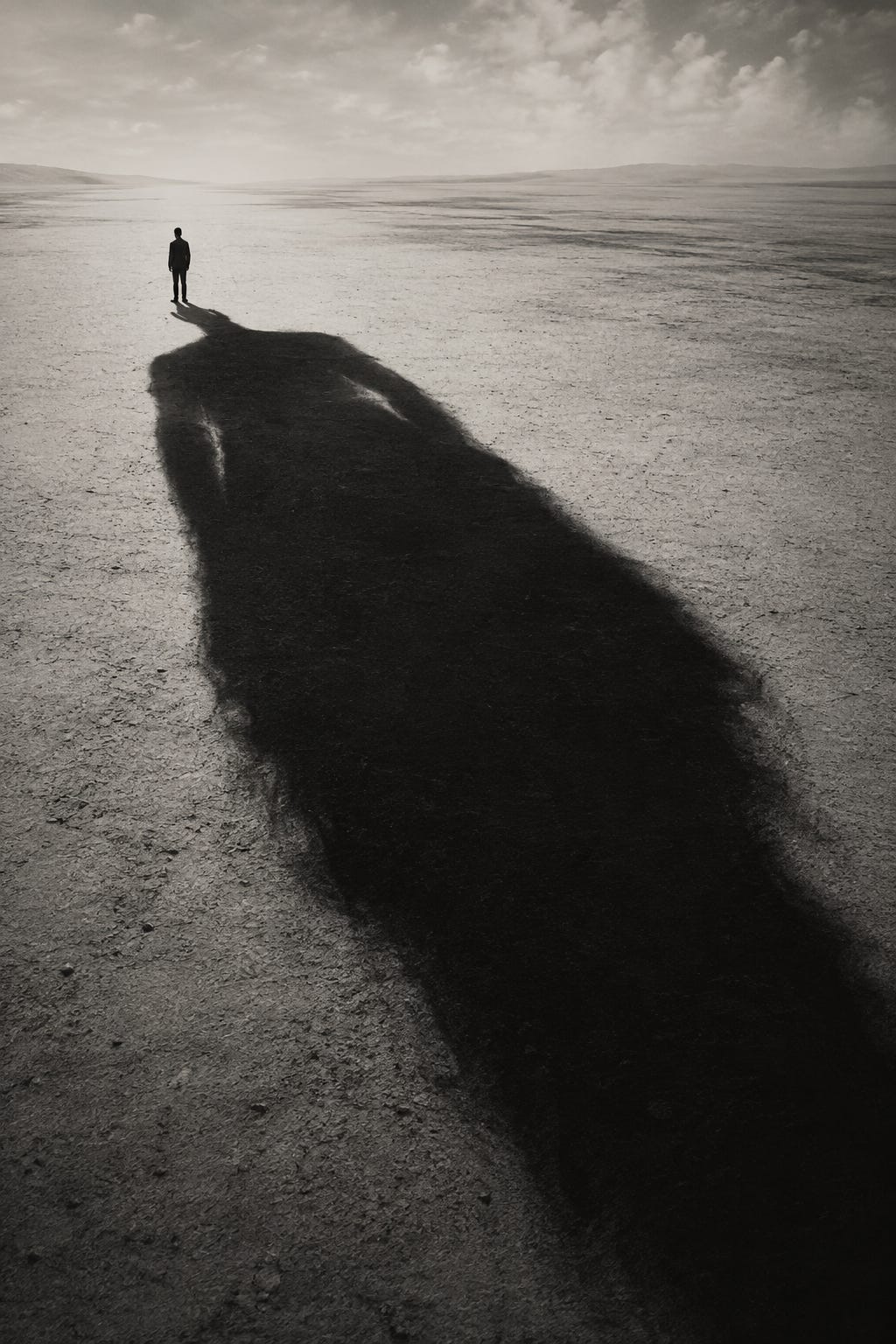
The Authority We Have Given Death
There is something strange about the authority we have given death.
We speak of death as though the end of life reveals something that living itself cannot. We imagine that our ending somehow discloses the truth of our existence, that mortality exposes what ultimately matters, and that the certainty of our disappearance provides the proper scale against which everything else should be measured.
Religious traditions have built entire architectures of salvation around human mortality. Philosophers have treated finitude as the horizon that awakens us to authentic existence. Nihilism invokes our eventual extinction as evidence against ultimate meaning. Even secular self-help regularly summons the end to discipline us into living more deliberately: remember that you will die, imagine yourself in your final days, ask what you will regret when they arrive.
Across otherwise incompatible worldviews, death keeps receiving the final word.
I want to question that arrangement.
Death is one of the deepest facts of being alive. It shadows every attachment because everything we love is vulnerable to disappearance. It limits our time and makes certain losses irreversible. Any account of human existence that refuses mortality eventually becomes dishonest about the conditions under which we live.
But taking mortality seriously is different from making it the interpretive center of existence.
I use the word thanatocentrism for this tendency: placing death at the center of our understanding of life and granting it disproportionate authority over meaning, value, urgency, and significance. Thanatocentrism does not simply acknowledge that we die. It turns our ending into the standpoint from which life is understood.
Beneath much of Western thought sits an assumption we rarely examine: mortality somehow possesses special authority over life. We have spent centuries asking what death means for existence, and far less time asking why we granted the ending that authority.
When Life Had to Defeat Death
Human beings have always lived among the dead. Long before systematic theology or philosophy, people buried bodies, mourned losses, preserved memories, tended graves, told stories about ancestors, and imagined continuities between the living and those who had disappeared. Mortality is not an intellectual discovery. It is among the oldest realities of human consciousness.
Something consequential happens when death moves from being a condition of being human to becoming the central problem life must overcome.
Much of Christianity developed within this architecture. Human experience became situated inside a larger drama in which mortality was not merely biological cessation but a theological crisis, entangled with sin, judgment, salvation, resurrection, heaven, hell, and eternal destiny. The stakes of earthly life extended infinitely beyond its temporal boundaries. What happened during a few decades in this world could determine what happened forever.
This arrangement gave the ending extraordinary interpretive power. Living became preparation. Decisions became eternally consequential. Belief became a matter of ultimate destiny. The present acquired meaning partly through its relationship to what supposedly awaited beyond it.
Christianity is hardly alone in developing responses to mortality, and its traditions contain far richer understandings of incarnation, creation, justice, love, community, and embodied existence than any single characterization can hold. Still, one strand of Western religious consciousness became deeply organized around the proposition that our ending presents a problem requiring metaphysical resolution.
The promise of eternal life answers that problem brilliantly. Death does not win. Separation is temporary. The self survives. Love continues. Justice eventually arrives. The grave loses its finality.
Yet notice what remains unquestioned beneath the consolation: mortality is still setting the terms.
Life requires eternity because its ending would otherwise threaten its ultimate significance.
Death After Religion
The decline of traditional religious authority did not remove mortality from the center of Western consciousness. In many cases, it intensified the problem.
When heaven disappears, death does not disappear with it.
The secular person inherits the same biological ending without the metaphysical architecture that once contained it. There may be no continuation of consciousness, cosmic reunion, resurrection of the body, divine judgment, or ultimate restoration. The person dies, the body decomposes, generations pass, memories disappear, civilizations vanish, stars exhaust their fuel, and eventually even the physical conditions that made human existence possible cease to exist.
Against this scale, an old question returns with greater force: if everything ends, what was any of it for?
The question feels almost self-evident because thanatocentrism is already embedded inside it. The ending is assumed to possess the authority to determine the value of everything preceding it. Permanence becomes the hidden criterion of significance. What does not last forever begins to appear vulnerable to the accusation that it never ultimately mattered.
This is an astonishing standard.
Almost nothing we value is held to this standard. Music does not need to play forever to matter, and a conversation can alter the course of a life in an hour. Childhood retains its significance after it has passed, just as decades of friendship remain real after one person dies. Even civilizations that eventually disappear leave behind consequences woven into lives they will never see. Impermanence does not reach backward and cancel what occurred.
Experience occurs within time. Its impermanence belongs to its structure.
Yet when the scale expands toward cosmic extinction, we often abandon the standards by which significance ordinarily functions and demand something impossible: permanence as proof of meaning.
Death has once again been invited to judge life.
When the Ending Decides
Nihilism often presents itself as the courageous willingness to face what religion cannot: there is no cosmic guarantee that human life matters.
That insight deserves to be taken seriously. The universe does not appear obligated to provide us with a metaphysical certificate of significance. Stars explode without consulting human values. Species disappear. Geological time dwarfs civilizations. The cosmos seems largely indifferent to whether human beings flourish, suffer, love, create, destroy one another, or disappear altogether.
The difficulty begins when cosmic indifference is converted into existential insignificance.
The argument frequently proceeds almost unnoticed. Human beings are temporary. Humanity will eventually disappear. The universe will continue without us. Therefore, nothing possesses ultimate significance.
But the conclusion contains a criterion that the premises never establish. Why should permanence determine significance? Why should cosmic recognition be necessary for human value? Why must the universe validate something for it to carry significance within the lived reality where value actually arises?
Nihilism can therefore preserve the architecture it believes it has escaped. Religion says death must be overcome for life to possess ultimate meaning. Nihilism says that because death cannot be overcome, ultimate meaning collapses. Their conclusions differ dramatically, but the deeper premise remains surprisingly similar.
Death gets the final vote.
Existential Health begins somewhere else. It asks whether the entire referendum was necessary.
Heidegger and the Privilege of Death
Any serious discussion of death and existential thought eventually encounters Martin Heidegger.
Martin Heidegger (1889–1976) was a German philosopher whose work profoundly shaped existentialism and phenomenology, particularly through his exploration of being, mortality, and the conditions of human existence. His analysis of Being-toward-death remains one of the most influential attempts to understand mortality as fundamental to being human.
For Heidegger, death is not simply an event waiting at the chronological end of life. Awareness of mortality shapes the structure of existence in the present. My death is uniquely mine. No one dies it for me. Confronting this possibility ruptures the anonymous habits through which I disappear into what “one” does, believes, values, and expects. Mortality individualizes. It exposes the borrowed nature of a life and confronts a person with the responsibility of existing as their own possibility.
There is tremendous insight here. Mortality does interrupt abstraction. The recognition that our time is finite exposes forms of existential deferral in which we endlessly postpone participation in our own lives. Death clarifies.
But clarification does not establish sovereignty.
Why should mortality possess greater revelatory authority than birth? Why should the impossibility of my continued existence reveal more about being than my radical dependence upon others? Why privilege death over embodiment, consciousness, attachment, vulnerability, desire, play, suffering, creativity, relationship, ecological belonging, or the sheer contingency of finding oneself here at all?
Being-toward-death captures something essential about human existence. The danger arises when an essential dimension becomes the privileged interpretive horizon.
Human beings are beings-toward-death. We are also beings-from-birth, beings-in-bodies, beings-with-others, beings-dependent-upon-worlds, beings-capable-of-love, beings-vulnerable-to-loss, beings-who-create, beings-who-destroy, beings-who-participate.
Death tells the truth about us.
It does not tell the whole truth.
The Architecture of Immortality
Psychology approaches the problem from another direction. Terror management theory, drawing partly from Ernest Becker’s work, argues that awareness of mortality generates a distinctive psychological predicament. Human beings possess enough cognitive capacity to understand that they will die while simultaneously carrying powerful biological impulses toward survival.
Culture helps manage this contradiction.
Worldviews locate individuals inside systems of significance larger than their biological lives. Religions promise literal immortality. Nations, families, institutions, movements, artistic works, reputations, achievements, and historical identities can provide forms of symbolic immortality. Something bearing our name, values, genes, influence, or story continues after the organism disappears.
Becker’s great insight was that much human striving cannot be understood apart from mortality consciousness. Civilization itself carries traces of our attempts to become significant enough to withstand disappearance.
Yet the insight becomes even more interesting when reversed.
What if some of our immortality projects reveal not only our fear of death but our assumption that death possesses the power to invalidate us?
The desperate need to leave something behind makes sense only if disappearance has been granted enormous interpretive significance. Legacy becomes a negotiation with extinction. Achievement becomes evidence submitted against oblivion. Fame promises continuation in other minds. Children become carriers of identity. Institutions preserve names. Monuments resist erasure.
None of these things are inherently pathological. Creating something that survives us can be beautiful. Caring about future generations is among the most expansive capacities human beings possess. The difficulty begins when continuation becomes necessary to justify having existed.
A human life should not have to defeat disappearance to earn the right to have mattered.
The Deathbed Is a Courtroom
Our culture contains a softer version of the same logic.
Imagine yourself on your deathbed.
The exercise appears everywhere in contemporary discussions of purpose, asking us to imagine which regrets will remain, what will have mattered, whether we spent our time well, which risks were worth taking, and which relationships will still seem important when everything else falls away.
There is wisdom in allowing finitude to disrupt triviality. A limited amount of time changes the structure of choice. We cannot pursue every possibility, maintain every relationship, inhabit every identity, or indefinitely postpone difficult decisions. Mortality places boundaries around participation.
But the deathbed is not an infallible tribunal.
The dying version of me is still one version of me, situated within extraordinary circumstances. Why should that person’s perspective possess greater authority than the person who loved breakfast with his children, became absorbed in meaningless play, spent an afternoon reading a novel, wandered through a city without accomplishing anything, or devoted years to something that eventually failed?
We have turned the imagined final moments into a courtroom where everything that came before appears for judgment.
A human life is larger than its final evaluation.
Some things possess significance simply because they were lived.
The Demand for Permanence
Beneath thanatocentrism lies another assumption: significance must somehow survive the destruction of the thing that carries it.
We rarely state this explicitly because doing so exposes how strange it is.
Suppose two people love each other deeply for forty years. Their relationship shapes their identities, bodies, memories, decisions, friendships, families, vulnerabilities, and experience of the world. Eventually both die. Centuries later, no living person remembers their names.
What exactly has been invalidated?
Nothing about their eventual disappearance changes the reality that existed between them. Their love does not require an eternal witness to certify that it happened. The universe does not need to remember them. Their relationship participated in reality while they were here.
The same applies to suffering. If someone experiences cruelty, the eventual extinction of humanity does not make that suffering less real. We would find it morally grotesque to tell a tortured person that their pain does not ultimately matter because the sun will eventually consume the earth. Cosmic scale is irrelevant to the reality of experience.
Strangely, we understand this more readily with suffering than with joy, love, beauty, or significance.
Pain is allowed to possess significance without permanence.
Why isn’t love?
Mortality Without Rescue
An Existential Health approach does not need to solve death.
For much of human history, our systems of meaning have attempted to place mortality inside an explanation. It becomes transition, punishment, liberation, reunion, reincarnation, passage, transformation, return, awakening, or entry into another dimension of reality. Even secular philosophies sometimes convert finitude into instruction, insisting that death teaches urgency, authenticity, gratitude, or perspective.
We seem uncomfortable allowing mortality to remain what it is: an immense and partially unknowable feature of being alive.
There are things we know. Organisms die. Bodies cease functioning. Relationships are severed. Those who remain experience absence. There are also things we do not know with the certainty our metaphysical systems often claim. The ultimate nature of consciousness, whether anything continues beyond biological death, and whether reality possesses dimensions unavailable to our present forms of knowing remain unresolved questions.
Existential Health does not require premature closure.
Symbolic sobriety is important here. We are capable of inhabiting mortality without forcing it into either religious certainty or materialist certainty beyond what our knowledge supports. Grief does not need to become a lesson, nor must finitude provide a philosophy.
Death is difficult enough without requiring it to explain life.
From Death Awareness to Reality Contact
The alternative to thanatocentrism is not life-centrism in the sentimental sense. It is not an insistence that life is beautiful, that every moment should be treasured, or that awareness of mortality ought to make us grateful.
Existence includes cruelty, boredom, terror, disappointment, absurdity, beauty, tenderness, monotony, ecstasy, illness, injustice, intimacy, confusion, and loss. Reality contact requires sufficient capacity to remain in relationship with this larger field without demanding that one dimension explain all the others.
Mortality belongs inside that field.
The crucial shift is from organizing life around death to allowing mortality to occupy its actual place among the conditions of being alive.
This changes the existential question. Instead of asking how life matters if it ends, we might investigate how significance actually arises within lived existence. Rather than asking whether love survives death, we might examine what love does while it is occurring. And rather than demanding that consciousness continue forever before becoming valuable, we might attend to the astonishing fact that experience exists now.
Existential Health is concerned with our capacity to inhabit reality rather than our ability to secure reality against loss.
Mortality therefore becomes an issue of capacity rather than metaphysical resolution. It asks whether we can remain present to a world in which everything we love is vulnerable, form attachments without demanding permanence, participate fully while knowing participation will end, encounter grief without forcing it to become meaningful, and live within the limits of what we know about death without filling those limits with borrowed certainty.
These are not problems to solve. They are dimensions of being human to become capable of holding.
Death Does Not Create Significance
There is a popular idea that mortality gives life meaning.
It sounds profound because scarcity does alter value. A limited number of days affects how we choose to spend them. Knowing that an encounter will end changes our experience of it. Finitude creates boundaries, and boundaries shape attention.
But claiming that our ending is the source of meaning goes too far.
Mortality does not create the significance of holding someone’s hand or generate the value of friendship. Nor does finitude manufacture beauty, curiosity, pleasure, justice, creativity, or belonging. These emerge through forms of relationship and participation that possess their own structures of significance.
If human beings were immortal, our relationship with time would be radically different. Certain choices might lose urgency. Commitments could take other forms. But it does not follow that nothing could matter. Conscious beings could still suffer. They could still care for one another. They could still encounter beauty, betrayal, discovery, attachment, conflict, creation, and transformation.
Death modifies significance.
It is not its source.
Without this separation, we remain dependent upon mortality even when trying to celebrate life. Death becomes the dark background required to make existence luminous.
Life does not need death’s permission to be vivid.
The Universe Is Not the Audience
Thanatocentrism frequently joins forces with cosmic thinking.
From the perspective of the universe, we are insignificant.
The statement sounds scientific but contains a category mistake. The universe, as far as we know, does not possess a perspective from which human significance is being evaluated. Galaxies do not rank our relationships. Black holes do not assess our moral achievements. Cosmic time does not issue verdicts about whether civilizations were worthwhile.
Perspective belongs to beings capable of perspective.
Human beings are tiny relative to galaxies. We are brief relative to geological time. These are statements about scale, not significance.
A newborn child is smaller than a mountain. This tells us nothing about which one matters more to a grieving parent. A human brain occupies an almost negligible fraction of the physical universe, yet within that small biological structure a conscious experience of reality arises in forms we are still struggling to understand.
Scale and significance belong to different categories.
The universe does not need to care about us for care to exist within the universe.
That may be one of the most consequential shifts available after the collapse of traditional metaphysical guarantees. We no longer need to imagine ourselves cosmically central in order to recognize that significance is real. Neither divine favoritism nor cosmic permanence is required.
Significance arises wherever beings capable of valuing encounter one another and the world.
Life Without an Alibi
There is a difficult freedom in relinquishing death’s interpretive sovereignty.
Religion often provides an alibi for being alive: our time here belongs inside another world, another story, another plan. Nihilism offers an inverted alibi: because no ultimate guarantee exists, our inability to establish final meaning is already explained.
Both positions can protect us from the more exposed condition of participation.
A life without alibi has no metaphysical guarantee that everything will turn out to have meant something. There may be losses that remain losses. Projects fail. Relationships end without reconciliation. People die before understanding what happened to them. Entire lives can contain enormous suffering without yielding a redemptive arc.
Existential Health does not require turning these realities into evidence for optimism.
Its wager is more modest and, in another sense, more demanding. Reality does not need to justify itself before we participate in it.
We are already here.
We are already implicated.
Our bodies already belong to ecological systems older than our species. Our identities already arise through relationships we did not choose. Our actions already alter the worlds of other people. Our attention already selects which dimensions of existence become available to us. Our capacity to participate is being exercised before we formulate a theory explaining why participation matters.
Meaning does not have to descend upon this situation from eternity.
Significance is already happening inside it.
Death in Its Place
None of this makes death small.
Anyone who has watched someone disappear from the world knows the enormity of the loss. A single absence may reorganize an entire family, dividing life into before and after. Rooms, calendars, identities, rituals, friendships, beliefs, bodies, and futures are altered. The absence of one person sometimes occupies more psychological space than the presence of hundreds.
The critique of thanatocentrism should never become an intellectual strategy for minimizing grief.
I have encountered this reality outside philosophy. As a first-responder chaplain, I arrived at scenes where someone had died and the ordinary world had been abruptly divided into before and after. There is nothing theoretical about standing near people whose lives have just been altered by a fatality. The shock, disbelief, grief, and irreversible absence resist abstraction.
Those experiences are part of why I would never want this argument to diminish the enormity of mortality. But they also taught me something about where that enormity comes from. The tragedy was not that an abstract principle called death had asserted its authority. The tragedy was that someone had been here and was suddenly gone. Someone belonged to others. Someone occupied a place in the world that could not simply be filled by another person. The ending carried such weight because of everything that preceded it.
Its significance comes from what has been lost.
The direction of explanation is important.
We do not value people because they will die. Their loss devastates us because they were already valuable. Mortality does not confer significance upon relationship. Relationship gives our eventual loss much of its existential weight.
This reversal changes everything.
Mortality is no longer sovereign over the meaning of life. Instead, what we experience while living explains why death carries such weight.
Mortality remains profound, frightening, mysterious, biologically decisive, emotionally devastating, and philosophically inexhaustible. It simply loses the authority we have unnecessarily granted it.
After Thanatocentrism
Human beings will continue asking what happens when we die. We should. The question arises naturally from consciousness confronting its own apparent limit. Religious traditions will continue offering answers. Philosophers will continue examining finitude. Scientists will continue studying consciousness, dying, decomposition, and the biological structures that sustain experience.
The task is not to eliminate the question of death.
It is to stop allowing that question to consume the question of life.
Existential Health begins with a different orientation. Before asking what survives us, we might become more capable of inhabiting the life already occurring. Rather than demanding guarantees of permanence, we might examine the forms of participation through which significance emerges. And instead of measuring our lives against eternity, we might become more attentive to the relationships, bodies, places, responsibilities, pleasures, wounds, communities, and worlds through which being alive actually happens.
There is no need to defeat death philosophically in order to live.
Nor must we transform mortality into a teacher whose every lesson deserves obedience. Finitude does not automatically make us wiser. It cannot tell us whom to love, what justice requires, how to repair what we have damaged, what kind of civilization we should build, or what forms of being deserve protection. Those questions belong to the living.
For centuries, we have asked whether life can withstand its own ending.
A more revealing question now presents itself: Why did we ever imagine that mortality was qualified to determine the value of our time here in the first place?
The end will come when it comes. Until then, mortality occupies its place among the conditions of being human, immense but not sovereign.
The work of being alive belongs to the living.
Author’s Note & Further Reading
For readers who want to explore some of the intellectual background to this essay, Heidegger’s Being and Time and Ernest Becker’s The Denial of Death are important reference points. I’ve also been thinking and writing about mortality, meaning, and our relationship with finitude for some time. You can find several related essays below.
I’ve been thinking and writing about mortality for some time. Two earlier essays approach the subject from different directions:
Tick-Tock, Tick-Tock: Afraid to Die and the Search for the Immortality Formula
An exploration of our fear of dying and the many ways human beings attempt to negotiate with impermanence, from religious promises of an afterlife to the search for other forms of continuation.
The Gift of Mortality: Why Human Beings Are Not Built for Forever
A different angle on finitude: what if mortality is not simply a problem to overcome, but part of the structure that gives shape to a human life? This essay considers what endless existence might do to urgency, attachment, choice, and our experience of being alive.
If you enjoy this work and would like to support its continuation, consider becoming a paid subscriber ($50 annually). Your support helps me continue developing the emerging field of Existential Health and building the work of CNRS. Paid subscribers also receive complimentary CNRS membership and access to its growing community, programs, and conversations.
I found Jim Palmer’s article on death a valuable contribution to the debate
Let me say, with the greatest respect I without wanting to be patronising than there is real intelligence at work here. I therefore merely intend to point out where the intelligence has outrun the argument to augment the debate not demolish it in any way
The first is in the Heidegger section. The rhetorical questions there, “why should mortality possess greater revelatory authority than birth, why not embodiment, why not dependence,” are good questions. But a question is not a refutation, and the essay never actually supplies the missing argument for why these alternative horizons are equally or more revelatory than death. It simply lists nouns, “beings-from-birth, beings-in-bodies, beings-with-others,” as though enumeration were demonstration.
Heidegger at least tried to show why death in particular individuates in a way birth cannot, since I did not experience my own birth as mine but will, in some sense, experience my own dying as mine. The essay never engages that asymmetry. It just multiplies categories and moves on.
The second problem comes in “The Demand for Permanence,” with the forty-year marriage. The passage asks what exactly has been invalidated once both parties are dead and forgotten, then answers, nothing. But that is the conclusion the nihilist denies, not a proof against him. Describing the scenario sympathetically and then declaring the verdict is not an argument, it is a mood dressed as one. The essay needed an account of why lived reality confers value independent of any witness, permanent or otherwise, and instead I get “their relationship participated in reality while they were here,” which restates the claim rather than grounding it.
The third break is “The Universe Is Not the Audience.” The observation that the cosmos has no standpoint from which to judge us is true and, frankly, trivial, nobody serious thinks Andromeda is filing verdicts. But the essay then slides from “the universe cannot judge us”, to which I wholeheartedly agree, to “therefore scale is irrelevant to significance,” and that inference does not follow.
Scale might be irrelevant to significance for reasons that need arguing, instead the essay treats the grammatical point about the universe lacking a perspective as though it settled the metaphysical one about whether smallness in time diminishes worth. That is the whole nihilist challenge, dispatched by category shift rather than confronted.
What ties the three problems together is that each time the essay reaches the load-bearing claim, it substitutes a redescription of the difficulty for a resolution of it.
That is not fatal to the project, redescription can be genuinely clarifying, and this piece often is. But I would stop calling it philosophy at those junctures and start calling it what it actually is there, eloquent reassurance.
The article is a curious case of arriving at a Stoic conclusion while perhaps rejecting the Stoic method.
Marcus Aurelius did not need a metaphysics of permanence to tell him that death was “according to nature,” nor did Epictetus need eternity to certify that a well-lived hour was already complete in itself. The Stoics got to “significance does not require permanence” two thousand years before this author did, and got there faster, because they simply refused the premise that the universe owes life a verdict. Memento mori, in Stoic hands, was never a threat to be defeated; it was a fact to be metabolise d so that I could stop postponing the only life I actually have.
The essay wants this exact sobriety, while treating “remember you will die” as part of the thanatocentric problem it is diagnosing. It has, in other words, reinvented the Handbook of Epictetus and then filed a complaint against its author.
The psychology is more honestly handled, though there is some minor sleight of hand.
Terror management theory is invoked correctly, Becker’s insight that civilisation is partly an elaborate hedge against oblivion is sound and well supported. But the essay’s own twist, that our immortality projects reveal not fear of death so much as a prior assumption that death has the authority to invalidate us, is an inference dressed as a discovery. It may be true. It is also exactly the way psychoanalytic claims usually are, convenient, elegant, and impossible to test against a control group of humans who never feared dying.
The chief merit of the article is structural, and it is a real one. The essay identifies a common move across four incompatible worldviews, Christian salvation, Heideggerian authenticity, nihilism, and pop self-help memento mori exercises, and shows that all four grant death the same unearned authority to adjudicate life’s worth.
That is a genuine piece of intellectual pattern recognition, the kind of thing that looks obvious once stated and was not obvious before. Watching the essay walk the same skeleton through four different costumes is the strongest sustained argument in the piece.
The second merit is the reversal in “Death in Its Place”: that we do not value people because they will die, we grieve because they were already valuable, and mortality only borrows its weight from what preceded it.
This is not new, we hears its cousin in Epicurus and in every decent eulogy ever delivered, but the essay states it cleanly and lets the chaplain anecdote carry it rather than over-arguing it. That restraint, rare elsewhere in the piece, is itself a mark of quality.
Third, the essay is honest about its own limits in a way many popular philosophy pieces are not. It explicitly declines to resolve what happens after death, calls this “symbolic sobriety,” and refuses the easy exits of either religious certainty or flat materialism. Refusing to manufacture false closure, while still writing seven thousand words on the subject, is harder than it sounds, and the essay largely manages it. I would call that its most underrated achievement.
I hope this analysis will be received in a manner. It is intended.
Yin and Yang; Life and Death. You cannot have one without the other. Once humans- or our evolutionary descendants- learn to keep individual consciousness/awareness alive indefinitely, then we will have a whole new ball game. For now, it’s Yin and Yang , just the way things are. At 75, I realize how precious are my remaining days. So long as my health holds up, I plan to savor each and every one.