

Stone-Cold Absurd
Living Life with No Answers and No Refunds

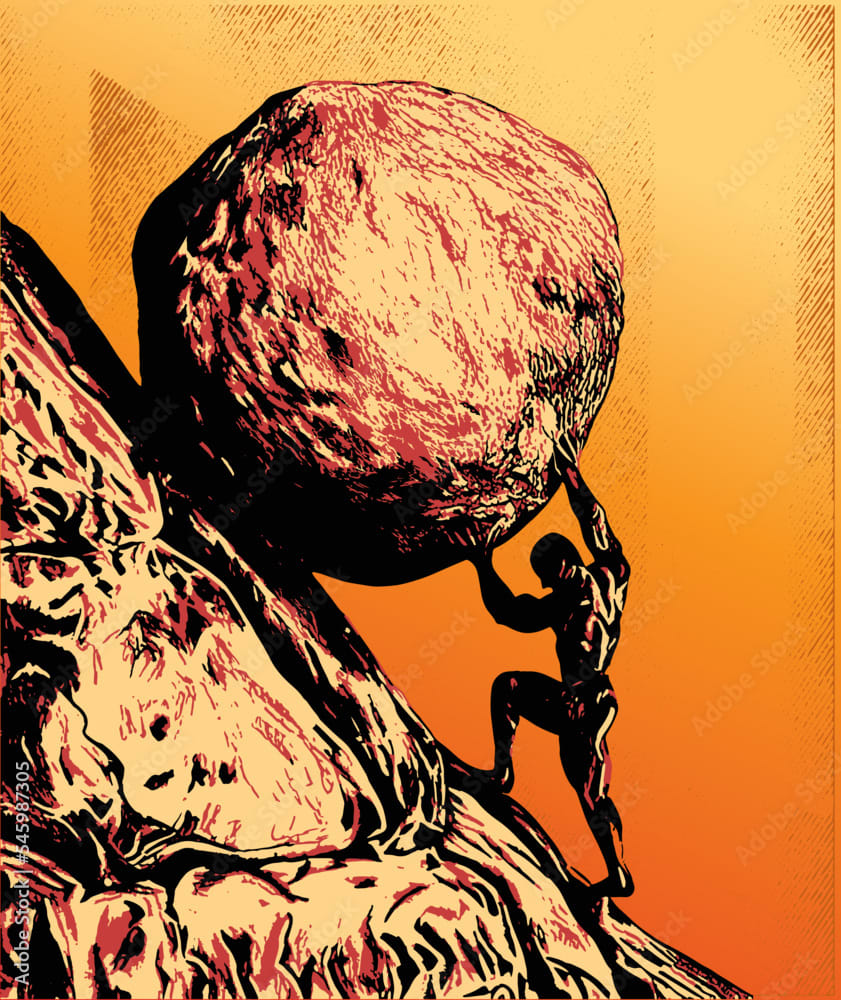
“The struggle itself is enough to fill a man’s heart.”
- Albert Camus
The image for this article isn’t exactly inspiring, right? A man alone, endlessly shoving a rock uphill only to watch it undo his progress is not the stuff of motivational posters or keynote speeches. There’s no breakthrough moment, no transformation arc, no sense that he’s “learning lessons” along the way. It looks less like enlightenment and more like a cautionary tale about poor career planning.
But this is precisely why this image lands. Life often feels this way.
This is not an essay about finding meaning. It’s about what happens when meaning stops cooperating—and life keeps asking to be lived anyway. If you’re looking for reassurance, resolution, or a story that makes the effort add up, you may want to look elsewhere. What follows stays with the harder question: how to live honestly when the guarantees are gone.
Decades ago, when I moved through my own post‑religion reconstruction, existential philosophers—particularly figures like Albert Camus—became essential companions. What drew me to them was their refusal to soften the conditions of being alive with replacement beliefs or borrowed certainties.
After years of inhabiting religious frameworks that promised coherence, resolution, and transcendence, I found in existential philosophy a rare honesty about uncertainty, suffering, and the absence of guaranteed meaning.
Thinkers like Camus helped me learn how to live without appeal—how to remain engaged, responsible, and awake in a world that does not rush to justify itself. Their work did not lead me away from meaning; it led me toward a more durable form of it—one rooted in presence, integrity, and fidelity to the real rather than dependence on inherited narratives.
During that disorientation, The Myth of Sisyphus didn’t give me answers or replacement meaning—it gave me permission to stop pretending.
Camus helped me see that continuing to live, care, and act without guarantees wasn’t a failure of faith—it was a form of honesty. His work named what I was already experiencing: the effort goes on even when the story collapses, and dignity can emerge from facing that reality without illusion.
The Myth of Sisyphus
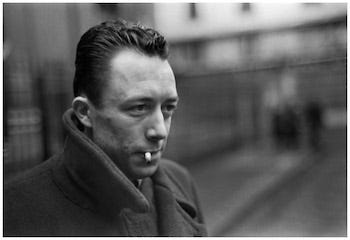
I previously published an article about Albert Camus in my philosophy series.
Albert Camus opens The Myth of Sisyphus with a claim that feels as unsettling now as it did when he first wrote it: the most serious philosophical question is whether life is worth living.
By this, Camus does not mean that life is obviously meaningless, nor that despair is the inevitable conclusion. He is naming a tension at the heart of human consciousness—a tension he calls the absurd.
The absurd arises from the collision between our deep, almost instinctual hunger for meaning, clarity, and coherence, and the universe’s persistent refusal to provide them. We ask why we are here, what our suffering is for, where all this is headed—and the world offers no answer. Not hostility. Not explanation. Only silence.
Faced with this silence, Camus notes, we rarely remain still. We reach for escape—religious faith that relocates meaning beyond contradiction, or metaphysical and moral stories that promise eventual resolution.
These responses are understandable. They arise from the same hunger that gives rise to the question itself. But Camus insists that they come at a cost. They require what he calls a “leap”—a refusal to remain fully faithful to what is actually given. For Camus, these leaps are not solutions to the absurd but evasions of it, ways of soothing the discomfort rather than facing it directly.
Camus’ question, then, is not whether meaning exists somewhere else, but whether it is possible to live well without appeal—without appealing to transcendence, final answers, or future justification.
It’s worth saying that The Myth of Sisyphus is not exactly a comfort read. Camus does not hand out warm blankets, inspirational quotes, or a five‑step plan for feeling better by Tuesday. This is not philosophy for people looking to be reassured that everything will work out. It’s philosophy for people who suspect it might not—and are willing to keep living anyway.
This is why The Myth of Sisyphus often lands with particular force for people in religious deconstruction. Leaving religion is not just a loss of belief; it is the loss of a story that once justified effort, suffering, and repetition. Camus offers no replacement narrative to fill that void, and that is precisely what makes his work both bracing and difficult.
For those accustomed to frameworks that promise resolution, redemption, or eventual payoff, his refusal to console can feel threatening. And yet, for many of us, it names the experience with rare accuracy: the work continues, the stone still rolls, and learning how to live without borrowed meaning becomes an act of integrity rather than failure.
The Myth of Sisyphus was a difficult text for me to stay with. It wasn’t exactly the sort of book you read to unwind; it was more the sort you read and then question all your previous coping strategies. As my own deconstruction deepened, it often felt volatile rather than clarifying—stripping away consolation faster than anything could replace it. There were moments when the exposure felt like too much.
And yet, by staying with Camus rather than rushing past him, something unexpected happened. The volatility itself became liberating. I felt the pressure ease—the burden to make my life add up, to justify my effort, to prove that the struggle was leading somewhere. What remained was permission to keep living honestly, without guarantees, and to discover that dignity could emerge not from meaning restored, but from presence sustained.
The question is: Can one live fully, lucidly, and passionately while accepting that the universe offers no ultimate explanation? This is not a call to despair, nor a flirtation with nihilism. It is an invitation to clarity. To see the conditions of existence without adornment. To live without lying to oneself.
In the final movement of the essay, Camus turns to the ancient Greek myth of Sisyphus, condemned by the gods to roll a stone up a hill for eternity, only to watch it tumble back down just before the top. The punishment is exquisitely futile. Nothing accumulates. Nothing is completed. There is no progress, no escape, no reward—and no sense that he’s one good push away from a breakthrough or a well‑earned vacation. For Camus, this image mirrors the human condition with uncomfortable accuracy. We labor, we strive, we repeat—and the fundamental questions continue to sit there, arms crossed, entirely unimpressed.
Yet Camus’ interpretation of Sisyphus is radically different from the traditional reading. He does not imagine Sisyphus redeemed, rescued, or secretly rewarded. There is no hidden meaning waiting at the summit. Instead, Camus imagines Sisyphus aware. Aware of the full extent of his condition. Aware of the futility of the task. Aware that nothing is coming to save him from repetition. And in that awareness, something decisive occurs. Hope for escape disappears. Illusion falls away. What remains is the task itself, seen clearly and engaged without deception.
This is why Camus concludes with his famous and troubling line:
“The struggle itself is enough to fill a man’s heart. One must imagine Sisyphus happy.”
This is a happiness rooted in lucidity, marked by freedom from false consolation and a reconciliation with reality as it stands. Sisyphus’ dignity does not come from meaning imposed on the task, but from his refusal to pretend that the task is something it is not. He continues, not because the stone will one day stay at the top, but because this is what remains when illusion has nothing left to offer.
Taken at first glance, this can sound bleak, even despairing—as though all consolation has been stripped away and nothing has been put in its place. I get it. Camus does not soften the blow.
But the invitation here is not to stop at the discomfort, nor to turn away from it too quickly. If you stay with this clarity—if you resist the urge to retreat or replace it—you may find that what initially feels like loss begins to open into a quieter freedom, one grounded not in answers, but in the relief of no longer having to pretend.
To Camus, happiness is not transcendence. It is accuracy. It is the quiet integrity of living without appeal, without denial, without the need for the world to justify itself before we consent to be present within it.
And yet, most of us do not begin our lives this way. We begin inside stories—stories that promise justification, direction, and eventual resolution. Long before we have the capacity to examine them, these narratives teach us what to expect from life and what life expects from us.
The Story and the Stone

Most of us are formed inside a story long before we ever choose one.
It often arrives through religion, but not limited to religion alone. It also comes through culture, family, and unspoken assumptions about progress, purpose, and payoff.
Life, we are told, is headed somewhere. Effort accumulates. Suffering is temporary. If we endure the climb long enough, something meaningful will eventually gather it all together. This story gives coherence to motion. It explains the strain. It justifies the sacrifice.
Yet for many people today, this narrative quietly loses its power. The collapse rarely arrives as rebellion. More often it appears as a slow recognition that the promised horizon no longer persuades. The story still echoes, yet it no longer organizes life from the inside.
What follows is commonly named a crisis of faith, though that language misses the deeper movement taking place. Faith itself has not failed. What has eroded is a framework that once helped translate experience into meaning. The disruption is existential. Inherited explanations no longer carry the weight of lived reality. People continue waking, working, loving, grieving, and caring, all while sensing that the familiar assurances no longer add up. The disorientation comes not from emptiness, but from exposure.
It’s worth naming why this vision can feel unsettling, even for those who sense its truth. Stories offer orientation, protection, and a sense that our effort is headed somewhere, and surrendering them can feel like stepping into open air without a net. Many people understandably prefer even constraining or painful narratives to the vulnerability of living without guaranteed meaning, because stories promise safety, coherence, and relief from the weight of uncertainty.
This matters because the way we understand meaning determines how we show up to ordinary life—how we wake, work, love, endure repetition, and face loss without guarantees. If we don’t learn how to live honestly when the stories collapse, we either numb ourselves, retreat into illusion, or quietly disengage from life while still going through the motions.
Existential health matters here because it addresses the human capacity to remain grounded, responsive, and alive when certainty recedes.
Many of the people I accompany are not searching for better answers. What they are carrying is fatigue—fatigue from sustaining beliefs that no longer feel honest. The stone is still being pushed, yet the narrative that once explained the effort has slipped away.
This moment is frequently labeled despair or nihilism. In practice, it often marks the beginning of clarity. What dissolves is not meaning itself, but the assumption that meaning must be guaranteed in advance. The greater danger at this threshold comes from urgency: the impulse to rush toward a replacement story, a metaphysical reassurance, or a therapeutic framework that restores coherence without asking us to stay with disorientation.
When the story collapses, the first impulse is to repair it—to reach for an explanation that makes the disruption bearable. This way of living resists that move. It stays present. Not through resignation or withdrawal, but through contact with what is here.
Camus’ Sisyphus clarifies this stance: the stone still falls, the hill does not change, and what disappears is the hope that something else will arrive to redeem the effort. The labor continues as it is. Life keeps its terms. What changes is how we meet them.
This clarity never settles permanently. It appears, fades, and reappears. No one lives here without interruption. Yet once it has been encountered, it alters how meaning is held. Dependence on narrative payoff loosens. Capacity for immediacy grows.
At this point, hope becomes complicated. While hope can sustain, it can also function as postponement—an effort to live elsewhere rather than here. When hope becomes a way of avoiding contact with the present, existential health weakens. Care, however, does not disappear with the loss of false hope. It deepens. It becomes less conditional. Action continues without bargaining.
What remains after familiar stories fall away is attention. Breath is noticed as it moves in and out, the weight of the body registers in real time, grief shows up with its own texture, and connection appears in fleeting moments that warm and then pass. These experiences are not symbols pointing beyond themselves. They do not encode a hidden message. They are life, as it actually occurs.
Existential health is not an ideology to adopt or a philosophy to defend. It is a lived capacity that emerges when overlays loosen. It shows itself in small, unremarkable ways: continuing without justification, tending what is fragile without pretending it can be saved, speaking what is true enough without demanding final answers, allowing meaning to arise and dissolve without fastening to it.
What survives the collapse of stories is fidelity. Fidelity to doctrine or destiny no longer holds. What remains is fidelity to the real—to what is happening now. To this step. This breath. This moment of being alive.
This path does not promise happiness or transcendence. What it offers is quieter and sturdier: the ability to live without deception. In an era marked by exhausted certainties and collapsing narratives, this capacity—to remain present, honest, and responsive without guarantees—may be one of the most humane forms of care we can learn to practice.
This way of living does not resolve the absurd, redeem the labor, or restore the story that once promised payoff. It asks for something quieter and more demanding: the willingness to remain present without appeal.
Wait. What? Jesus?
I’m aware that invoking Jesus at this point may feel like a category error, or worse, a bait‑and‑switch. After Camus, absurdity, and the stripping away of comforting narratives, Jesus can sound like a retreat into the very framework many people have worked hard to leave behind. That hesitation makes sense. I felt it too. For many of us, Jesus is inseparable from systems that demanded certainty, obedience, and self‑erasure.
What follows is not a return to Christianity or a theological solution to the absurd, but a way of encountering Jesus again—outside the stories built around him—as someone who also lived without appeal, without explanation, and without escape from the weight of being alive.
For me, Jesus begins to make sense again at precisely this point—not as a solution to the absurd, but as someone who also refused to lie about the conditions of being alive. Stripped of later theological overlays, Jesus does not offer an explanation for suffering, a metaphysical escape hatch, or a promise that effort will finally be justified by a future payoff. He speaks and lives in the present tense. His language of the “kingdom of God” is not deferred resolution but immediate practice—attention, fidelity, and responsibility within the world as it is.
In this sense, Jesus stands surprisingly close to Camus. Both resist the urge to explain suffering away. Both reject moralistic accounts that turn pain into a lesson or a test. Both respond to the weight of existence not with theory, but with lived integrity.
Seen this way, Jesus is less a figure of transcendence than of presence. He does not invite people to escape the hill, but to remain awake on it—to feed the hungry, tend the sick, stay with grief, forgive without guarantee, love without protection.
Even his final moments echo the refusal of false consolation: abandonment is not reinterpreted, suffering is not spiritualized, and silence is not filled with explanation. What remains is fidelity—to God as he understands it, to humanity, and to the reality of the moment itself. Like Sisyphus in Camus’ telling, Jesus does not escape the task. He inhabits it fully.
This is why, in my own reconstruction, Jesus no longer functions as an answer that resolves the absurd, but as a companion within it. Not a redeemer who removes the stone, but a presence that shows how to lift it without illusion. That doesn’t make the task meaningful in the old sense. It makes it honest. And in that honesty—quiet, costly, and unspectacular—something like dignity emerges again.
In the season after my crisis of faith—when I had left Christianity and was trying to figure out what “spirituality” could even mean on the other side—The Myth of Sisyphus met me with a kind of brutal companionship. I wasn’t looking for a new set of beliefs; I was trying to learn how to live when the old framework no longer carried my weight.
Camus didn’t give me a “post‑religion” replacement story. He gave me language for what I was already experiencing—effort without guarantee, meaning without cosmic reassurance, and the possibility that staying honest and present might be the most spiritual thing left to do.
A Parting Word

Whether one names this posture through Camus’ Sisyphus or simply through the practice of staying awake to life as it is, the shape remains the same. As the day arrives, the work repeats, the body continues to age, care presses in, and grief returns in its own time—without any final explanation to gather it all together.
And still, the task is taken up—not because it leads somewhere else, but because this is where life is actually lived. The stone is lifted again. The breath is drawn. Nothing has been solved. Nothing has been justified. And yet, in the refusal to lie about what is, a grounded dignity begins to take shape.
This way of living does not announce itself with insight or resolution. It looks more like an ordinary morning. The alarm goes off. The body rises, heavier than it once was. Coffee is made. A familiar ache settles in. A loved one needs care, or work waits, or grief lingers quietly in the room. No hidden meaning has arrived overnight. Nothing has shifted in the grand sense. And still, the day is entered—with attention—as the same tasks return and the same effort is required.
It’s worth pausing here to say something easily misunderstood: the problem is not that human beings live inside stories. We always have. Stories give shape to time, help us locate ourselves within the vastness of experience, and offer enough orientation to take the next step without being paralyzed by infinity. To expect a human life to be lived without any narrative at all would be neither honest nor humane. We need provisional frames—ways of making sense that are light enough to move with us and sturdy enough to hold us for a season. Wanting a story to live inside of is not a weakness; it is part of how consciousness survives its own depth.
What becomes dangerous is not story itself, but stories that demand loyalty at the expense of reality—stories that require us to deny what we are experiencing, reinterpret harm as virtue, or postpone life in the name of a future payoff that never arrives. These are not stories we live inside so much as stories that live inside us, quietly dictating what we are allowed to notice, feel, or name. A story becomes false not because it offers meaning, but because it insists on meaning where there is none, or refuses to release us when it no longer fits.
The invitation here is not to abandon narrative altogether, but to hold our stories with enough honesty and humility that they can be revised—or relinquished—when they begin to ask us to lie in order to belong.
I want to be honest with you about this: living this way is not easy. The human experience is not for the faint of heart. There are losses that do not resolve, efforts that do not accumulate, and questions that refuse to close. There are days when the weight feels heavier, when clarity offers no comfort, and when continuing without guarantees feels like more than we have to give. If this feels daunting, it doesn’t mean you’re failing. It means you’re paying attention.
And yet, this honesty has brought me something I didn’t expect. Without the pressure to make life add up, without the demand that suffering justify itself or that meaning arrive on schedule, something steadier has emerged. I feel more present in my own life, more available to the people and moments that are actually here.
The meaning I experience now is quieter and less dramatic, but it is real. It comes from showing up without illusion, telling the truth as best I can, and staying engaged even when nothing promises to redeem the effort. There are no guarantees here—only the dignity of meeting life as it is, together, and choosing to remain awake within it.
Support this work as a paid subscriber ($50 annually) and get a complimentary membership to the Center for Non-Religious Spirituality. Post‑religion spirituality, existential health, and honest companionship—no doctrine required.
Jim, you’re touching on a profoundly important question: “Camus’ question, then, is not whether meaning exists somewhere else, but whether it is possible to live well without appeal—without appealing to transcendence, final answers, or future justification.”
Sisyphus has the intention and the agency to push the stone uphill. The stone rolling back down — forgive me for saying this as a physicist — is not a physical law. It is a sign that another kind of energy is missing, one that is essential to human life. I call this backward-flowing time and the energy associated with it. It even has a physical meaning: physicists work with backward-flowing time when calculating certain particle processes. But what matters here is this: it is a kind of energy in which the cause lies in the future and the effect appears in the present — causality is reversed.
This is the energy that allows someone to say: I don’t know why I’m doing this, why I feel called to walk this path — but I know I must. I suspect this feels familiar to you, Jim, because without that inner impulse of will, you wouldn’t be writing these powerful essays.
So you and Camus are both right: religion can provide access to this energy — this immersion in backward-flowing time — but only when it is authentic. Bhakti. Otherwise it becomes self-deception, something people eventually abandon. And then a void appears, a kind of despair. At that point, one has to rediscover faith and hope through a more natural spirituality.
Allow me to say this plainly: I believe Camus is mistaken when he writes, “The struggle itself is enough to fill a man’s heart. One must imagine Sisyphus happy.” No — I don’t think that is true. Not without that other dimension, that future-anchored energy of meaning and calling. Existential health requires that we connect to this backward-flowing time as well — that faith awakens in us, or an unshakable trust in the future.
What you are wrestling with here is not just an intellectual issue. It is one of the central existential questions of being human — and today, perhaps even a civilizational one. Thank you for raising it.
Jim Palmer, when you first came across my radar almost 4 years ago, I was still entrenched in Evangelicalism. Attempting to defend what I thought I believed. Now, years later, I take strength in writings such as this article. Not for the answers you provide. But for the honesty. Last night, I lashed out on social media towards “god” for turning a blind eye to all the suffering. In a dream early this morning, i realized my anger needs to be laid at the feet of those who convinced me of a certain “god” story as fact. And then i came across your article.
It would seem as though Sisyphus turns around from time to time, to hold the stone with his back, while viewing the world behind him😊