

Sapiens
Survival Architecture and the Problem of Coherence in the Modern World

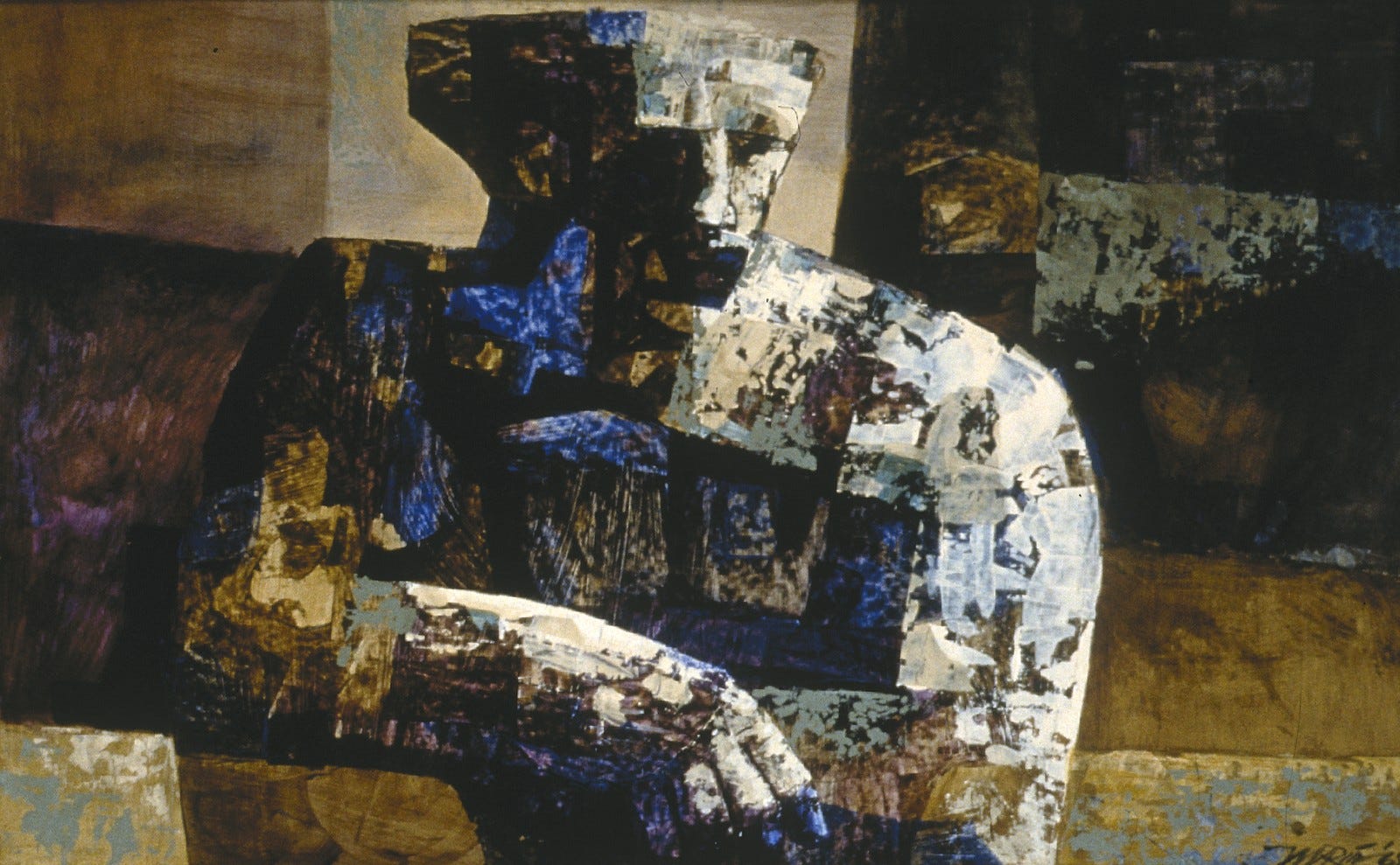
Human beings are not just trying to survive; we are trying to maintain a version of reality that allows us to keep going. Existential health is the capacity to remain aligned with reality even when it destabilizes the structures that make life feel coherent.
Introduction

To understand yourself only at the level of personality, biography, or personal history is to work with a narrow slice of what you are. It keeps the focus on your story, your choices, your circumstances, which all matter, but it leaves out the deeper structure that is shaping those things from underneath.
When you begin to understand who you are at the level of the species, something shifts. You are no longer interpreting your experience as purely personal. You start to see the patterns, tendencies, and constraints that come with being human as such.
At the level of Homo sapiens, much of what feels unique to you is not unique at all. The need for certainty, the discomfort with ambiguity, the pull toward belonging, the construction of identity, the tendency to create and defend meaning, these are not personal quirks or failures. They are expressions of a shared human structure. Seeing this does not reduce your individuality. It places it in context. It allows you to distinguish between what is yours to take responsibility for and what is built into the conditions of being human.
This shift has practical consequences. It reduces unnecessary self-judgment, because you begin to recognize that many of your reactions are not signs that something is wrong with you, but signs that something is working as designed. At the same time, it increases responsibility in a more precise way. Once you can see the underlying patterns, you are less likely to be unconsciously driven by them. You can begin to work with them, rather than from inside them.
Understanding yourself at the species level also changes how you relate to others. Instead of interpreting people primarily through moral categories or personal narratives, you start to see the same underlying structures operating in them. Their defensiveness, their certainty, their confusion, their need for meaning, these are not random or inexplicable. They are part of the same architecture you are navigating. This does not eliminate disagreement or conflict, but it can reduce the tendency to turn difference into dehumanization.
Most importantly, this perspective opens up a different kind of inquiry. Instead of asking only, “What is wrong with me?” or “How do I fix my life?” you begin to ask, “What does it mean to be a human organism trying to remain intact in this kind of reality?” That question moves the focus from self-correction to understanding. And from there, a different kind of change becomes possible, one that is not driven solely by effort or willpower, but by a clearer relationship to the conditions you are actually operating within.
Survival, Story, and the Problem of Being Human

Human beings tend to interpret their lives at the level of the personal, organizing experience through the categories of individual history, identity, decision-making, and circumstance. That frame feels sufficient because it is immediate and familiar, but it obscures the deeper structure that makes such interpretation possible in the first place.
To understand Homo sapiens only in terms of biography is to miss the architecture that governs how experience is stabilized, filtered, and made coherent under conditions that are neither stable nor inherently meaningful.
The central problem is not simply how humans survive in the modern world, but how they maintain a workable sense of reality within it, how perception, emotion, and meaning are continuously organized into a form that can be inhabited without collapse.
Personal life is inseparable from a deeper system of survival architecture, one that does not merely respond to reality, but actively shapes it into something that can be sustained, even when that shaping begins to drift from the conditions it is meant to track.
Personal meaning, belief, and crisis are not generated by the individual alone, but emerge from underlying organizing processes that precede and condition conscious interpretation. To remain within a purely personal frame without accounting for these processes is to mislocate the source of one’s own experience, and therefore to misunderstand both its constraints and its possibilities.
As Homo sapiens, survival has never been reducible to biological persistence. Human beings do not merely continue as organisms; they must maintain a viable experience of being in the world under conditions that are uncertain, unstable, and frequently indifferent to their continued existence.
The problem of survival is therefore not exhausted by the management of physical threat, but extends to the ongoing regulation of psychological and interpretive coherence. The organism must not only endure external conditions, but must render those conditions intelligible enough to remain functionally oriented within them. The capacity to metabolize reality into a form that can be lived with is not an optional feature of human life, but a structural requirement of it.
Human beings do not merely survive by staying alive; they survive by maintaining an experience of life that remains coherent enough to inhabit.
Survival architecture is the integrated system through which human beings maintain both biological survival and psychological coherence by organizing perception, emotion, cognition, and meaning into a form of reality that can be stably inhabited.
These are not separable domains, but interdependent layers of a single system whose primary function is the stabilization of experience across time. Survival architecture does not simply preserve the organism; it preserves the continuity of the self as an intelligible and operative structure. It reduces the indeterminacy of reality to manageable proportions, filters perceptual input according to relevance for coherence, and generates interpretive frameworks that allow the individual to act without being overwhelmed by ambiguity or contradiction.
Survival architecture does not show you reality as it is; it shows you reality as you can tolerate it.
The effectiveness of this system is precisely what obscures its operation. Because survival architecture produces a coherent experience of reality, it presents its own outputs as if they were direct perceptions rather than mediated constructions. The individual does not experience themselves as operating within a system that filters and organizes reality; they experience themselves as encountering reality as it is. This transparency is not incidental, but functional. A system that constantly revealed its own contingency would undermine the stability it is designed to maintain. As a result, the distinction between what is constructed and what is given becomes difficult to detect from within the system itself.
Interpretive containment is the process by which perception and understanding are limited to what can be integrated without destabilizing psychological coherence, such that what cannot be metabolized is not simply rejected, but never fully registered as available to perception in the first place.
What feels like personal meaning is often the output of a system designed to stabilize experience before it accurately represents reality.
This is where a critical inversion occurs. Once a given configuration of meaning, identity, or belief becomes necessary for the maintenance of coherence, its epistemic status becomes secondary to its functional role.
Survival architecture does not prioritize truth in any abstract or objective sense; it prioritizes the preservation of a stable, continuous, and actionable experience. Coherence is not evidence of truth; it is evidence that a system is successfully maintaining itself.
Interpretations that support this function are retained and reinforced, while those that threaten it are attenuated, reinterpreted, or excluded. The system does not need to falsify reality in a deliberate sense; it only needs to selectively admit what can be integrated without destabilization. In this way, the maintenance of coherence begins to take precedence over the accuracy of representation.
Coherence is not evidence of truth; it is evidence that a system is successfully maintaining itself.
Narrative as Psychological Immunity
Narrative plays a central role within this architecture, not as a cultural embellishment, but as a primary regulatory mechanism.
Human beings construct stories not simply to describe their experience, but to organize it into a form that can be sustained over time. Narrative establishes causal relationships, assigns significance, and situates the individual within a broader field of meaning. It transforms discontinuous events into a continuous account, thereby enabling the individual to maintain a sense of identity across changing conditions.
Narrative is not primarily a way of describing reality; it is a way of regulating exposure to it. Without it, experience would remain fragmented and difficult to integrate, undermining both action and self-recognition.
In this respect, narrative functions analogously to an immune system operating at the level of meaning. It protects the individual from disintegration by absorbing and interpreting potentially destabilizing inputs in ways that preserve coherence.
However, like biological immune systems, it does not perfectly distinguish between what is threatening and what is informative. Once a narrative becomes structurally necessary, it begins to defend itself against disruption, regardless of the epistemic status of that disruption. Information that contradicts the narrative is not assessed in a neutral field of inquiry, but encountered as a potential threat to the stability of the system. The result is not the cessation of critical thought, but its reorientation toward the preservation of the existing structure.
The more necessary a narrative becomes for stability, the less freely it can be questioned.
The Environment Survival Architecture Was Built For

This dynamic becomes more intelligible when situated within the conditions under which survival architecture evolved. In early human environments, the primary challenges to survival were immediate, embodied, and non-symbolic. Threats such as predation, injury, environmental exposure, and loss of group cohesion were directly encountered and required rapid, context-sensitive responses. The feedback loop between perception and consequence was relatively short, allowing misalignments between interpretation and reality to be corrected through direct experience.
Under such conditions, the different layers of survival architecture remained tightly coupled to the environment, with biological, cognitive, and affective processes tracking conditions that were immediately consequential for survival. Perception was not free to drift far from what was occurring, because error carried immediate cost, and those costs enforced a continuous recalibration of the system.
Within this context, the role of narrative and symbolic meaning-making was likewise constrained by the demands of accuracy. Interpretations that diverged too far from reality did not simply become alternative perspectives; they became liabilities. Misinterpretation increased risk, reduced coordination, and compromised survival, narrowing the range of viable belief. Myth, ritual, and early forms of symbolic organization were therefore anchored in lived experience, even as they extended beyond it, providing meaning without severing the connection to the conditions that made that meaning necessary.
The system maintained calibration not because it was oriented toward abstract truth, but because the environment imposed continuous constraints that limited the persistence of misrepresentation. Reality functioned as an external regulator, not merely informing perception, but actively shaping the boundaries within which interpretation could operate.
In ancestral environments, reality constrained interpretation; in modern environments, interpretation often replaces reality. What has changed is not the structure of survival architecture, but the disappearance of the constraints that once disciplined it. Without immediate consequence to enforce recalibration, interpretation is no longer held tightly to reality, and can persist, expand, and reinforce itself even when it drifts from the conditions it is meant to track. The result is not an immediate breakdown of the system, but a loosening of the relationship between perception and consequence, allowing coherence to be maintained independently of accuracy.
The contemporary environment reflects this shift. Modern humans are no longer responding primarily to immediate, embodied threats, but to symbolic, abstract, and often continuous ones. Concerns related to status, identity, reputation, economic security, and ideological alignment do not present as discrete events with clear resolution points, but as ongoing conditions that sustain activation without completion. The nervous system remains engaged without the opportunity to discharge, extending states of vigilance that were once episodic into something more continuous.
At the same time, the informational landscape has expanded beyond the scale for which survival architecture was originally calibrated. Individuals are embedded in networks of representation and abstraction that cannot be directly perceived or fully understood, yet still require interpretation.
Under these conditions, the symbolic layer assumes a more dominant role in organizing experience. Identity, ideology, and belief systems no longer function as secondary supports anchored to direct experience, but as primary structures through which reality is interpreted.
Because these structures provide coherence in the absence of immediate feedback, they become increasingly self-reinforcing. Interpretations are no longer constrained by direct consequence in the same way, allowing them to persist even when they are only loosely coupled to the conditions they are intended to represent. The system continues to perform its stabilizing function, but it does so at an increasing distance from the realities it evolved to track.
The Environment We Actually Inhabit

Our contemporary environment differs from this ancestral context in ways that fundamentally alter the operation of survival architecture. Modern humans are no longer responding primarily to immediate, embodied threats, but to symbolic, abstract, and often continuous ones. Concerns related to status, identity, reputation, economic security, and ideological alignment do not present as discrete events with clear resolution points, but as ongoing conditions that sustain activation without completion. The nervous system remains engaged without the opportunity to discharge, leading to chronic states of low-level or intermittent stress that are not easily integrated.
At the same time, the informational landscape has expanded to a scale and complexity that exceeds the processing capacities for which survival architecture was originally calibrated. Individuals are embedded in networks of representation, communication, and abstraction that cannot be directly perceived or fully understood. The cognitive system continues to generate patterns and interpretations, but does so on the basis of partial, mediated, and often conflicting inputs. As a result, the symbolic layer of survival architecture assumes an increasingly central role, organizing experience in the absence of direct, reliable feedback from the environment.
The human mind does not passively receive the world; it actively constructs a version of it that can be lived with.
This shift produces a condition in which narrative, identity, and belief are no longer constrained by immediate reality to the same degree as in earlier environments. The system remains oriented toward coherence, but the mechanisms that previously enforced calibration have weakened. Individuals can sustain highly organized and internally consistent interpretations of the world that are only loosely coupled to the conditions they are intended to represent. Because these interpretations continue to support functional coherence, their inadequacy may not become immediately apparent, particularly when they are socially reinforced within shared symbolic systems.
You can be psychologically coherent and systematically out of contact at the same time.
The Failure Mode: High-Functioning Misalignment

The resulting condition can be described as high-functioning misalignment, in which individuals maintain stability, productivity, and even success while becoming progressively less responsive to the realities they inhabit.
This misalignment is not experienced as a breakdown, but as continuity, because the same structures that generate coherence also obscure the extent of their own mediation. What is presented to the individual is not reality in its unfiltered form, but a version of it that has already been organized into something interpretable and stable. As a result, the individual experiences themselves as rational, reflective, and informed, yet this rationality operates within parameters that are not themselves subject to scrutiny. The limits of the system are not perceived as limits, but as the boundaries of reality itself.
Within this condition, intelligence does not function as a corrective force in any straightforward sense. It does not automatically expand access to reality, but increases the capacity to organize, defend, and refine the interpretive structures already in place.
In this context, intelligence becomes recursively embedded within survival architecture, enhancing its ability to maintain coherence under pressure. It allows for the construction of more nuanced explanations, more internally consistent narratives, and more sophisticated integrations of conflicting information, but all within a framework whose foundational assumptions remain intact.
Intelligence therefore increases the sophistication of a system’s defenses as often as it increases its openness to revision, enabling individuals to generate increasingly refined justifications for interpretations that remain structurally constrained.
The result is not a failure of reasoning, but a form of reasoning that operates effectively within boundaries it does not recognize as boundaries, preserving coherence even as responsiveness to reality diminishes. In this way, the system does not collapse under misalignment. It adapts to it, extending its own continuity while gradually reducing its capacity to register what falls outside its organizing frame.
This is why misalignment can persist without obvious dysfunction. A person can continue to act, decide, and succeed within the world as they understand it, while that understanding becomes increasingly decoupled from the conditions it is meant to track.
The issue is not that the system fails to produce coherence, but that it succeeds too well at producing it under conditions where coherence is no longer a reliable indicator of alignment. What emerges is a stable, self-reinforcing structure of interpretation that can absorb contradiction, reinterpret disruption, and maintain continuity, even as its correspondence with reality becomes progressively attenuated.
Religion, Deconstruction, and Functional Continuity

Religion provides a particularly clear instance of survival architecture operating at the level of collective symbolic organization. It offers comprehensive frameworks for interpreting uncertainty, regulating behavior, and stabilizing identity within a shared narrative structure.
While religious systems can vary widely in content and expression, their functional role within survival architecture remains consistent. They provide coherence at scale, enabling large groups of individuals to align their perceptions and actions within a common interpretive framework, reducing ambiguity by embedding the individual within a system of meaning that is socially reinforced and symbolically maintained.
However, the process of religious deconstruction illustrates that the functional dynamics of survival architecture persist even when specific belief systems are rejected. Individuals who disengage from religious frameworks often do so at the level of propositional content, discarding particular doctrines or narratives while leaving the underlying structure of interpretation largely intact.
The rejection of belief does not, in itself, alter the conditions that made belief necessary. The requirement for coherence, stability, and meaning remains operative, continuing to organize perception even in the absence of the original framework.
In the absence of explicit recognition of survival architecture, new frameworks frequently emerge to fulfill the same function, whether in the form of political ideologies, therapeutic paradigms, or alternative spiritual systems. What is often experienced as liberation from one system can therefore become a reconfiguration within another, as the underlying need for interpretive stability seeks new forms through which to express itself.
Leaving a belief system does not dissolve the need it was organizing; it forces that need to take a new form, reconstituting itself through different language, symbols, or structures while preserving the same underlying function of stabilizing identity, regulating uncertainty, and maintaining coherence across experience.
This continuity of function across changing forms reveals why high-functioning misalignment can persist across domains. Individuals may experience themselves as having fundamentally changed their worldview, while the underlying processes that organize perception remain largely unexamined. The surface structure shifts, but the deeper architecture continues to operate, allowing coherence to be maintained even as responsiveness to reality remains constrained. In this way, movement between systems can produce the appearance of transformation while preserving the same patterns of interpretation that limit what can be seen, questioned, or revised.
The problem, therefore, is not located in any specific system, but in the structural dynamics that generate and sustain them. Without recognizing those dynamics, individuals can move across multiple frameworks while remaining governed by the same underlying processes, mistaking variation in form for transformation in function. The difficulty is not leaving a system, but recognizing the conditions that make systems necessary in the first place.
Why Post-Disciplinarity Is Required

This recognition places pressure on disciplinary approaches that attempt to account for human behavior within isolated domains. Psychological, philosophical, neuroscientific, and theological frameworks each provide partial accounts of the phenomena in question, but tend to abstract their object of study from the broader system in which it operates. In doing so, they often mistake a layer of survival architecture for the whole, analyzing cognition without fully situating it in meaning-making processes, or examining belief without accounting for its regulatory function within the organism.
As a result, they risk reifying particular aspects of human experience while leaving the integrative dynamics that produce that experience unexamined. What is lost is not simply completeness, but coherence at the level of explanation, as the interaction between biological regulation, symbolic organization, and environmental context remains fragmented across disciplinary boundaries.
An adequate account therefore requires a post-disciplinary approach that can situate these domains within a unified framework, recognizing both their interdependence and the limits of their individual explanatory power. This is not a rejection of disciplinary knowledge, but a reconfiguration of how it is used.
Each field retains its insights, but those insights are no longer treated as self-sufficient. Instead, they are understood as partial perspectives on a system whose behavior cannot be fully explained from within any single vantage point. Post-disciplinarity, in this sense, is less a new field than a shift in orientation, one that prioritizes the relationships between domains over the autonomy of any one of them.
Anthropology offers a critical orientation in this regard, not as a comprehensive solution, but as a methodological stance that situates human behavior within evolutionary, cultural, and environmental contexts. It does not treat belief, identity, or meaning as abstract categories, but as adaptive responses shaped by specific conditions and pressures over time.
By examining how patterns of meaning, identity, and belief emerge and function across different contexts, it becomes possible to see them as expressions of survival architecture rather than as isolated or purely conceptual phenomena. This shift does not reduce their significance, but recontextualizes it within the broader dynamics of human survival and adaptation, allowing what appears as uniquely personal or cultural to be understood as part of a continuous process that extends across individuals, groups, and historical conditions.
What becomes visible through this lens is not only how these systems function, but why they persist, even when they no longer align with the conditions that originally gave rise to them. Without this broader framing, interventions remain partial, addressing symptoms within a given domain while leaving the underlying architecture intact. With it, the possibility emerges for a more coherent understanding of human behavior, one that can account for both stability and misalignment without reducing either to a single explanatory register.
Existential Health

The comparison between early and modern survival architecture is not merely descriptive. It establishes the conditions that make existential health necessary. If survival architecture is the system that maintains both biological survival and psychological coherence, then existential health concerns how that system is relating to reality under contemporary conditions.
The question is not whether the system is functioning, because it is almost always functioning, but how it is oriented and what it is capable of registering. A system can remain fully operational while becoming progressively less responsive to the reality it is meant to track.
In earlier human environments, this distinction was less pronounced. Survival architecture and reality were closely aligned through short feedback loops that enforced correction. Perception, response, and meaning-making were continuously calibrated by direct consequence. Under those conditions, coherence and contact were not easily separable. Misalignment could not persist for long without immediate cost, and adaptation was therefore built into the structure of experience itself. Existential health, in that context, did not emerge as a distinct concern because survival and responsiveness were tightly coupled.
In the modern world, those two can drift apart. The environment no longer enforces alignment, allowing misalignment to persist without immediate consequence. A person can maintain psychological coherence through narrative, identity, and belief while becoming increasingly out of contact with reality. The system continues to perform its stabilizing function, organizing experience, reducing uncertainty, and preserving a sense of self, but it does so by filtering, simplifying, or distorting what is actually happening. From within the system, this often presents as clarity or conviction. From outside it, it appears as rigidity, reactivity, or disorientation.
This is the core problem existential health names. It is not primarily a problem of mental illness, nor is it resolved by conventional notions of wellness. A person can be high-functioning, socially integrated, and materially stable while operating within a form of misalignment in which their experience of reality is mediated more by protective narrative than by direct contact.
The issue is not whether the system is stable. The issue is what that stability is built on. Existential health begins where the preservation of meaning is no longer the highest priority.
In this sense, existential health is the capacity to remain in relationship with reality even when that relationship destabilizes the narratives that have been maintaining psychological coherence. It involves recognizing the operations of survival architecture without being entirely governed by them, and developing the ability to tolerate ambiguity without immediately resolving it into familiar interpretations.
This does not eliminate meaning-making, nor does it return the individual to some pre-symbolic immediacy. Rather, it changes the relationship between constructed meaning and ongoing experience, allowing revision to occur without total disorientation.
This reconfiguration is inherently destabilizing because it challenges the primacy of coherence as the organizing principle of experience. To allow reality to exert corrective pressure on established narratives is to risk periods in which previously reliable structures no longer hold.
For this reason, existential health is not achieved through the accumulation of knowledge alone, but through a shift in how one relates to the processes that generate knowledge in the first place. It requires a form of resilience that is not based on maintaining stable interpretations, but on remaining responsive as those interpretations are revised.
Nothing in this suggests that survival architecture can be suspended or transcended. It remains the condition under which experience is organized. What changes is the degree to which its operations are recognized and engaged consciously. When seen clearly, the system becomes more flexible. Its constraints do not disappear, but they loosen enough to allow perception to update, response to adjust, and meaning to remain revisable rather than fixed.
Under modern conditions, this flexibility is not optional for those concerned with remaining in contact with reality. Because misalignment can now persist without immediate consequence, the responsibility for recalibration shifts inward. Not as a moral demand, but as a structural necessity. To be existentially healthy is to take up that responsibility, not by abandoning coherence, but by refusing to preserve it at the cost of contact.
The Structural Tension

Nothing in this account suggests that survival architecture can be eliminated or transcended in any absolute sense. It is a constitutive feature of human existence, and any attempt to step outside it entirely would itself be an expression of its operation.
The relevant distinction is not between having and not having such a system, but between remaining unaware of its influence and developing the capacity to recognize and work with it. This recognition does not grant complete freedom from its constraints, but it does alter the relationship between the individual and the structures that shape their experience.
The alternative to this recognition is not a catastrophic breakdown, but a more subtle and pervasive condition in which coherence is maintained at the expense of contact. Individuals continue to function within systems that provide stability and meaning, yet those systems become increasingly decoupled from the realities they are intended to interpret. Because this decoupling does not immediately disrupt functionality, it can persist indefinitely, shaping perception and action without being brought into question.
Under these conditions, the problem of being human is not simply that we construct meaning, but that we are structurally oriented to preserve those constructions even when they no longer serve their original function.
The problem is not that humans construct meaning, but that they are structured to preserve it even when it no longer corresponds to reality.
The capacity for self-reflection does not automatically resolve this tension, because it operates within the same architecture it attempts to examine. What is required is not a final resolution, but an ongoing engagement with the limits and operations of the system itself, and a willingness to allow those limits to be exposed rather than continually reinforced.
Nothing external is positioned to resolve this condition. The structures that once provided authoritative frameworks for meaning are themselves subject to the same dynamics, and cannot offer a position outside them.
The responsibility therefore does not lie in finding a system that escapes survival architecture, but in developing a relationship to it that does not collapse entirely into its demands for coherence. This is neither a stable endpoint nor a guaranteed achievement, but an ongoing condition of tension between the need for structure and the demand for contact with what exceeds it.
A Different Orientation

What emerges from this analysis is not a solution in the conventional sense, but a clarification of the conditions under which any solution would have to operate. Human beings are not simply meaning-making creatures. They are organisms structured to preserve the coherence of those meanings, even when that coherence comes at the cost of contact with reality. Survival architecture does not fail in the modern world because it is broken, but because it continues to function under conditions that no longer constrain it in the ways that once kept it calibrated.
The consequence is not immediate collapse, but the gradual normalization of misalignment. Individuals can remain stable, functional, and even successful while operating within interpretive systems that are increasingly disconnected from the realities they are attempting to navigate. Because those systems continue to provide psychological continuity, their inadequacy is not experienced as a problem from within. It is reinforced, shared, and often institutionalized.
This places the burden of alignment in a different location than it has historically occupied. It is no longer enforced primarily by external conditions, but must be taken up as an internal capacity. Not in the sense of adopting new beliefs or abandoning old ones, but in the ability to remain in contact with reality even when that contact destabilizes the structures that have made experience coherent. This is not a permanent state, nor is it something that can be achieved once and secured. It is an ongoing tension between the need for stability and the demand for responsiveness.
To see survival architecture at work is not to step outside of it, but to alter one’s relationship to it. That alteration does not remove constraint, but it changes its character. It allows for a form of coherence that does not depend entirely on the exclusion of what challenges it. It makes possible a way of being that can absorb disruption without immediately converting it into reassurance.
Nothing in this guarantees clarity, certainty, or resolution. What it offers instead is a different orientation. One in which the preservation of meaning is no longer the highest priority, and where the capacity to remain in contact with what is actually happening becomes the more fundamental task. Under modern conditions, that shift is not optional for anyone concerned with understanding what it means to be human. It is the beginning of taking that question seriously.
If you find value in this kind of work, writing that prioritizes depth, clarity, and intellectual honesty over easy answers, consider becoming a paid subscriber ($50 annually). This kind of thinking takes time to develop, refine, and articulate, and your support makes it possible to continue building a body of work that does not collapse complexity into simplicity, or trade rigor for reach. Paid subscribers help sustain a space where difficult questions can be examined seriously, where ideas are developed with care, and where the goal is not just to inform, but to sharpen how we see and think.
What stood out to me here is the distinction between coherence and contact. A person can remain highly functional while becoming progressively less responsive to what is actually happening, and from the inside that often feels like clarity rather than misalignment. That’s what makes this so difficult to catch.
The shift usually isn’t dramatic. It’s the gradual replacement of reality by interpretations that are stable enough to live inside.
And by the time that starts to hurt, the system is often more invested in preserving continuity than allowing itself to be corrected. That’s why so much apparent change never reaches the level of structure.
Brilliant deconstruction of the human condition through the evolution of social order, narrative, and unconsciously directed survival architecture. The drift in consensus of the species in epistemic cohesion being derived from representations of reality as opposed to direct observation has led to personal narratives that persist without meaningful consequence. The failure of religious survival architecture is that it no longer has the capacity to confine reality to the tolerable, and therefore fails to show the individual who they are.