



The Reality of Post-Religion Holiday Hurt

For many people the holidays are difficult to navigate for several reasons. The holiday season, often wrapped in glittering expectations of joy and togetherness, can also be a time of deep pain and dissonance.
Thanksgiving and Christmas can amplify the absence of loved ones—whether through death, estrangement, or relational rupture. Traditions become reminders of what’s missing. Gatherings may reignite unresolved tensions, especially in families with histories of trauma, religious discord, or ideological divides. Gift-giving, travel, and hosting can create a financial strain in these times of economic instability.
The holiday season can particularly be difficult for the deconstructing religion-leaver. The pressure to gather with family can reignite old wounds, especially in households marked by dysfunction, estrangement, or religious tension. Leaving faith can strip holidays of their former meaning, leaving one adrift without the rituals and traditions that once anchored the season. Over the years in my religious deconstruction work with religion-leavers, navigating holidays has been one of the most difficult and painful realties.
One could summarize holidays hurt for the religion-leaver as follows:
❤️🩹 Nostalgia meets rupture: The holidays can trigger emotional pain tied to religious trauma, spiritual abuse, or lost community. Holidays often carry emotional weight from past religious observance—rituals, songs, prayers, and gatherings that once felt sacred may now feel alienating, painful or unsafe. Even decorations or scents may act as sensory flashbacks. You may feel pressure to perform rituals that no longer resonate—church services, prayers, or gift-giving customs that once felt sacred but now feel hollow. While others celebrate joyfully, you may feel grief, anger, or confusion. This contrast can deepen feelings of isolation.
❤️🩹 Family tension: Deconstruction often leads to strained relationships, especially when family members remain devout. The holiday table becomes a battleground of belief, belonging, and silence. You might face pressure to attend religious gatherings defend your choices, or endure religious conversations that invalidate your journey. This can trigger grief, anger, or loneliness.
❤️🩹 Loss of ritual structure: Holidays like Christmas are deeply ritualized in religious contexts. Once structured by faith, the holidays may now feel hollow. Without the scaffolding of religious holidays, you may feel adrift—unsure how to mark time, honor values, or gather meaningfully. Leaving religion can feel like losing the calendar’s emotional architecture.
A Post-Religion Holiday Reclamation

The holiday season can be painful for the religion-leaver, but it also opens space for boundary-setting, meaning-making, and ritual rewilding. What follows is quick guide for a post-religion holiday reclamation.
Holidays as Self-Agency Catalyst
Religious deconstruction is a powerful catalyst and radical act of reclaiming self-agency. Self-agency is the ability to recognize and act on your own intentions, choices, and values.
Toxic religion destroys self-agency by replacing personal autonomy with fear-based obedience, suppressing critical thinking, and embedding shame as a tool of control. It teaches you to distrust your own voice, body, and moral compass.
High-control religion demands absolute allegiance to sacred texts or leaders, discouraging doubt or inquiry. This suppresses critical thinking and fosters dependency on external authority. Fear of punishment (e.g., hell, divine wrath, excommunication) is used to enforce conformity. This creates a compliance-based identity rather than one rooted in choice. You’re taught that submission is virtue, and questioning is sin. This erodes one’s ability to trust their own judgment. You’re expected to conform to a pre-scripted identity (e.g., “godly woman,” “spiritual leader”) rather than explore who you truly are.
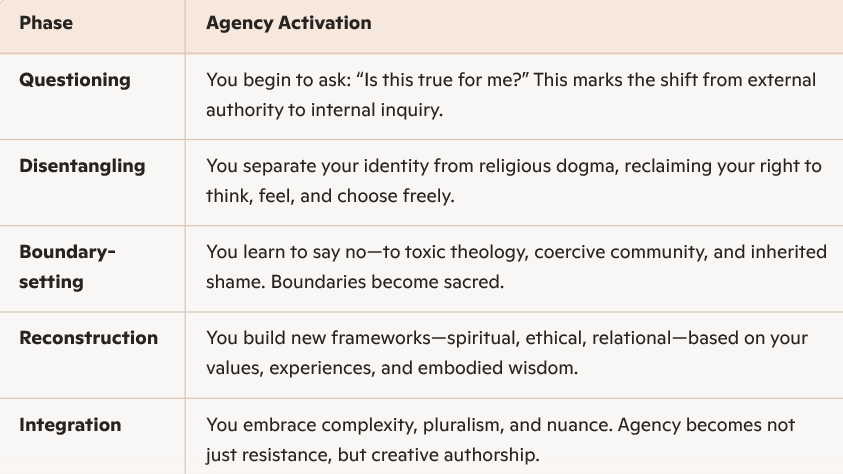
I created this diagram to depict components of rebuilding self-agency after leaving religion:
🌲Start your own traditions
The holiday season is a catalyst for exercising and strengthening one’s self-agency. It’s letting go of how it’s always been, and creating new traditions and rituals that reflect your emerging values. In the Center for Non-Religious Spirituality, we are offering a “Rewilding the Holidays Workshop and Discussion”.
Starting your own holiday rituals and traditions can also be a step in healing from the harm of toxic religious patriarchy. Historically, religious patriarchy positioned men as divine representatives, gatekeepers of sacred knowledge, and leaders of ritual life. Women were often relegated to domestic or symbolic roles, their spiritual agency suppressed under doctrines of obedience and submission.
Leaving religion doesn’t erase the impact of this conditioning—it opens space to reimagine it. Reclaiming ritual authority is a form of epistemic justice: it restores the right to name, interpret, and embody the sacred on one’s own terms.
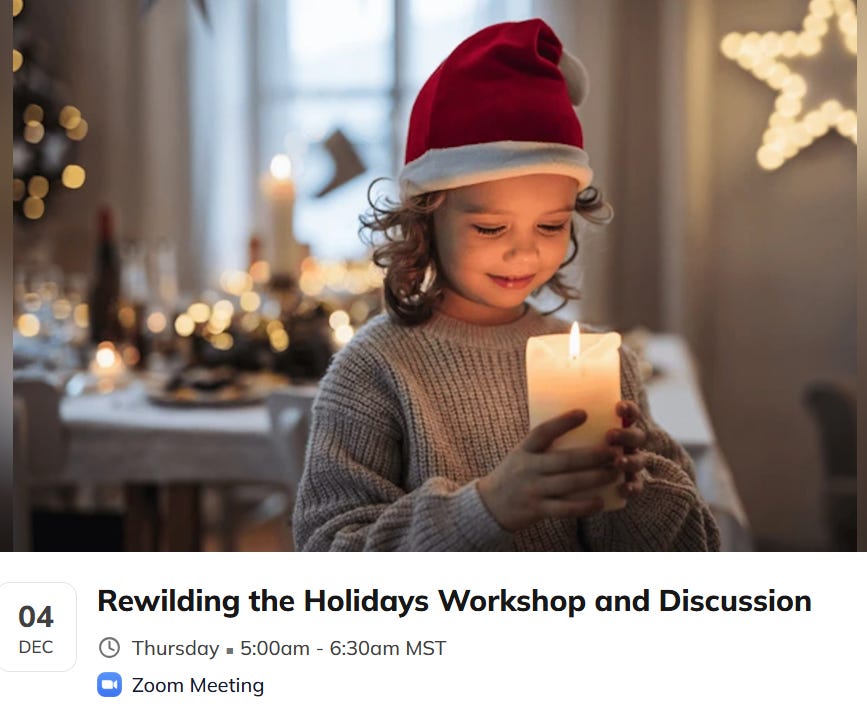
Here’s the workshop description:
After stepping away from Christianity, the holidays can feel like an empty stage — the scene is familiar, but where’s the script?“ Rewilding Your Holidays” is an open, conversational workshop for anyone wanting to rediscover what winter celebration can mean now, on the other side of deconstruction.
Together, we’ll explore questions like:❄️ What makes a ritual feel alive rather than inherited?
🎄 How can we celebrate the season in ways that feel authentic?
🎁 What traditions have you created or reclaimed that bring warmth and connection?
Bring your stories, your questions, or the small practices that have worked for you. We’ll share ideas and hopefully gain some inspiration to help bring some more joy this holiday season.
As a token of my appreciation for paid subscribers ($5 monthly or $50 annually), you receive a free full membership (and complimentary copies of two of my books) to the Center for Non-Religious Spirituality.
Post-Religion Holiday Reconstruction Guide
Here’s a brief guide for reclaiming self-agency by starting your own holiday traditions:
🧠 Step 1: Reflect on What You’re Leaving Behind
Name the rupture: What traditions feel painful, hollow, or coercive? What triggers grief or religious trauma?
Honor the grief: Light a candle for what was lost. Journal about memories, both warm and wounding.
Separate meaning from context: You can still love candles, music, or gift-giving—without the theology attached.
📋 Step 2: Identify What You Want to Keep or Create
List your values: What do you now hold sacred? Connection, rest, nature, generosity, transformation?
Choose your motifs: Stars, trees, light, food, storytelling—these can be reclaimed as symbols of your own spiritual lexicon.
Set boundaries: Decide what gatherings, conversations, or rituals feel safe. You don’t owe anyone participation in traditions that harm you.
🌱 Step 3: Build New Traditions
Here are a few ideas for new holiday traditions to spark your imagination.
Seasonal Altars: Create a home altar with seasonal elements (pine, citrus, bones, feathers) and symbols of what you’re honoring—grief, joy, ancestors, transformation.
Make Your Own Myth: Invite friends to co-create a new holiday myth or story that reflects your shared values—justice, joy, interdependence, or grief.
Gift of Presence: Instead of material gifts, offer “presence tokens”—handwritten notes, shared walks, or acts of service.
Ritual Potlucks: Host a meal where each dish represents a story, memory, or intention. Include a moment of collective reflection or blessing.
“Un-Christmas” Gatherings: Host a gathering that honors the season without religious framing—focusing on warmth, chosen family, and shared meaning-making.
Invent-a-Tradition Night: Each family member creates a mini tradition (e.g., “Pajama Poetry Hour” or “The Feast of Forgotten Toys”) and leads it.
Blanket Fort of Belonging: Build a giant fort. Fill it with books, snacks, and stories. Declare it a sacred space for rest.
Truth or Transformation: Instead of dares, offer symbolic challenges (e.g., “Name a fear you’re ready to release”).
🔥 Step 4: Ritualize the Shift
Create a symbolic act: Burn old beliefs, plant seeds of new values, or craft a talisman of agency.
Build a tradition map: Sketch out seasonal rituals—solstice, New Year’s, spring renewal, harvest gratitude.
Invite co-creation: Ask friends or chosen family to help shape these traditions. Agency thrives in relational safety.
⛓️💥 Step 5: Set Boundaries
You don’t owe anyone theological explanations. You are entitled to protect your emotional space and say no to triggering events or conversations. Here are a few examples of protecting yourself during the holiday season:
🛠️ Boundaries as ritual: Set clear boundaries around topics, participation, and emotional safety. For example: “I’m not comfortable discussing religion at dinner. If it continues, I’ll step away for a bit.” This isn’t control—it’s survival.
🛠️ Reclaiming agency: You don’t owe anyone an explanation for your spiritual path. You can choose which traditions to keep, remix, or release.
🛠️ Grief as sacred: Let yourself mourn what was lost—community, certainty, belonging. Ritualize this grief through journaling, nature walks, symbolic acts, or creative expression.
🛠️ Find chosen kin: If biological family feels unsafe, gather with friends or communities who honor your journey. “Friendsgiving” and alternative celebrations can become powerful sites of belonging.
🛠️ Nature as sanctuary: If religious spaces feel unsafe, turn to the more-than-human world. A walk in the woods, a bonfire, or a moonlit reflection can become sacred.
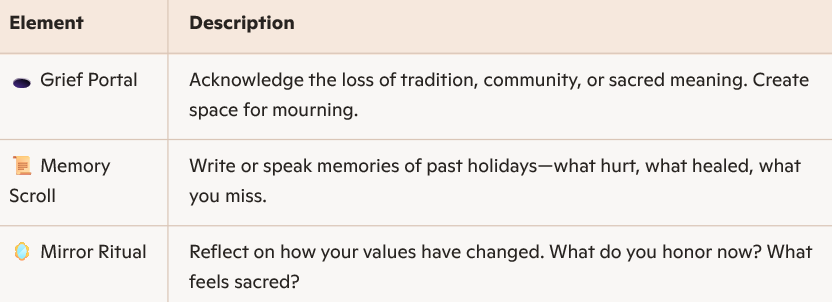
Leaving religion doesn’t mean abandoning celebration, it means redefining it. You’re not just surviving the holidays; you’re crafting new ways to honor time, connection, and transformation. I created the below diagram as a suggestion for converting the holidays from rupture to reflection.
A Word to the Walking Wounded
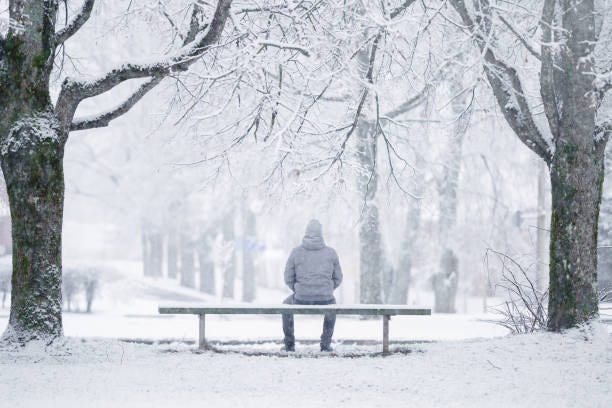
That phrase—“the walking wounded”—carries a haunting truth for many who’ve left religion, especially those disentangling from systems of patriarchy, epistemic harm, or spiritual abuse. It names the invisible injuries: the grief, the rupture, the loss of language, belonging, and legitimacy. But it also opens a doorway to ritual, reclamation, and renewal.
🩸 The Wounds
💔 Relational Rupture
Loss of family, community, and shared rituals
Estrangement from loved ones who remain in the faith
Feeling gaslit, misunderstood, or erased
🧠 Epistemic and Hermeneutical Harm
Internalized shame, fear, or self-doubt from years of indoctrination
Difficulty trusting one’s own intuition, body, or moral compass
Lack of language to name the trauma or articulate new truths
🕯️ Spiritual Disorientation
Grief over the loss of a once-meaningful worldview
Longing for ritual, myth, and sacredness without dogma
Feeling spiritually homeless or existentially adrift
Despite the wounds, religion leavers walk. They walk through grief, through silence, through the wilderness of redefinition.
Further Resources

I have published countless articles related to religious deconstruction, post-religion reconstruction and existential health. A few I would recommend are:
📄 The Leaving-Religion Resource Guide
📄 Landslide: Surviving a Belief-System Avalanche
In 2020 I founded the Center for Non-Religious Spirituality (CNRS). The Center for Non-Religious Spirituality acknowledges the innate spiritual component of all people and the lived human experience. Through individual work, group work, courses, workshops and retreats, CNRS promotes and fosters spirituality as a universal means for individual and collective well-being.
The CNRS online community exists for the following reasons:
Making new friends and connections with people who are on a similar path, understand, and accept you as you are
Being a community of support and encouragement for people who are in the process of rebuilding their lives after leaving religion
Offering individual and group spiritual direction within the framework of “non-religious spirituality”
Opportunities for individual and group counseling and support groups for people who have experienced religious trauma, spiritual abuse, or toxic religious indoctrination
Providing a network of resources for people in the process of deconversion, deconstruction, and reconstruction
Training and certifying non-religious spiritual directors, as well as offers continuing education and training courses
Promoting the significance of existential health for all generations as the cornerstone of individual, collective, societal and planetary flourishing.
As a token of my appreciation for paid subscribers ($5 monthly or $50 annually), you receive a free full membership (and complimentary copies of two of my books) to the Center for Non-Religious Spirituality.
In Summary:
The holiday season, often wrapped in glittering expectations of joy and togetherness, can also be a time of deep pain and dissonance.
The holidays can trigger emotional pain tied to religious trauma, spiritual abuse, or lost community, but can also be a catalyst for exercising and strengthening one’s self-agency.
Leaving religion doesn’t mean abandoning celebration, it means redefining it; you’re not just surviving the holidays; you’re crafting new ways to honor time, connection, and transformation.
Despite the wounds, religion leavers walk - they walk through grief, through silence, through the wilderness of redefinition.
“In the midst of winter, I found there was, within me, an invincible summer. And that makes me happy. For it says that no matter how hard the world pushes against me, within me, there’s something stronger – something better, pushing right back.”
- Albert Camus
I went through all of that when my Christian faith didn't seem to have space for my new abilities post spiritual awakening. But I realize now that I've sort of upleveled, not abandoned, my old beliefs. And I feel closer to my sources of divine support than ever. So I now know that the holidays are really inside of me, not scaffolded by external constructions. And that has made all the difference... Now I feel more of a celebration inside. Thank you for the work you're doing to support us as we go through this journey.
Good work Jim. Loved it.