

Exiled
Surviving a Leaving-Religion Relational Rupture


That metaphor of exile is piercingly accurate for many who leave religion. Leaving religion often feels less like walking away and more like being cast out. It’s a loss of homeland. Religion often functions as a spiritual homeland—a place of belonging, identity, and shared memory. Leaving it can feel like being banished from your own origin story.
Leaving religion is often a cultural displacement. You no longer fit into the codes, rituals, or language of your former community. Even everyday conversations can feel foreign. You carry an invisible grief. Unlike death or divorce, religious exile is rarely publicly mourned. The pain is real, but often unacknowledged.
Leaving religion often feels like tearing out a piece of your soul—especially when that religion shaped your identity, relationships, and sense of meaning. The emotional pain is often layered and complex, and it doesn’t always show up in ways people expect. Some of the emotional impacts of leaving religion include:
Grief and Loss: You’re not just leaving beliefs—you’re leaving a community, rituals, and a worldview. It can feel like a death, with all the stages of mourning.
Guilt and Shame: Many report feeling intense guilt for questioning or leaving, especially if they were taught that doubt equals betrayal.
Identity Crisis: Religion often provides a ready-made identity. Without it, people can feel unmoored, asking: “Who am I now?”.
Fear and Anxiety: Fear of hell, divine punishment, or social rejection can linger long after beliefs have changed.
Loneliness and Isolation: Relationships may fracture. Communities may withdraw. And finding new belonging can be daunting.
The relational fallout of leaving religion is often traumatic. Relationships are strained. Family and friends may not understand. Some may see your departure as a threat or betrayal. Leaving religion is a loss of community. Leaving a tightly-knit religious group can feel like exile.
Loss of Love and Belonging

Abraham Maslow’s Hierarchy of Needs identifies “love and belonging” as a universal human need. The Love and Belonging level of Maslow’s Hierarchy of Needs is where we shift from survival to connection, from safety to intimacy. Maslow believed that once physiological and safety needs are met, humans naturally seek emotional connection and social inclusion.
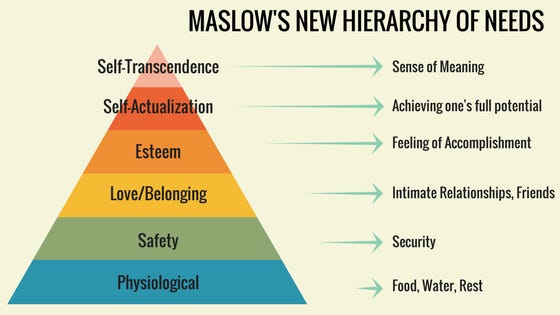
This tier in Maslow’s Hierarchy includes:
Friendship: Deep, reciprocal relationships that offer emotional support.
Family bonds: A sense of kinship, shared history, and unconditional love.
Romantic intimacy: Emotional and physical closeness, trust, and affection.
Community and group belonging: Feeling part of a tribe, team, or spiritual fellowship.
Belonging helps shape our sense of self through shared values and mutual recognition. When we feel loved and accepted, we’re more likely to pursue higher goals like esteem and self-actualization.
In the absence of these, human beings suffer. Lack of love and belonging can lead to loneliness, anxiety, and depression. Isolation is more than just being alone—it’s a rupture in the relational fabric that humans are wired to need. Its impact can be profound, especially on mental, emotional, and even physical health.
For many people, the needs represented in the “Love and Belonging” tier of Maslow’s Hierarchy are met through their religious faith and affiliation.
Here are a few examples:
Family
A person is typically born into and inherits a religious framework that is foundational to their family system and relationships. Religion fosters family cohesion and shapes family narratives. Families are the primary site for religious socialization—passing down beliefs, practices, and stories from one generation to the next. This transmission fosters a sense of continuity and belonging, linking ancestors to descendants.
Friendships/Social Network
It’s common for a person’s friendships and their social and support network to be tied to their religious belief-system and community. Religion often provides a common language of values. Friends who share religious beliefs may engage in soul-level conversations—about God, purpose, and transcendence. This depth can foster “spiritual friendship”, a bond rooted in mutual growth and a sense of sacred connection. Religious communities often act as friendship incubators, offering structured opportunities for connection—study groups, service projects, youth retreats. These settings provide relational scaffolding, especially for those seeking belonging.
Spouse/Life Partner
Religious faith plays a significant—sometimes decisive—role in spouse selection across cultures and traditions. It’s not just about belief alignment; it’s about shared meaning, moral compatibility, and long-term relational cohesion. The choice of a spouse or life partner is often predicated upon shared religious beliefs. When two people share a faith, they often share the same assumptions about God, life’s purpose, and ethical behavior, which forms a basis for trust and intimacy.
Cultural Belonging
Religion acts as a potent form of cultural glue—binding individuals into shared systems of meaning, identity, and practice. It’s not just about belief in the divine; it’s about how symbols, rituals, and moral codes create cohesion across families, communities, and entire civilizations.
Religion functions as a profound cultural gateway—a portal through which individuals and communities share, access, shape, and transmit meaning. These beliefs and values become embedded in language, art, music, and social norms. Religious rituals—birth ceremonies, weddings, funerals—are cultural touchstones that reinforce belonging and continuity. They create shared emotional experiences that bind communities together. Religion is a social technology for enforcing norms and expanding trust beyond kinship.
The Leaving-Religion Third Tier Collapse

When someone leaves religion and begins to deconstruct their faith, they often experience a profound relational world rupture they weren’t quite prepared for. Religious deconstruction is not just a shift in beliefs, but is often a dismantling of the relational and social architecture that once held a person’s life together.
⚡Faith Community Exile
Faith communities often function as primary relational ecosystems—providing friendship, mentorship, and emotional support. Deconstruction can lead to exile or estrangement, especially when questioning is seen as betrayal.
In some high-control religious environments, a person who leaves can become a target of shunning, which is a deliberate form of ostracism practiced by some religious communities to enforce conformity and punish dissent. Members are told not to speak or associate with the person. The person is erased from group communications. Guilt, shame, and fear are weaponized to isolate and silence.
⚡Family Rupture
Families may interpret deconstruction as rebellion or moral failure. This can rupture intergenerational bonds, especially when religion is tightly woven into cultural or ethnic identity.
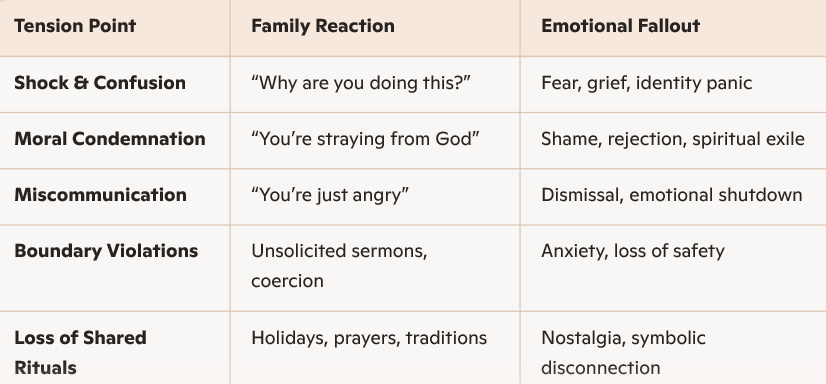
For many religion-leavers, parents may respond with fear, shame, or attempts to “bring you back,” creating emotional strain or even cutoffs. Siblings may either become allies or deepen the divide, depending on their own beliefs. You may grieve the loss of unconditional acceptance, realizing that love was tied to compliance. You may feel unsafe—unable to share your truth without backlash.
Religious deconstruction family dynamics can include the following:
⚡Spousal Estrangement
In spousal relationships, if one partner deconstructs and the other doesn’t, it can destabilize shared rituals, parenting values, and spiritual intimacy. Some relationships survive through reconstruction, others dissolve under the weight of spiritual mismatch or significant belief conflicts.
Many marriages are formed within a religious ecosystem—shared beliefs, community, and rituals. When one partner deconstructs, the other may feel betrayed, abandoned, or spiritually incompatible, leading to relational rupture. Deconstruction often involves rejecting patriarchal structures. This can clash with a spouse’s expectations of gender roles, parenting, or moral authority—especially in high-control religious environments.
In a nutshell, leaving religion is losing relationships. And the fallout can be devastating. One’s family might see your shift as betrayal or rebellion. Friends might fear that your questions might unravel their own beliefs. Partners whose intimacy was built on shared religious beliefs are estranged. One’s faith community withdraws their support and label you “dangerous”.
⚡Post-Religion Rebuild Struggle
Religion often offers a ready-made identity and community. Leaving can feel like losing your tribe, your role, and your relational map. You may find that your former community operated on implicit rules related to gender roles, emotional expression, or authority, that no longer apply. Navigating new norms can be disorienting.
If your departure from religion involved betrayal, manipulation, or spiritual abuse, it can be hard to trust new people or believe that relationships can be safe. You may worry that others—especially those still religious—will judge your choices, question your morality, or try to “bring you back.” Even if you no longer believe toxic religious doctrines, the emotional residue of shame and unworthiness can linger, making vulnerability feel dangerous.
Religious deconstruction often involves a profound and painful loss of belonging. It can result in a deep and disorienting relational void—not just the loss of belief, but the unraveling of the social fabric that once held your world together. Forming new relationships after leaving religion can feel like trying to build a house without a blueprint, in a landscape where the language of belonging has changed.
Deconstruction often triggers a loss of self: Who am I without this belief system? It can feel like a death of identity, and makes it difficult to manage one’s relational world. Former roles (leader, worshipper, servant) may no longer fit, and new ones haven’t yet formed. Some deconstructing individuals feel too spiritual for secular spaces, yet too questioning for religious ones. This liminal zone can feel isolating—like being spiritually homeless. After experiencing betrayal or judgment, many struggle to trust new friendships or communities. There’s often a fear of being misunderstood, dismissed, or spiritually invalidated.
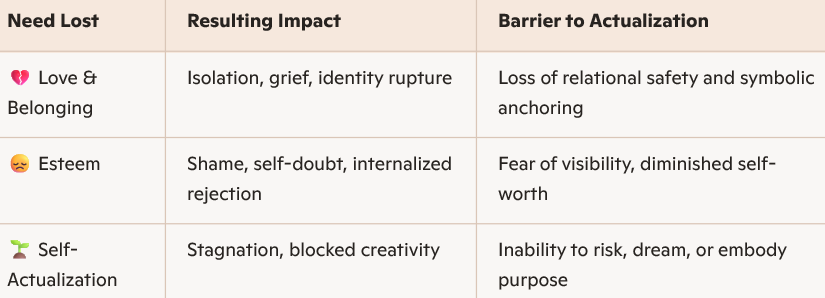
With respect to Maslow’s Hierarchy, when the third tier of “love and belonging” disintegrates—whether through religious shunning, relational rupture, or cultural exile—it deeply fractures the psychological scaffolding that supports “esteem” and “self-actualization”.
The loss of love and belonging doesn’t just hurt—it disrupts the entire architecture of human flourishing. In Maslow’s Hierarchy of Needs, these relational needs form the middle tier, acting as a bridge between basic survival and higher-order fulfillment. When that bridge collapses, the path to self-actualization becomes fractured.
Without love and belonging, the psyche lacks the relational scaffolding needed to build esteem. And without esteem, the courage to pursue self-actualization falters. You could visualize it this way:
The Fallout in Their Words

The loss of relationship related to leaving religion ranges in its severity. You could diagram this spectrum as follows:
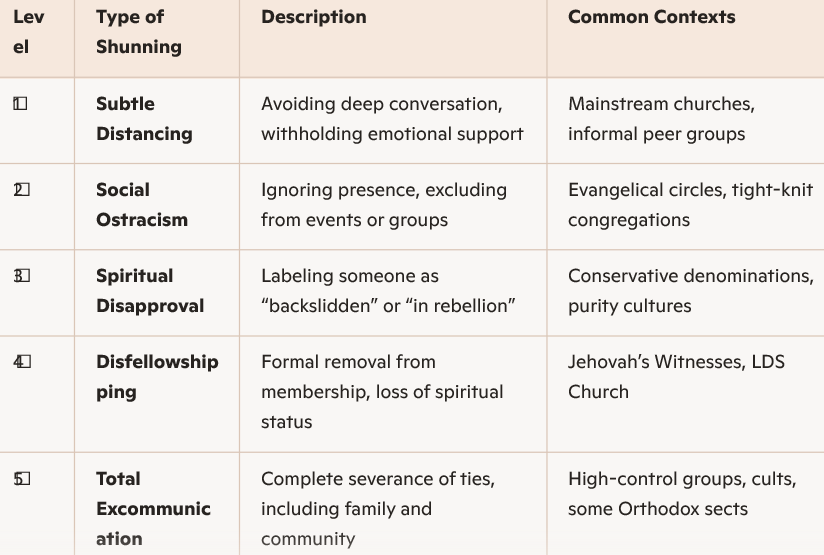
At it’s worst, high-control religion uses the practice of shunning to punish leavers. Religious shunning is a formal or informal practice in which a religious group or community deliberately avoids, excludes, or cuts off individuals who are perceived to have violated its beliefs, norms, or authority structures. The individual is ignored, avoided, or excluded from communal activities, conversations, and relationships. Church members are ordered to cut off all contact with the shunned individual—even family.
In a social media post I asked people how leaving-religion impacted their relational world. I received hundreds of responses. Here is a brief sampling:
“I lost all my “friends” and no one interacts with me.”
“Yes, I felt exiled, ostracized, shunned, betrayed, isolated, and abandoned. Some losses hit close to home and hurt deeply.”
“The worst of it is losing my sons.”
“The fallout was both immediate and profound.”
“The friendships I thought were forever dissolved almost overnight. We had all spoken of “covenant,” binding ourselves to each other. At the time, it felt sacred. Now it seems so absurd.”
“The loss was brutal. I was also going through a divorce (the most brutal of all). My very first therapist in my very first appointment said, “You’re not going through one divorce, you’re going through six - my marriage and the end of 5 friendships.”
“Yes it was the most excruciating part of my life. I’ve lost about 12 friends. It was traumatic. The betrayal.”
“I felt betrayed by all of my previous friends and my family. I was shunned, gossiped about, accused of the most awful things.”
“It's definitely been a loss. I’m estranged from my parents, siblings and their kids. I can no longer talk to aunts, uncles or cousins. The grieving took much time and can still overwhelm during holidays or around birthdays.”
“I’m in the closet. Even my family doesn’t know.”
“My father decided to disown me. My other relatives and friends also either shunned me or tried to bring me back into the fold.”
“My Mom says I’m a liar (for not telling her sooner), and I’m teaching my kids to be liars and ruining their lives. They cut off all contact with me and won’t reply to my texts. I wish I didn’t care.”
“Our daughter has not allowed us to see our grandkids for the last two years because we left the church. We saw them this weekend at a family wedding but when we tried to talk to them, we were told that they can’t talk to us because we worship Satan now.”
“I have family members that have shunned me, but still somehow can’t leave me alone. They take every opportunity to tell me how disappointing I am.”
“I have seen people I once considered good friends out in public. They saw me, I waved and they turned and quickly walked the other direction.”
“As I grew in knowledge, my friendships and family that maintained their belief structures fell away and my life changed dramatically. I’ve since become estranged from my mother and my siblings because of their rigid beliefs.”
Examining the Research

In 2024, a major article was published titled, Religion and Loneliness: Investigating Different Aspects of Religion and Dimensions of Loneliness. You can read the article in full, but I want to briefly summarize a few of the findings:
📑The Leaving-Religion Community/Belonging Void Must be Addressed
“The nexus of religion, spirituality, and loneliness constitutes an important yet incomprehensibly understood and dynamic domain of research, reflecting broader inquiries into how social and spiritual connections influence social and psychological well-being. Religion is considered an important constituent element for life satisfaction, prominently because of the social relationships built within religious congregations and facilitated by religious service attendance within those congregations…. Research suggests that feeling part of a community, whether through place or shared religious beliefs, can counteract loneliness.”
It’s unrealistic for a person to walk away from their religious community and not miss a beat in the rebuilding of their lives. Yes of course, leaving a toxic religious environment can be liberating. But it’s important to realize that you likely also lost something valuable that needs replaced, namely relationships, community, social support, a place of belonging.
📑The Exodus from Religion Creates a Relational Crisis
“Recent shifts in the religious and spiritual fabric of society, including a notable decline in traditional religious affiliation and attendance juxtaposed with an increase in individuals identifying as ‘spiritual but not religious’, underscore the necessity of examining the consequences of these changes for social connectedness. This evolving landscape prompts a reevaluation of the roles that religious congregations and spiritual practices play in fostering community and alleviating loneliness, a condition characterized not just by a lack of social contacts but by the subjective feeling of being disconnected or isolated.”
Perhaps the greatest crisis to address with the exponential rise of religion-leavers is not a “meaning crisis” but a relational crisis in the form of loneliness, disconnection and isolation.
📑Non-Religious Community Spaces and Places are Needed
“While religious congregations have historically and continue to be centers of social life for millions of Americans, empirical observations consistently indicate a rise in individuals identifying as religiously unaffiliated alongside a downturn in attendance at religious services, potentially signaling a shift in the potency of religious congregations as social meeting places.”
Though faith communities meet the belonging and social needs of the religious, new social spaces and meeting places must be developed to meet these needs among the non-religious.
📑Toward a Social Spirituality
“While it may seem intuitive that the rise of the spiritual but not religious entails solitary faith practices in a type of ‘privatization’ of religious belief and practice, research highlights the existence of non-religious collectives engaging in communal spiritual practices.”
Leaving religion is not a rejection of community, which is evidenced by a robust social and relational spirituality among the non-religious.
“Self-transcendence” is the forgotten summit of Maslow’s Hierarchy—a level he proposed late in life that goes beyond self-actualization. While self-actualization is about becoming the fullest version of yourself, self-transcendence is about moving past the self entirely to connect with something greater: others, nature, the cosmos, or a sense of the sacred. It’s seeking meaning beyond the self through pathways such as altruism, unity, and spiritual awakening.
Social spirituality is the heartbeat of collective transcendence—it’s where the sacred emerges not in solitude, but in shared experience, communal rituals, and relational depth. Unlike individualistic or doctrinal spirituality, social spirituality centers on the idea that the divine—or the numinous—is most vividly felt in connection.
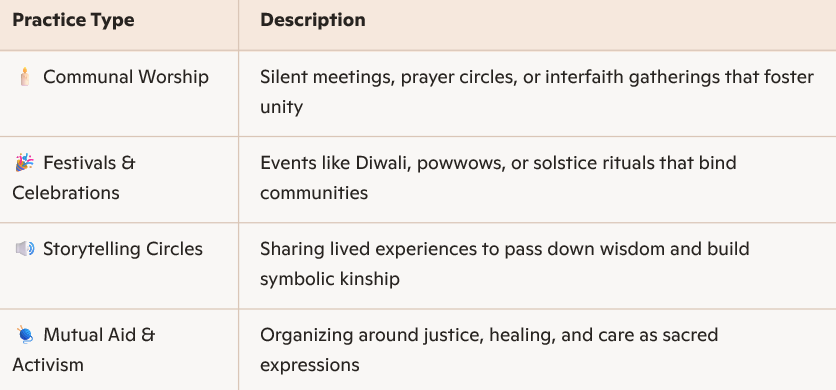
A few core principles of social spirituality include:
Sacred community: A sacred sense of community where people gather with intention, creating spiritual resonance through shared rituals, storytelling, and mutual care.
Relational Transcendence: The divine is not just “above” or “within,” but between us—in the space of empathy, solidarity, and co-creation.
Collective Rituals: From Quaker silent meetings to indigenous powwows, social spirituality transforms group interaction into sacred practice.
Civic Engagement as Spiritual Practice: Studies show that increased spirituality correlates with pro-social behavior—like volunteering and activism, and community building.
You might diagram it this way:
📑The Long View
“Research also indicates that religious attendance acts as a unifying force across the lifespan, particularly benefiting older adults as they transition away from roles linked to work and family.”
It’s significant to remember that the role of community, belonging and social support stretches across one’s lifespan and increases in importance throughout the aging and life stages. Across all stages, social connection is linked to better health, resilience, and longevity. In fact, research from Harvard shows that loneliness and social isolation increase the risk of premature death by up to 29%.
The Relational Rupture Survival Guide
A general framework related to navigating the relational fallout of leaving religion includes:
🌿Grieve fully: Let yourself mourn the relationships that couldn’t hold your evolution
🌿Set boundaries: You don’t owe anyone an explanation for your growth
🌿Find your people: Seek communities that honor curiosity, pluralism, and mutual liberation
Some specific pathways to healing could be:
✔️ Radical honesty: Share your story with clarity and compassion
Radical honesty in religious deconstruction is a sacred act of reclamation. It’s not just about telling the truth—it’s about telling your truth with clarity, compassion, and courage. When you share your story, you’re not just narrating events; you’re metabolizing rupture into meaning, and offering others a mirror for their own healing.
Specifically this means:
Clarity: Naming what happened—without euphemism or denial. This includes spiritual abuse, manipulation, shame, or the slow erosion of trust.
Compassion: Holding your past self with tenderness. You believed, you belonged, you tried. That deserves honor, not ridicule.
Courage: Speaking even when your voice shakes. Especially when your story challenges dominant narratives or sacred cows.
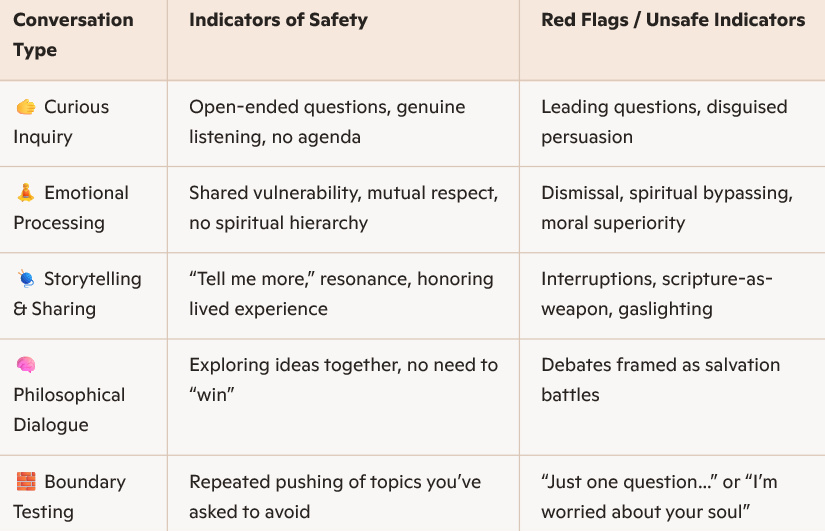
✔️ Boundary setting: Define what conversations are safe and what aren’t
Boundary setting during religious deconstruction is a radical act of self-respect. It’s how you protect your emotional integrity while navigating relationships that may still be tethered to the system you’ve left. Defining what conversations are safe—and what aren’t—isn’t about shutting people out. It’s about creating space for truth without trauma.
Here is a guide to help:
✔️ Symbolic rewilding: Create new rituals that reflect your evolving truth
Symbolic rewilding is the art of crafting rituals that speak to your soul after the scripts of religion have fallen away. It’s not just about replacing old practices—it’s about rooting new ones in your lived truth, your body’s wisdom, and the sacredness of nature, story, and community.
✔️ Chosen kinship: Build relationships rooted in mutual liberation, not dogma
Chosen kinship is the soulwork of religious deconstruction—it’s how we rebuild belonging not through shared dogma, but through shared humanity. When traditional communities fracture, chosen kinship offers a radical alternative: relationships rooted in mutual liberation, emotional safety, and symbolic resonance.
Some characteristics of chosen kinship include:
Voluntary, Not Inherited: Unlike religious or familial ties that may be obligatory, chosen kinship is formed by intentional resonance.
Liberatory, Not Hierarchical: These relationships reject spiritual superiority, gender roles, and moral policing. Everyone is a co-journeyer.
Symbolic & Somatic: Kinship is felt in the body, expressed through ritual, and anchored in shared meaning—not just shared beliefs.
✔️ Therapeutic support: Process grief, shame, and relational trauma with care
Therapeutic support during religious deconstruction is not just helpful—it’s often essential. You're not just questioning beliefs; you're untangling grief, shame, and relational trauma that may have been woven into your nervous system, identity, and sense of safety. This is deep work, and it deserves deep care.
Professional therapy could be vital in the religious deconstruction process for several reasons:
Grief Processing: You're mourning lost community, rituals, and a former self. Therapy helps name and metabolize that grief.
Shame Recovery: Many religious systems instill chronic shame—about bodies, desires, doubts. Therapy helps you reclaim worthiness.
Relational Trauma: If love was conditional, boundaries were violated, or spiritual abuse occurred, therapy offers a safe container to heal.
Nervous System Regulation: Questioning faith can trigger threat responses—freeze, fawn, hypervigilance. Somatic modalities help restore safety.
✔️Rebuilding Tools: Tools for rebuilding new relationships include:
🛠️ Authenticity Over Conformity: Post-religious relationships often require a shift from fitting in to showing up as your full self. That’s liberating—but also terrifying.
🛠️ Boundary Work: You may need to learn how to set and honor boundaries, especially if your previous relationships were built on obedience or submission.
🛠️ Mutuality Over Doctrine: Building relationships based on mutual resonance rather than shared dogma takes time, intention, and emotional risk.
🛠️ Interoception Check-Ins: Tuning into your body’s signals during relational interactions. Ask: “Do I feel safe, seen, and sovereign here?” I published an article on interocepotion in the religious deconstruction process.
In 2021 I founded the Center for Non-Religious Spirituality as a safe and supportive community for people who have left religion and rebuilding their lives and relational world.
The CNRS online community exists for the following reasons:
🌱 Making new friends and connections with people who are on a similar path, and understand and accept you as you are.
🌱 Being a community of support and encouragement for people who are in the process of rebuilding their lives after leaving religion.
🌱 Offering support groups for people who have experienced religious trauma, spiritual abuse, or toxic religious indoctrination.
🌱 Providing a network of resources for people in the process of deconversion, deconstruction, and reconstruction.
🌱 Training and certifying Non-Religious Spiritual Directors and Existential Health Practitioners.
As a token of my appreciation for those who support my work and writing as a paid subscriber at $5 monthly or $50 for a year, I offer a free full membership to the Center for Non-Religious Spirituality. This is a great time to join. Next week we are hosting our next “Deconstruction Mini-Lab” and we have an upcoming workshop on atheist spirituality. Additional perks for paid subscribers include free copies of my two-volume set of religious deconstruction and reconstruction books:
Life After Religion: A 30-Day Detox Guide
How to Have a Great Day Without Religion: A Universal Handbook for Living Life Well
In Summary
Leaving religion often feels less like walking away and more like being cast out, and the relational fallout is often traumatic.
The loss of love and belonging doesn’t just hurt—it disrupts the entire architecture of human flourishing.
It’s unrealistic for a person to walk away from their religious community and not miss a beat in the rebuilding of their lives.
If your departure from religion involved betrayal, manipulation, or spiritual abuse, it can be hard to trust new people or believe that relationships can be safe.
Boundary setting during religious deconstruction is a radical act of self-respect; it’s how you protect your emotional integrity while navigating relationships that may still be tethered to the system you’ve left.
Post-religious relationships often require a shift from fitting in to showing up as your full self.
“I don't even remember the season. I just remember walking between them and feeling for the first time that I belonged somewhere.”
- Stephen Chbosky, The Perks of Being a Wallflower

Yesterday, I shared an article from the Salt Lake Tribune, an independent newspaper in Utah which highlighted the difference between active LDS and former LDS and their experience as it relates to relationships. Unsurprisingly, the common theme was LDS say—we still love them we don’t care. But the exLDS folks all share exactly what Jim covers in this post.
Such a comprehensive look at the leaving a high-demand religion situation. Thanks for all you do, Jim Palmer. I wish I'd heard your voice 28 years ago when we left the 2x2s. There were no support groups. No one online. No one knew anything about it. We didn't even have words to describe what we'd been in and what it was like to have left. It was so challenging to create a different life for all the reasons you outline. It's wonderful that there are so many resources for people now to take the same journey.