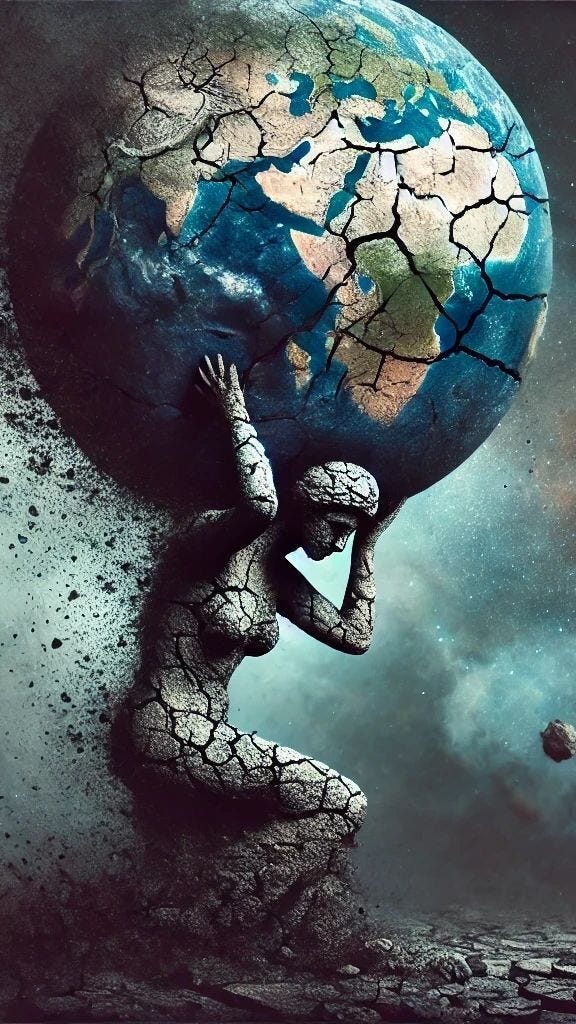
United Nations Art Exhibit: Re-Connections: In Kinship With Nature
“We are human only in contact, and conviviality, with what is not human.”
- David Abram
Toxic religion is bad for the planet. We will examine this fact more closely momentarily.
Evert day I work with people who were deeply harmed by toxic religion. This includes what I call “human development deficits”. Such deficits include:
⚡ impaired self-determination capacities
⚡ diminished critical thinking skills
⚡ delayed emotional development
⚡ inadequate knowledge base
⚡ mental health damage
⚡ sexual neurosis
⚡ spiritual codependency
By the way, spiritual codependency is a pattern where one’s sense of spiritual worth, identity, or connection becomes entangled with another person’s approval, needs, or beliefs—often under the guise of love, service, or religious duty. Spiritual codependency occurs when one’s spiritual identity is outsourced to another’s validation, and spiritual hunger is misdirected into an unhealthy relational enmeshment. This stands in contrast to spiritual autonomy, which is navigating one’s own spiritual path with integrity, discernment, and freedom—without outsourcing your authority to external dogma, leaders, or toxic relational dynamics.
Let me add one more item to the human development deficit list:
A ruptured relationship with the more-than-human world.
The “more-than-human world” refers to the vast web of life that includes—but is not limited to—human beings. It encompasses animals, plants, ecosystems, landforms, and elemental forces, all of which possess their own forms of agency, intelligence, and relationality.
The more-than-human world conversation matters because it challenges human supremacy, restores ecological reverence, and reimagines our place in a living, relational cosmos. It’s not just about “nature”—it’s about healing the rupture between humans and the rest of life.
A few core concepts of the more-than-human world include:
🌿 Beyond “nature” and “non-human”: Unlike terms that exclude humans (e.g., “natural world”), this phrase includes humans while decentering them. It affirms that we are embedded within a larger animate community.
🌿 Relational ontology: The more-than-human world is not a backdrop or resource—it’s a living network of beings with whom we are in constant relationship.
🌿 Animacy and agency: Inspired by Indigenous worldviews and ecological philosophy, it recognizes that animals, plants, rivers, and even rocks may possess forms of sentience, emotion, and purpose.
One of the most tragic ways toxic religion does harm is by corrupting our relationship with the more-than-human world. Religious deconstruction must include an accounting of this rupture, and post-religion reconstruction must place the healing of our relationship with the natural world at the center. “Religious trauma” is an individual, collective and planetary trauma. The healing and recovery process involves repairing our relational world at every level, including:
relationship with ourselves
regenerative gender paradigms
ecological or multispecies relationships
How Toxic Religion Causes Planetary Suffering
Toxic religion harms the planet by pedaling dominionist ideologies, obstructing environmental action, and perpetuating anthropocentric worldviews that sever humans from ecological responsibility.
Let’s briefly breakdown the primary ways that toxic religion causes planetary suffering:
🌍 1. Dominionism and Anthropocentrism
Toxic religion often interprets sacred texts as granting humans dominion over nature, rather than stewardship. This fuels exploitive and extractive mindsets that justify deforestation, pollution, and biodiversity loss.
Anthropocentric theology places human salvation above planetary wellbeing, sidelining ecological ethics and interspecies kinship.
🛑 2. Obstruction of Climate Action
Some religious groups deny climate science, framing environmental degradation as divine will or end-times prophecy. This undermines urgency and policy support.
Resistance to reproductive health and education—especially contraception—can contribute to unsustainable population growth, straining ecosystems.
🏛️ 3. Political Alliances That Undermine Ecology
Toxic religion often aligns with political movements that deregulate environmental protections, especially in contexts where religious nationalism is strong.
These alliances can block climate legislation, defund conservation efforts, and prioritize short-term economic gain over long-term planetary health.
🧠 4. Epistemological Harm
By delegitimizing indigenous, pagan, or animist cosmologies, toxic religion erases ecological wisdom embedded in land-based spiritualities.
It also frames nature as fallen or profane, severing symbolic ties between the sacred and the Earth.
🔄 5. Missed Opportunities for Ecological Renewal
While many faith traditions have rich ecological teachings, toxic religion suppresses these in favor of purity codes, moralism, or eschatology.
This prevents the emergence of eco-theologies, green rituals, and spiritual frameworks that could mobilize communities for planetary healing.
What is Ecological Dominionism?
Ecological dominionism is a theological-political ideology that interprets the biblical concept of “dominion” as a divine mandate for humans—especially Christians—to control, exploit, and govern nature without restraint. It often justifies environmental degradation as part of God’s plan, framing ecological stewardship as secondary or even idolatrous. Western Christianity’s dominionist theology is considered by many a root cause of the ecological crisis.
This view is primarily rooted in Genesis 1:28, where God commands humans to “fill the earth and subdue it,” which ecological dominionists interpret this as a license for unlimited resource extraction and control over all living things. They often reject environmentalism as “nature worship” or “idolatry”, arguing that prioritizing ecological concerns over human needs violates divine order.
What is Religious Anthropocentrism?
Anthropocentrism is the belief that humans are the most important beings in the universe, often viewing nature as a resource for human use. In toxic religious frameworks, this manifests as spiritual exceptionalism—humans are seen as divinely chosen, while other life forms are spiritually irrelevant or inferior.
Toxic religion reinforces anthropocentrism by placing humans at the center of spiritual and moral concern, often at the expense of ecological integrity and interspecies ethics. This worldview legitimizes exploitation, erases nonhuman value, and severs sacred ties to the Earth.
The core features of religious anthropocentrism include:
📛 Human exceptionalism: Humans are viewed as spiritually and morally superior to all other life forms.
📛Instrumental view of nature: Nature is valued only insofar as it benefits humankind.
📛 Moral exclusion: Animals, ecosystems, and elemental forces are excluded from ethical concern.
📛 End-times theology: Environmental collapse is sometimes framed as inevitable or irrelevant to salvation.
What is Eco-Theology?
Eco-Theology is a branch of theology that explores the relationship between religion and the natural world, emphasizing ecological responsibility, interdependence, and the sacredness of all life. It challenges anthropocentric interpretations of scripture and seeks to reframe spiritual practice as a path toward planetary healing.
Core principles of eco-theology include:
🌿 Interconnectedness of all life: Eco-theology affirms that humans are part of a larger web of creation, not its rulers.
🌿 Intrinsic value of nature: The Earth and its ecosystems are seen as sacred, not merely resources for human use.
🌿 Spiritual responsibility: Faith traditions are called to respond to environmental crises with ethical, symbolic, and practical action.
🌿 Scriptural reinterpretation: Texts like Genesis, Psalms, and Romans are reread to emphasize stewardship, kinship, and ecological lament.
Non-anthropocentric hermeneutics is an interpretive approach that decouples meaning-making from human-centered frameworks, emphasizing the intrinsic value, agency, and moral relevance of the more-than-human world. It challenges traditional readings of texts—especially religious or philosophical ones—that prioritize human interests above all else.
Non-anthropocentric readings of scripture reinterpret biblical texts to emphasize the intrinsic value of all creation—not just humans—within a theocentric or ecocentric framework. These approaches challenge human supremacy and invite spiritual kinship with the more-than-human world.
A few key principles of non-anthropocentric hermeneutics include:
🌿 Theocentrism over anthropocentrism: Scripture is read as centering God’s relationship with all creation, not just humanity. The Earth, animals, and ecosystems are seen as part of God’s beloved community.
🌿 Ecological hermeneutics: Advocate for reading scripture through the lens of ecological crisis, asking how texts can support biodiversity, sustainability, and interspecies ethics.
🌿 Critique of hierarchical dualism: These readings reject binaries like spirit/matter, human/animal, sacred/profane, which have historically justified domination and ecological harm.
Here are a few examples of non-anthropocentric scriptural reinterpretations:
📜 Genesis 1:28
“And God blessed them, and God said unto them, Be fruitful, and multiply, and replenish the earth, and subdue it: and have dominion over the fish of the sea, and over the fowl of the air, and over every living thing that moveth upon the earth.”
“Dominion over” is reframed as stewardship or kinship, emphasizing care rather than control. Humans are part of creation, not its rulers.
📜Psalm 104
Read as a celebration of biodiversity and ecological interdependence, where mountains, beasts, and waters are part of divine choreography.
📜 Romans 8:22 (“creation groans”)
“For we know that the whole creation groans and suffers the pains of childbirth together until now.”
“Creation groans” is interpreted as a call to ecological lament and solidarity, not just human redemption.
Examples of Eco-Theology
Thomas Berry
Thomas Berry (1914–2009) was a Catholic priest, cultural historian, and visionary thinker who pioneered eco-theology and coined the term “geologian” to describe his life’s work: reconnecting humans with the Earth through story, spirituality, and ethics. He believed the universe is a “communion of subjects, not a collection of objects,” and called for a new era of ecological intimacy and responsibility.
Some of the key ideas and contributions of Thomas Berry include:
🌀 1. The Universe Story
Co-authored with Brian Swimme, this cosmological narrative reframes evolution as a sacred unfolding.
Berry saw the Earth’s history as primary revelation, urging humans to find meaning in the 13.8-billion-year journey of life.
🌱 2. The Ecozoic Era
Berry envisioned a new epoch where humans live in mutually enhancing relationships with the Earth.
This contrasts with the “Technozoic Era,” dominated by exploitation and ecological collapse.
📜 3. The Great Work
Berry’s call to action: transform four institutional realms—politics, economics, education, and religion—to align with Earth’s needs.
He believed this transformation was humanity’s sacred task in the face of planetary crisis.
🌿 4. Twelve Principles for Understanding the Universe
These principles articulate Berry’s belief that the Earth and cosmos are sacred texts, offering guidance for ethical and spiritual life.
Berry advocated for “intimacy with the planet” as the only path to human and planetary flourishing. I diagramed a framework for this idea:
Robin Wall Kimmerer
Robin Wall Kimmerer is the author of Braiding Sweetgrass: Indigenous Wisdom, Scientific Knowledge and the Teachings of Plants. Her concept of “regenerative intimacy” informs eco-theology’s emphasis on reciprocity and relational repair.
“Regenerative intimacy” describes a reciprocal, embodied relationship with the Earth—one that heals both land and spirit through reverence, responsibility, and kinship. It’s not just about sustainability—it’s about restoring sacred connection and mutual flourishing
🌿 The core concepts of regenerative intimacy include:
Rooted in Indigenous wisdom, regenerative intimacy honors the Earth as a living relative, not a resource.
It involves reciprocity: giving back to the land, not just taking from it.
It’s expressed through ceremony, gratitude, and ecological restoration, where healing the Earth also heals ourselves.
🌱 Why It Matters
Counters extractive paradigms: Regenerative intimacy replaces domination with devotion.
Heals relational rupture: It offers a path for those recovering from spiritual alienation or ecological grief.
Inspires ritual rewilding: Practices like seed saving, land tending, and grief ceremonies become sacred acts of intimacy.
Lynn White Jr.
Lynn White Jr. (1907–1987) was a historian and scholar best known for his groundbreaking 1967 essay, “The Historical Roots of Our Ecologic Crisis,” which argued that Western Christianity’s anthropocentric theology played a central role in environmental degradation. His work catalyzed the field of eco-theology by challenging religious assumptions about nature and dominion.
📜 A few of the key ideas from Lynn White Jr. include:
🔥 1. Christianity’s Role in the Ecological Crisis
White claimed that Christianity, especially post-medieval Western forms, desacralized nature by emphasizing human dominion over creation.
He argued that this theological shift enabled the rise of technological exploitation, framing nature as inert and utilitarian.
🌿 2. Anthropocentrism and Dominionism
White traced how biblical interpretations—especially Genesis 1:28—fueled human supremacy and justified ecological harm.
He contrasted this with earlier animist and pagan traditions that viewed nature as spiritually alive.
🌀 3. Call for Religious Reformation
White didn’t reject religion—he called for a new religious ethic that honors the Earth.
He proposed St. Francis of Assisi as a model for ecological humility and kinship with all creatures.
“What we do about ecology depends on our religious beliefs. We shall continue to have a worsening ecologic crisis until we reject the Christian axiom that nature has no reason for existence save to serve man.”
- Lynn White Jr.
Lauret Savoy
Lauret Savoy is a geologist and writer exploring race, land, and memory in eco-spiritual contexts.
Who Is Lauret Savoy?
Multiracial heritage: African American, Euro-American, and Native American
Academic role: David B. Truman Professor of Environmental Studies at Mount Holyoke College
Geologist and cultural historian: Her work bridges Earth science with cultural memory, environmental justice, and racial identity
📚 Key Works
📖 Trace: Memory, History, Race, and the American Landscape
A mosaic of personal narrative, historical inquiry, and ecological reflection. Savoy traces how the American land and its people are marked by displacement, silence, and erasure.
📖 Colors of Nature: Culture, Identity, and the Natural World
A collection of essays exploring how culture and identity shape our relationship with the natural world.
📖 Bedrock: Writers on the Wonders of Geology
A celebration of Earth’s deep time and the poetic resonance of geologic processes.
Some of the core themes in her work include:
🪴Race and environmental history: She critiques how dominant narratives of nature often exclude or erase the experiences of people of color.
🪴Memory as landscape: The land itself becomes a text inscribed with histories of migration, trauma, and resilience.
🪴Geology as metaphor: She uses Earth’s strata and erosion as metaphors for cultural fragmentation and personal identity.
🪴Re-membering: Her writing is a form of reassembling broken histories into present awareness—a ritual of healing and reclamation.
Other emerging and interdisciplinary voices in the space of eco-theology and eco-spirituality include:
Larry Rasmussen is a Lutheran ethicist who links climate justice with moral formation and public theology. He is the Reinhold Niebuhr Professor Emeritus of Social Ethics at Union Theological Seminary.
Cherice Bock holds a Ph.D. in environmental studies and M.Div. from Princeton Theological Seminary. She is a Quaker eco-theologian integrating climate grief, activism, and spiritual formation.
More-Than-Human Deconstruction
I recently published a substantial article that explores religious deconstruction and post-religion reconstruction in light of the more-than-human world, More-Than-Human Deconstruction: Exploring Nature’s Way of Rewilding Spirituality. This piece is my attempt to plant a flag for expanding this work from an exclusively anthropocentric endeavor to one centered in the more-than-human world.
I have also planted this flag by centering the move-than-human world conversation in the training of non-religious spiritual directors and existential health practitioners through the Center for Non-Religious Spirituality, which I founded in 2020.
This past week Jessica Böhme, PhD gave a presentation to our current training cohort group titled: “Reconstructing Spirituality in a More-Than-Human World: Moving Beyond Anthropocentric Healing.” Jessica is the founder of Institute for Practical ekoPhilosophy. In my view, she is a pioneering figure in coupling deconstruction and reconstruction with the more-than-human world. Her presentation on this topic is brilliant, which you can watch below:
Religious deconstruction and the more-than-human world intersect when spiritual seekers begin to dismantle inherited beliefs and rediscover sacredness through ecological relationships, multispecies kinship, and nature-based symbolism. This shift often marks a move from anthropocentric theology to biocentric reverence. Repairing our ruptured relationship with the more-than-human world involves decentering the human by embracing ecological humility and multispecies kinship.
Aspects of this process include:
🔥 Deconstructing Anthropocentric Theology
Question inherited doctrines that frame nature as fallen, inferior, or utilitarian.
Explore eco-theologies, animist traditions, and biocentric philosophies (e.g., Thomas Berry, Robin Wall Kimmerer, Lauret Savoy).
🌿 Ritualize Ecological Kinship
Create ceremonies that honor seasons, migrations, or ecological thresholds.
Use natural materials (stones, feathers, fungi, soil) as ritual objects.
Invite animals, plants, or landscapes as symbolic participants in rites of passage.
🌍 Practice Multispecies Listening
Engage in contemplative walks, sit spots, or dreamwork with animals and landscapes.
Treat nonhuman beings as subjects—not objects—in spiritual inquiry.
🌀 Learn the Language of Nature
Study local species, ecosystems, and indigenous ecological knowledge.
Track animal behavior, plant cycles, and weather patterns as spiritual texts.
Journal dreams, synchronicities, and encounters with nonhuman beings.
For more resources in exploring our relationship with the more-than-human world, check out the work of Anna-Marie Swan.
Related articles to this topic:
The Gospel of Jane
“What you do makes a difference, and you have to decide what kind of difference you want to make.” - Jane Goodall
More-Than-Human Deconstruction
“We lost connection with the earth, sun, moon and stars, and then we constructed roofs and walls to meet with God. We domesticated our more-than-human nature with bricks and mortar, and let dogma deafen our souls to our mother tongue of nature. We have left our first love. We search for the divine in books and buildings, unaware that …
In Summary
Toxic religion is bad for the planet.
The more-than-human world conversation matters because it challenges human supremacy, restores ecological reverence, and reimagines our place in a living, relational cosmos.
Anthropocentrism is the belief that humans are the most important beings in the universe, often viewing nature as a resource for human use.
Thomas Berry advocated for “intimacy with the planet” as the only path to human and planetary flourishing.
Repairing our ruptured relationship with the more-than-human world involves decentering the human by embracing ecological humility and multispecies kinship.
Thank you for reading today’s article. If you found it meaningful, please consider becoming a paid subscriber for $5 monthly or $50 for a year. As a token of my appreciation I offer several perks including two free books on religious deconstruction and post-religion reconstruction, and a free full membership to the Center for Non-Religious Spirituality.
Humankind has not woven the web of life. We are but one thread within it. Whatever we do to the web, we do to ourselves. All things are bound together. All things connect.
- Chief Seattle, Duwamish


As a soil scientist, this hits deep. Understanding the depth of the chemistry and physics while inhaling the smell of soil—remembering I am human. It calls up Genesis 2:7. 💜🙏🏽
My sustainability writing on Solarpunk Thinking is grounded in many of the concepts you discuss here, Jim. I’ve settled on a framework that asks us to nurture relationships of mutuality and justice with all subjects in an expansive community. One where those subjects are not separated by time, geography, or being human or not. Writing from Aotearoa New Zealand, I’m also influenced by matauranga Māori—indigenous wisdom.